Showing posts with label Stockholm. Show all posts

Friday, 10 August 2018

Wrecked in Stockholm: The Fatal Voyage of the Vasa


As much as I love history, I don't make a beeline for historical museums when I'm visiting a new city.

As a travel writer I need new or under-explored attractions to write about; and chances are, a long-established historical museum will either be overexposed or a bit dull.

So I reluctantly set time aside to visit the Vasa Museum when I visited Stockholm, Sweden in 2012. It had been open since 1990, after all, and housed a ship that was almost 300 years old.

But I'm glad I did go. It was magnificent.

Here's the story. On 10 August 1628 the splendid new warship Vasa set sail on its maiden voyage, crowds cheering it from the docks.

It managed to cover a full 1300 metres out from Stockholm when it keeled over and sank.

Awkward. Especially since the Vasa was headed to the war raging between Sweden and the Polish-Lithuanian Commonwealth.

The Commonwealth was Eastern Europe's great power of the time, covering a million square kilometres from the Baltic to the Black Sea, and this was the fourth conflict in a row between the rival Baltic kingdoms.


Seventeenth-century Sweden's loss was our gain, however. Surprisingly well-preserved by the brackish conditions of the Baltic, the ship was rediscovered and salvaged in 1961. After decades of treatment, it was installed in its current home.

Walking around its hull in dim light, peering at it from different angles, it was easy to imagine it was the 17th century again and the Vasa about to undertake its disastrous first voyage.

I recommend a visit to the museum if you're ever in Sweden.

Which goes to show, you should never write off a history museum because the subject sounds a bit, er, dry.

The Vasa Museum is located at Galärvarvsvägen 14, Stockholm. Find opening hours and entry fees at its website.

Friday, 10 June 2016

The Tour With the Dragon Tattoo: Stieg Larsson's Stockholm

Last month I joined a tour of "Scandi noir" TV crime dramas In Copenhagen, Denmark, which I'll be writing about later. The experience reminded me of the time I took the Millennium tour along the mean modernist streets of Stockholm, Sweden. 

As my article about that tour has since disappeared from the Web, here it is again for your enjoyment...


“Over there is where all the bad people live,” says Kirsti Hirvonen. “At least, according to Stieg Larsson.”

Tour guide Kirsti is gesturing across the water from a high point on the island of Södermalm, just south of Stockholm’s picturesque Old Town.

As our group gazes out at the city spread below us, there’s little evil to be seen. On the contrary, it’s a beautiful vista of church steeples, brightly painted historic buildings and cruise boats.

Larsson, however, was the type of novelist who peels back a city’s prim exterior and reveals the sinister truth beneath.

His immensely popular Millennium trilogy of novels, beginning with The Girl With the Dragon Tattoo, pits crusading journalist Mikael Blomkvist and socially dysfunctional IT genius Lisbeth Salander against a grimy cast of psychopathic killers, corrupt businessmen, crooked cops and sinister gangsters.

Larsson, who died in 2004 before his novels were published, was himself a journalist who investigated right-wing extremism.

As he lived here in Södermalm, he chose its streets as the setting for the Stockholm sections of his stories, using real addresses and peopling them with good guys such as Blomkvist and his colleagues at Millennium magazine.

The black hats lived over there across the water, in the establishment part of town. Not that it’s all bad – Kirsti points out the distinctive brown-brick bulk of the City Hall, where the Nobel Prize winners each year are celebrated at a lavish banquet.

Our tour group met outside Bellmansgatan 1, the fictional address of Blomkvist. It’s an attractive old building with reddish-brown walls, a pointed tower and planter boxes in the windows.

It looks too expensive for a journo, but Kirsti tells us that the building is actually public housing, and that creative types still live in this area of Sodermalm.

“Söder”, as it’s nicknamed, was once one of the poorest districts in Stockholm, housing many factories and humble working-class homes. However, it’s been thoroughly gentrified in recent decades and is now packed with top-notch restaurants and cutting-edge bars.

As we walk, Kirsti points out locations used in both the Swedish and Hollywood films of The Girl With the Dragon Tattoo, explaining the differences between the two versions.

She also relays a funny story about the American movie’s director David Fincher, whose Hollywood credentials couldn’t save him from being given a bad table at a local restaurant.

Speaking of which, we then pause outside the Lebanese restaurant Tabbouli, which Larsson tweaked to Bosnian restaurant Samir’s Cauldron in his books. Nearby is Lundagatan, where Salander first lived in a tiny apartment.

According to Kirsti, this ace researcher and surprisingly good fighter was based on Pippi Longstocking, the unconventional, assertive children’s book character created by Swedish author Astrid Lindgren.

The architecture is changing as we move away from the water, revealing big concrete housing blocks from the 1960s.

As we pass them, Kirsti discusses the dispute over the ownership of Larsson’s work since he died, claimed by both his family and his de facto partner. Her useful advice: “If you’re living together and not married, make a will.”

Reaching Hornsgatan, we leave the quiet streets behind for the bustle of a busy commercial road and pause at Mellqvist Kaffebar, a real-life café frequented by Blomkvist in the novels.

In real life Larsson had an office nearby, and it’s easy to imagine him having the inspiration for his stories while enjoying fika (a coffee break) here.

More fiction landmarks follow as we head east past grand art nouveau apartment buildings once owned by wealthy industrialists.

There's Maria Square, an early hangout of Salander; Salvation Tattoo, her favourite tattoo parlour; the synagogue attended by police inspector Bublanski; and the address of the Millennium offices above Gotgatan, a lively pedestrian street.

Plunging into a well-groomed residential quarter, we pass the beautiful St Catherine’s Church to admire the flash apartment building bought into by Salander after she fleeced a dodgy businessman of his billions.

Descending hillside steps to the square in front of Slussen Metro station, I feel the memorable scenes of the Millennium novels have been vividly filled out in my mind by the colours, sounds and smells of Sodermalm’s real-life streets.

And there’s one more treat in store – before she walks off, Kirsti points me to Nystekt Stromming, a van in front of the station which she says serves the city’s best herring burger.


I walk over, order one, and before long am sitting at a plastic table in the late northern summer sunshine, chewing away as I look over the nearby waterway. There’s something fishy going on here, but for once it isn’t happening in the pages of a Larsson thriller.

The Millennium Tour departs 11.30am Saturdays from October to June; then at
6pm Wednesdays and 11.30am Saturdays from July to September. Ticket $20, visit stadsmuseet.stockholm.se.

Wednesday, 20 August 2014

Are Museums Boring?

We were talking dull museums on Twitter today.

It started when someone enthusiastically endorsed this article from the UK's Daily Telegraph, "21 Reasons Why I Hate Museums".

Aside from wondering what had happened to articles structured around a mere five or ten points, I found myself in two minds about this piece.

On one hand, I kind of agree with its main point.

Too many people trudge around museums while on vacation out of a sense of duty, regardless of whether the exhibits are engaging or they're interested in its subject matter.

To my mind, this approach is a hangover from the 19th century idea that travel should always be educational and instructive.

By contrast, I've been in cities where I've read a description of the major museums, and then decided I'd rather go on a walking tour or hang out in an interesting neighbourhood.

I can't speak highly enough of this latter strategy, if thought and research is applied to the selection of neighbourhood. I've had some great articles result from simply exploring in this manner (eg my day hanging out in St Roch, Quebec).

On the other hand, I feel the Telegraph article is unfair in dismissing museum visits altogether.

For my money, there are two key elements which must be in place for a museum visit to be a highlight of your holiday:

1. The museum has a creative and stimulating approach to addressing its subject;
2. The subject is something you're personally interested in.

The second point is really the most important, as a personal interest in the subject matter will excuse a fair bit of dodgy presentation.

As proof that interesting museums exist (at least for me), here are twelve accounts I've written of museums which were personal highlights because the above elements were in play:


What about you? Which museums moved you, and why? Leave a comment below.

Thursday, 24 July 2014

Thank You for the Music: Stockholm Memories of ABBA

Dancing queens, as seen on on the ABBA City Walk
conducted by Stockholm City Museum
In June 2012 I met up with Micke Bayart in Stockholm, Sweden. In his youth, Micke had been a member of the German ABBA fan club and had met all four band members.
 

He later moved to Sweden, and in 2011 published the book ABBA by Micke, recounting his experiences as a fan.

Over some very strong Norwegian beer at a bar in the hip Södermalm district, we talked about ABBA…


TR: Tell me what ABBA means to you? Why were they special?


MB: ABBA made the best music there ever was. When I was a boy, it would give me joy, listening to them.

Benny and Björn were such good writers, and music makers, and they really reinvented themselves all the time.

I still remember when I listened to my very first ABBA record, it was Arrival in 1976. It was just by coincidence that I discovered them because as a little boy I used to have braces and my grandfather said “I need to take you to the neighbouring town to have some special treatment on your teeth.”

I said no way. Then I made a deal with him. Every time we went to see the specialist I wanted to have a small present as a kind of compensation. He said “It’s a deal.”

On one of the trips back home, we passed by a big window of a record store and I saw the album cover, of four people in a helicopter. I loved everything about flying. So I said, I want that record.

TR: That’s an interesting way into it. People talk about the costumes, but I seem to remember the music much more vividly than the video clips.

MB: You have to bear in mind that it wasn’t the age of MTV. So what they did from a very early point was to make those videos. It was a good way of being present in countries they never could travel to in person.

Also bear in mind it was the '70s and every other group had those outrageous costumes, like the Bay City Rollers, like KISS. Compared to them it was nothing special.

TR: How do Swedes remember ABBA now?

MB: Today Swedes are very proud of ABBA. Yesterday when I flew home from Barcelona, in the inflight magazine there was an article about great moments in Swedish history. Among them was 1974 when they won Eurovision with Waterloo.

That celebration would have never occurred in the 1970s because there was a strong left wing movement in Swedish society that felt artists should be singing about critical issues and problems in society, and singing live and not too commercial.

ABBA stood for everything that Swedish music at that time wasn’t.

TR: They were seen as too frivolous? Too trivial?

MB: Yes, and because they were making loads of money. Now all those people that really hated ABBA back in the 1970s praise them.

That’s a shame I think, because you should really stand up for your opinions. You can say "I was wrong", now I really appreciate them, but don’t pretend that you liked them all the way.

It was a cultural elite that had that idea. The average person really liked ABBA. They weren’t played that often on Swedish radio, so people had to buy the records.

TR: You’ve personally met all the members of the group. Do you have a favourite memory?

MB: There’s one meeting I’d like to mention with Frida. By the time we met her in '86 she had turned blonde. It was in Austria. She was there privately on a skiing holiday, and we approached her as the fan club.

She said, come up to my hotel, and then we spent almost three quarters of an hour talking very privately. She told us during the course of the interview that she had stopped singing and recording. We thought afterwards that we shouldn’t write about that in our fanzine.

It was so cool to be part of that, because I mean, hey, we were talking to one of the members of ABBA and at the same time she was so down to earth. And that’s of course the fact of being Swedish, I think you don’t look at yourself as being high up there and having the diva attitude.

A funny thing about Sweden is that with the long dark winter nights we’ve still been able to create such joyful music. That’s really an interesting combination, I think.

Find out more about ABBA by Micke at the book's Facebook page.

Friday, 20 July 2012

Skål! More Cafe-Bars of Södermalm

Last post I reviewed three bars in or near the ever-so-hip SoFo district of Södermalm, an island south of Stockholm's central business district.

This week I go north to the area around Slussen, with its steep bluffs and views of the picturesque Old Town...

1. Gondolen, Stadsgården 6. This remarkable bar is suspended in the air high above the locks in the channel between Södermalm and Gamla Stan (the Old Town).

The structure was originally built in the 19th century as a lift to take residents up to the heights above the water, a development which led to an early gentrification of parts of the island - because you no longer had to haul your way up those steep inclines if you were posh and fancied a view:


The lift shaft on the water side no longer works, so Gondolen is accessed via a lift in the commercial building it's attached to. As you'd expect, there are great views from the bar:


As for the bar's name, you might imagine like I did that it's a fanciful reference to the gondolas of watery Venice - but you'd be wrong.

The lift was rebuilt in 1933, at the height of the age of the airship (and four years before the destruction of the Hindenburg ended it).

According to my barman, the name Gondolen evokes the gondolas which once hung beneath the gigantic balloons, carrying the passengers and crew. There is, I imagine, still a passing resemblance:


There's a restaurant attached but I was happy to order a dry martini made with local Svensk Vodka ($13.50), reflect on the last time I'd encountered a zeppelin in my travels, and enjoy the view.

2. Akkurat, Hornsgatan 18. Not far to the west, this sprawling modern pub stocks an astounding range of beers - 700 in bottles and at least 20 on tap on any given day. You can see some of the variety via this board, which listed some of the offering on the day I visited:


I was at the bar to interview Micke Bayart, a diehard ABBA fan who met all the group's members in the 1980s and had recently written a book about his experiences, ABBA by Micke.

As we talked, we each tried a couple of the bar's stock, helped by this gent behind the bar:


I started with a Golden Ale from Sweden ($10.25), then recklessly moved onto the #500 ($14.50) from the Norwegian brewer Nøgne Ø - which I belatedly realised was 10% alcohol. Powerful stuff.

3. Mellqvist Kaffebar, Hornsgatan 78. Further to the west is a cafe-bar I didn't actually get to drink in, as it was about to close when I passed by. It's worth noting, however, as one of the regular haunts of ace investigative reporter Mikael Blomkvist in the Millennium series of novels:


If you're a fan of The Girl With the Dragon Tattoo, you'll remember this as the cafe in which Salander asks Blomkvist for a sizeable and very consequential loan near the end of the book. In real life, novelist Stieg Larsson worked nearby and hung out here. And, possibly, plotted over coffee... 

This post was sponsored by AFerry.co.uk.

Wednesday, 18 July 2012

Skål! Cool Cafe-Bars of Södermalm

The island of Södermalm, south of Stockholm's Old Town, was once known for its industry and gritty working-class housing. Now the wheel has turned, and its proximity to the city centre has led to gentrification and an influx of the monied and the arty.

Crossing that new population with the still-gritty streetscape has given rise to some interesting places to have a drink. Here are a few I visited on my recent trip to Sweden (assisted by the Stockholm Visitors Board)...

1. Gilda, Skånegatan 79. This cool cafe-bar is located in the pretentiously-named SoFo district of Södermalm, south of Folkungagatan and east of Götgatan. It's in a pleasant spot, as it overlooks the greenery of Nytorget square. As you can see from the pics, it's a relaxed, eclectically decorated hang-out of the hip:


It serves decent food too - I had an excellent tuna toastie ($10.50) and double-shot black coffee ($3.50), with the coffee served in the sort of delicate cup and saucer your gran might have sipped tea from. Nice touch, Gilda (whoever you are):


2. Cafe String, Nytorgsgatan 38. Not far away in SoFo is this corner cafe with huge windows letting in natural light on the strange collection of oddments that constitute its decor. It's a laidback, grungy sort of place, very reminiscent of the retro-themed cafes of Brunswick Street, Melbourne in the 1990s:


I had a coffee ($2.80) here when it opened one morning, and on the way out admired the all-season Santa in the front window, next to a scuffed old motorbike:


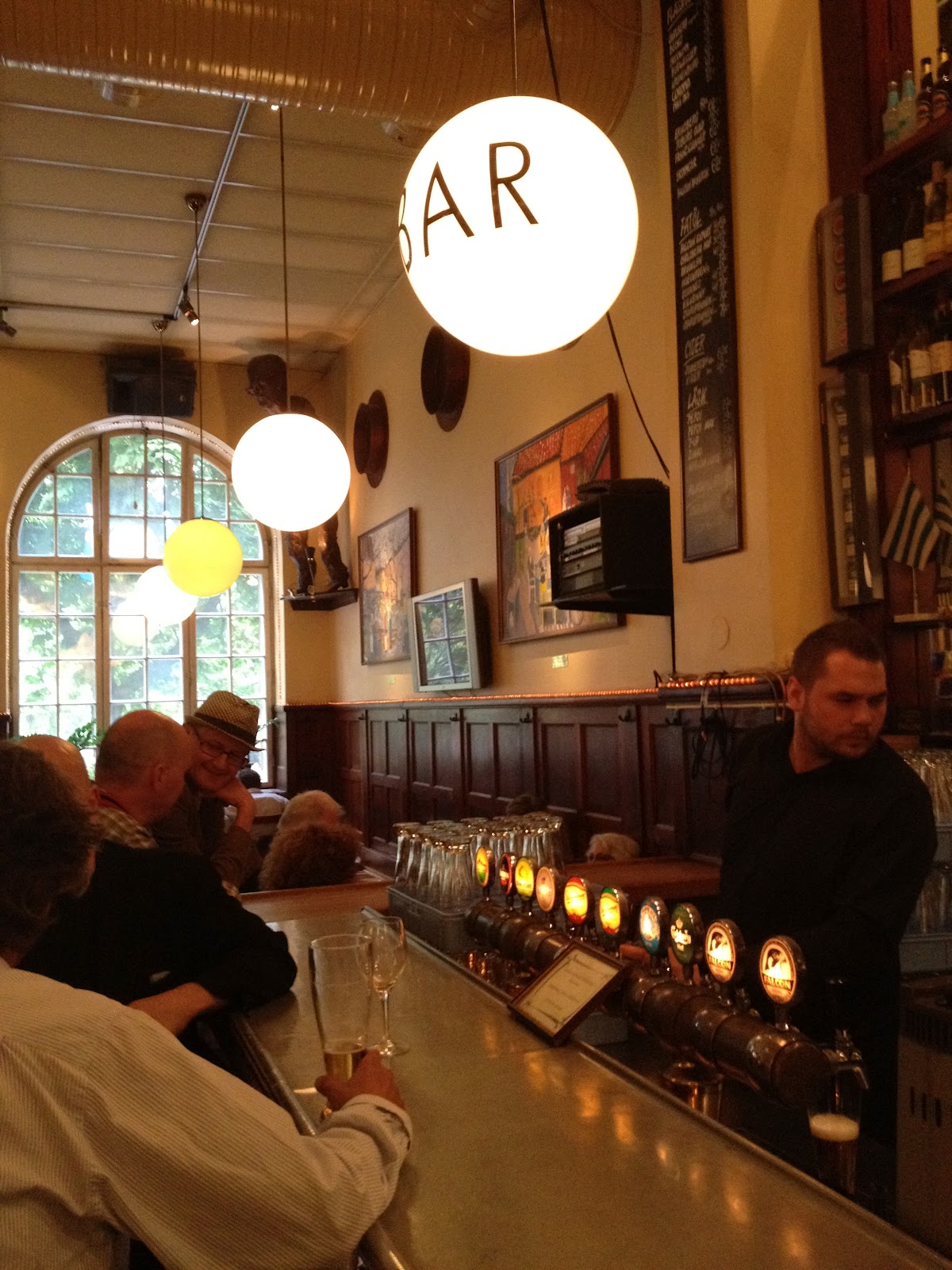
3. Kvarnen, Tjärhovsgatan 4. Just outside SoFo to the north, this old-fashioned beer hall is the polar opposite of an edgy modern cafe. Open since 1908, its cavernous interior is furnished with timber tables against wood-panelled walls, and there's a long, pitted, metal-topped bar running down one side:


I wasn't eating, but the menu looked interesting. The standard offer was two courses for $25, including such Scandi options as pickled herring cake, smoked sausages, homemade meatballs and reindeer stew. 

Given these homegrown food choices, I was surprised to find that the bar didn't have any Swedish beers on tap; so I settled for a 600ml glass of Falcon ($9.60), which was once an iconic Swedish brew but is now owned by the Danish company Carlsberg:


The only negative thing about Kvarnen was a
compulsory $3 coat check (in my case, a jacket check) as you enter, whether you're wearing light or bulky outerwear. Presumably they just have to do without this annoying little surcharge on hot days.

Next: Three more Södermalm drinking holes of an entirely different nature - one very high, another with an overwhelming range, and a third which features in fiction...

This post was sponsored by AFerry.co.uk.

Friday, 22 June 2012

Welcome to Södermalm


On Monday afternoon, I popped up out of Medborgarplatsen Station in the district of Södermalm in Stockholm, Sweden, and was a bit surprised by my surroundings.

I'd fancifully imagined the Swedish capital to be a wall-to-wall mix of grand old palaces and ultra-modern buildings, in a spotless contemporary setting; a kind of "Disneyland meets IKEA" arrangement.

What I found instead in Södermalm was this:


Now I don't want to be rude, but my first impression of this scene was that it looked the way a street would've looked if one of Europe's ex-communist countries had somehow soldiered on and found money for building maintenance.

It turns out, however, that's what Söder is like. It was once a gritty working-class area with a mix of architecture including modernist housing blocks built in the 1960s. However, in recent years it's become an uber-hip district of cool bars, shops and cafes, and a bit of urban starkness does this image no harm at all.

As an example, here are a couple of shots of my new favourite "local" cafe-bar (ie it's walking distance from the hotel), Gilda at Skånegatan 79:


Södermalm's not entirely composed of stark 1960s modernist facades, as it turns out. Down near the waterfront facing Gamla Stan (the Old Town), there are some hilly streets full of beautiful residences.

This street is Bellmansgatan - in fact, that reddish building on the right was the address given in The Girl With the Dragon Tattoo for the home of novelist Stieg Larsson's detective hero, Mikael Blomkvist:


There's a beautiful view toward the Old Town from a lookout near this building. It gives you a sense of the watery nature of Stockholm, sited as it is across an archipelago:


And further east of this point, in a small square in front of Slussen Station, is the final Södermalm gem I'd like to share with you. This stall came recommended by a local - all it sells is herring, in various guises:


... and here's the particular item my benefactor suggested. It's a “strömmingssburgare” - a herring burger. To the flattened fried herring fillets are added iceberg lettuce, creme fraiche, red onion and parsley, and the whole mess is jammed into a bun:


Sitting at a rickety table next to the stall in the warm 8pm June sunshine, I chewed my way through my herring burger. It was tasty. Fishy. And tasty.

Disclosure time: On this trip I was assisted by the Stockholm Visitors Board.

Thursday, 5 April 2012

Light Packing Revisited

Way back in May 2008 I wrote a blog post on light packing, listing the items I take with me on Lonely Planet assignments to Poland.

It's still one of the more popular posts on my blog, receiving many visits and comments.

Four years on, I'm planning to travel to Poland again and things have changed. Technology, in particular, has moved on and has allowed me to reduce my packing even more.

I still travel with cabin luggage only, stored in my trusty High Sierra backpack purchased in 2005 (pictured above, packed and ready to fly via Ryanair from Poznań last year).

So it's time for an update. Here's what I'll be taking with me this year to Poland (with sidetrips to London, Stockholm and the eastern Czech Republic):

Clothing:
  • 3 shirts (2 t-shirts + 1 with a collar)
  • 3 pairs of socks
  • 3 pairs of underwear
  • 2 pairs of trousers (1 jeans, 1 black)
  • 1 bathers
  • 1 fleecy top
  • 1 scarf
  • 1 woolly hat
  • 1 jacket
  • 1 pair of boots
Tech:
  • iPad
  • Apple wireless keyboard
  • iPhone
  • Mophie Juice Pack battery case for the iPhone 
  • small tripod & Glif tripod stand for the iPhone
  • chargers for the above, plus an AU > Euro power adapter
  • headphones
Other:
  • folder with printouts of Lonely Planet text by city
  • clipboard
  • pens & 2 notepads
  • foldable bowl and fork/spoon
  • Crumpler satchel
  • toiletries
Of course, a fair few of these items will be travelling on my person rather than in the backpack.

So what's changed since 2008?

Threads and tech

The clothing is much the same, based on my "rule of three" - I've found it's the perfect mix for a late Polish spring, adaptable to hot humid days and cool chilly ones. My one indulgence is the pair of bathers, because I do just occasionally stay at a hotel with a swimming pool.

The tech is quite different. Out goes the Sony Vaio laptop, Olympus digital camera, Palm PDA and Nokia mobile phone; in comes the iPad, wireless keyboard, iPhone and Mophie battery case. Clearly that's a big reduction in weight, especially when you factor in the fewer leads and chargers required.

Paper goes digital

Physical books have completely disappeared too, present instead in digital form on the iPad and iPhone. Though I have been known to pick up the odd undemanding novel from the local bookshop chain EMPiK as I potter around Poland.

Unfortunately I still need printouts of the previous edition of the Lonely Planet guidebook I'm researching. I'd love to have all this on a waterproof tablet with a long battery charge, on which I could make quick marginal notes with a stylus. One day perhaps, as the tech matures.

Image reduction

Where's the camera, you might wonder? For years I've taken photos on a simple compact digital camera, and had plenty of them published. Now, with the camera of the iPhone 4S approaching the quality of that of my digital camera, I've decided to use that for my photography instead.

It's a bit of a leap and I'm aware it has limitations, but I trialled it recently on a week in Thailand and it was quite successful. The bonus of being able to automatically back up images via hotel wifi to iCloud each evening is an added incentive. It'll be interesting to see how it goes.

Bowl food = soul food

The other item that might raise eyebrows is the foldable bowl. It's a clever item you can buy from camping stores, a flat circular piece of plastic which magically folds into a usable bowl. It's for evenings when I'm completely exhausted and just want to eat something simple in my hotel room - I pick up some muesli and milk and use the bowl for them. Bliss.

What do you think, would this work for you or is it too restrictive? Do you have light packing tips you'd like to share?