Showing posts with label Seattle. Show all posts

Friday, 8 December 2017

One Trip, Multiple Stories: A Travel Writer's Rail Journey in West Coast USA

For the journey detailed below, I paid for my airfares and received on-the-ground assistance from local tourism authorities and hotels. Full disclosures are included with each linked article and blog post.

This is, remarkably, my 500th post at Aerohaveno. I started the blog way back in 2008, during the golden age of blogs, when social media outlets such as Facebook were new and yet to be adopted by the masses.

In that era, a blog was the prime means for an individual to put their views online, whether on a topic of expertise or simply as personal reflection.

Now we have the noise and colour of social media, and perhaps wonder if things are better.

In any case, for post number 500 I'd like to repeat what I did for post 400 - draw back the curtain on how travel writing works, at least for a freelancer like me.

In post 400 I looked at a trip I undertook around the world. This time I'll focus on the west coast of the USA.

In October 2015 I flew into Los Angeles, then caught Amtrak trains up the west coast with visits to San Francisco, Portland and Seattle along the way.

I've chosen this 2015 trip because the period elapsed since then has been long enough for almost everything I wrote about it to be published.

Below I'll outline how each activity led to a specific piece of writing - with a link to the published article or blog post.

Are you sitting comfortably? Then we'll begin.

Monday 12 October 2015

Activity: Fly Qantas from Melbourne to Los Angeles.
  1. Resulting story: A review of Qantas' Premium Economy class for Fairfax Media's Traveller website in Australia.
  2. Blog Post: Catching public transport from LAX to Downtown LA.
Activity: Check out the renovated and reopened Clifton's Cafeteria in LA's Downtown.
  1. Resulting story: A short item about Clifton's in a round-up of 2015 travel finds for Fairfax Media's Traveller website and print section in Australia. 
  2. Second resulting story: An article about Downtown LA highlights for roundtheworldflights.com [story not currently online].
Tuesday 13 October to Wednesday 14 October 2015


Activity: Take the guided studio tours at Warner Brothers, Universal Studios and Paramount Pictures.
Resulting story: An article about LA movie studio tours for Lonely Planet's website.

Wednesday 14 October 2015


Activity: Visit new Australian-owned café, Paramount Coffee Project.
Resulting story: An article about Aussie-owned food and coffee outlets in LA, for Fairfax Media's Good Food website in Australia.

Thursday 15 October 2015


Activity: Explore new contemporary art gallery, The Broad, in LA's Bunker Hill.
  1. Resulting story: A short item about The Broad in a round-up of 2015 travel finds for Fairfax Media's Traveller website and print section in Australia.
  2. Blog Post: My visit to The Broad.
Activity: Visit the Museum of Jurassic Technology in Culver City.
  1. Resulting story: An article listing six quirky attractions of LA, including the Museum of Jurassic Technology, for Lonely Planet's website.
  2. Second resulting story: Commissioned for an Australian media outlet, but yet to be published.
Friday 16 October 2015


Activity: Catch the Coast Starlight sleeper train north from LA to Oakland (for San Francisco); then later onward to Portland and Seattle.
  1. Resulting story: An article about the entire rail trip for the magazine Get Up & Go in Australia.
  2. Second resulting story: An article about the sleeper train experience for Fairfax Media's Traveller website and print section in Australia.
Saturday 17 October 2015


Activity: Join the eccentric Emperor Norton's Fantastic San Francisco Time Machine tour.
Resulting story: An article about the tour's highlights for Fairfax Media's Traveller website in Australia.

Sunday 18 October 2015

Blog Post: Review of the long-running musical revue Beach Blanket Babylon.

Monday 19 October 2015


Activity: Attend the North Beach Underground tour of San Francisco, focusing on the Beat Generation.
  1. Resulting story: A 'Postcard from San Francisco' article for the Spectrum (culture) section of The Age newspaper in Melbourne.
  2. Blog Post: Profile of six memorable tours of San Francisco.
Blog Post: San Francisco's retro public transport.

Thursday 22 October to Sunday 25 October 2015

 
Activity: Visit Voodoo Doughnuts, Stark's Vacuum Cleaner Museum, Powell's City of Books and other offbeat attractions in Portland, Oregon.
Resulting story: A list of 'Ten attractions keeping Portland weird' for Fairfax Media's Traveller website in Australia.

Blog Post: Memorable street art of Portland.

Saturday 24 October 2015

 
Activity: Join a food walking tour of North Mississippi Avenue, Portland.
Resulting story: An article about highlights of the tour, for Fairfax Media's Good Food website in Australia.

Blog Post: A visit to Stark's Vacuum Cleaner Museum, Portland.

Sunday 25 October 2015

Blog Post: A tour of Portland's coffee culture.

Monday 26 October 2015

 
Activity: Take a coffee walking tour of Seattle, Washington.
Resulting story: An article about the city's coffee highlights for Fairfax Media's Traveller website in Australia.

Wednesday 28 October 2015

Blog Post: Visiting Seattle's Living Computer Museum.

Thursday 29 October 2015

 
Activity: Travel to Snoqualmie and North Bend, to visit locations from the TV series Twin Peaks.
  1. Resulting story: A 'Postcard from Twin Peaks' article for the Spectrum (culture) section of The Age newspaper in Melbourne.
  2. Second resulting story: An article about Twin Peaks locations for Lonely Planet's website.
  3. Blog Post: My visit to Twin Peaks locations.
Sunday 1 November 2015

Blog Post: Taking a tour of Underground Seattle.

Monday 2 November 2015

Activity: Fly from Seattle to Los Angeles via Alaska Airlines.
Resulting story: A review of Alaska Airlines' domestic Economy class for Fairfax Media's Traveller website in Australia.

Activity: Fly Qantas from Los Angeles to Melbourne.
  1. Resulting story: A review of facilities at LAX for roundtheworldflights.com [story not currently online]. 
  2. Blog Post: Review of the new Qantas International Business Lounge.
And that's that! I arrived back home on Wednesday 4 November, courtesy of the International Dateline.

Writing output, financial income

By my count, the trip produced a total of 18 paid articles for outside publications (with a 19th yet to be published and paid for), and 12 posts on this blog.

I calculate the paid articles earned a total of $8850.72 (all figures here are in Australian dollars) for both words and photos, before adding any applicable sales tax.

About another $500 should come in from the final article. And there was additional research undertaken on the trip which I may yet write about, as well as revisiting its attractions in new ways.

The blog posts don't earn any direct income, but drive traffic to Aerohaveno and thus contribute to the occasional small payments I receive from the Google Ads running on my blog.

Expenses

I had significant expenses on this journey, especially since I was paying my own airfares on this occasion.

Including airfares, I estimate my total expenses on this trip at $3028.26, which leaves a profit of $5822.46 (plus $500 from the unpublished article, and possible income from future stories derived from the same research material).

Some trips have a greater return on outlay, others less so. Quite aside from the profit, however, this west coast USA trek turned out to be one of my favourite journeys ever, and I was very glad I'd taken it.

It's not easy to make a living from travel writing; but if you can derive a published story per day from a particular trip, you're off to a decent start.

After this epic post, it's time for a break! Aerohaveno will be taking a break over the holiday season, and will be back with you in early January. Have a great New Year!

Friday, 1 September 2017

Seattle's Living Computer Museum

I stayed in Seattle as a guest of Railbookers, Visit Seattle and the Fairmont Olympic Hotel, though I paid my own airfare to the USA.

When I visited Seattle in 2015, I was struck by how many museums it had which referenced either technology or the future (or both).

One exception that referenced both technology and the past was the Living Computer Museum, in the industrial district of SoDo; named in the American style after its location South of Downtown.


Established by Microsoft co-founder Paul Allen, the museum is dedicated to presenting the history of computing via working models of computers over the decades, which visitors are welcome to use.

To its credit, it has Apple computers on display as well as PCs.

This is the Apple Lisa, a 1983 computer which was one of the first to feature a graphical interface rather than a simple command line. It was inspired by a then decade-old groundbreaking graphical design by Xerox, which never fully capitalised on this brilliant leap in usability.


A large room at one end held a assortment of huge mainframe computers that looked as though they'd been salvaged from the set of 2001: A Space Odyssey...


... though I most enjoyed sitting down and interacting with the individual computers. This early AT&T machine had a vertical page-shaped monitor. I wonder why that didn't become more of a thing? For writing, it would have made a lot of sense.


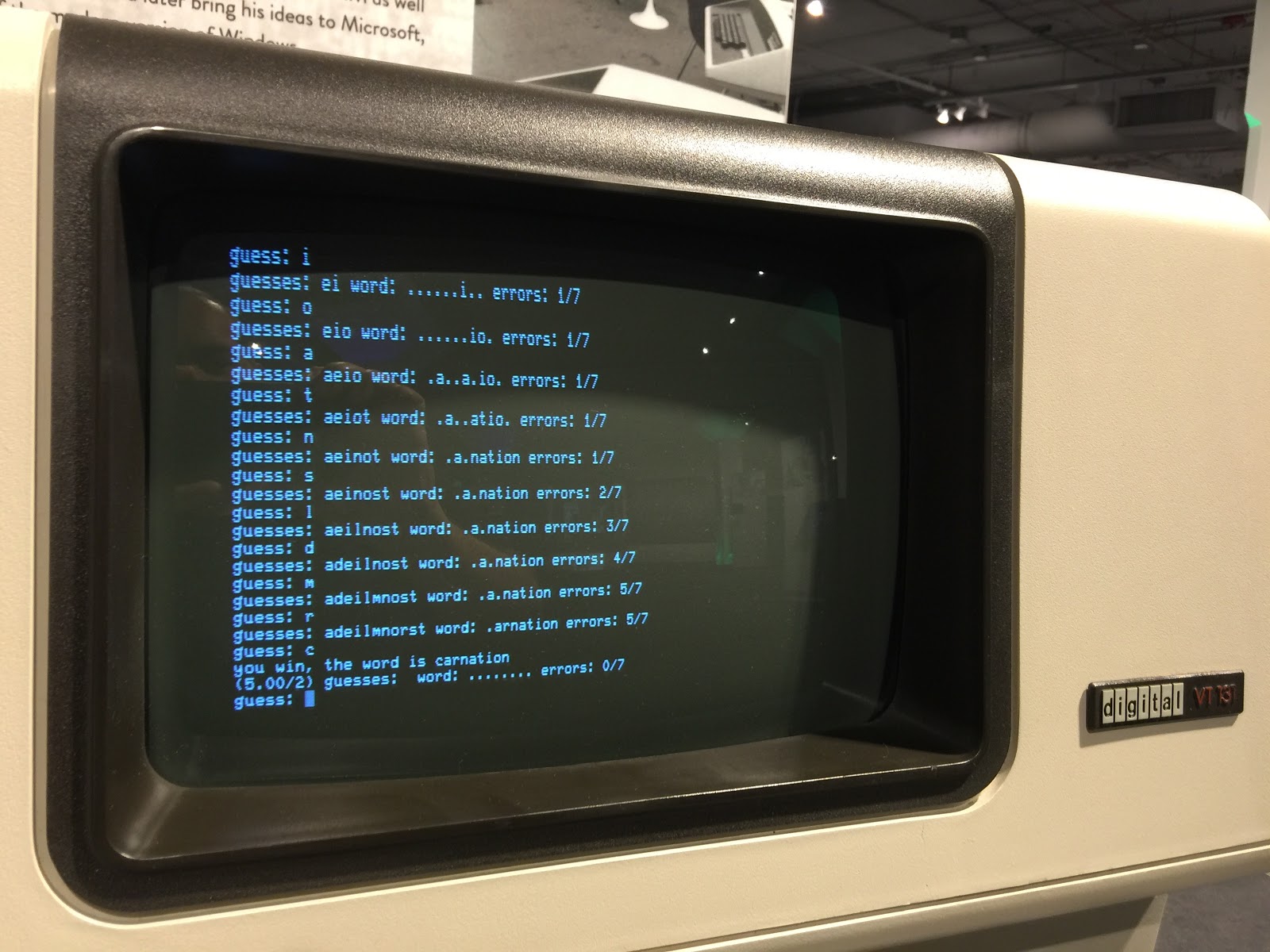
I enjoyed a game of Hangman on this DEC VT131 terminal...


... and wrote a note in Notepad on an early IBM PC running Windows 1.0:


And of course, I had to play a game of Pac-Man on one of the early games-based computers, the Atari 400:


There was a lot more to the museum, including guided tours. It may look a bit dry in images, but all the explanatory captioning was very good and it was involving, even for a layman who's merely used computers a lot in his work.

Since I visited, the museum has renamed itself Living Computers Museum + Labs, adding a section dedicated to emerging technologies such as virtual reality and self-driving cars.

But I'll always have a soft spot for these older devices, which helped us in the transition from the hard copy working world, to that dominated by the IT of today.

Living Computers Museum + Labs is located at 2245 First Ave South, Seattle, USA. Entry fee US$12. For opening hours and other details, visit its website.

Friday, 9 June 2017

Twin Peaks: It is Happening Again


When Twin Peaks burst onto our TV screens here in Australia in 1991, we knew immediately we were watching something special.

At the time, Narrelle Harris and I were deeply involved in science fiction fandom, particularly those sections serving enthusiasts of British programs such as Doctor Who and Blake’s 7.

So it made sense for us to extend our fannish habits toward this astonishing new American show, with strong strands of horror and fantasy in its DNA.

One thing we did was to hold a costume party, on 18 May 1991. That’s where the above photo comes from – yes, that’s me as Doctor Jacoby, at the tender age of 26. Here's another shot of some attendees, appearing as (from left to right) Nadine, Audrey, James, two Coopers and Blackie:


The second and more substantial thing was to create a fanzine, Wrapped in Plastic (no relation to the US magazine of the same name, which ran from 1992 to 2005).

Publishing a fan magazine like this was second nature back then for ardent fans of popular science fiction or fantasy TV shows. For – and bear with me here – the Internet as we know it was yet to be born.

Yes! The World Wide Web was only opened to the public in late 1991, and the Mosaic browser which made it useful and easily accessible debuted in 1993. Email had been around for a while, but generally only scientists and academics used it back then.

So, in the age before digital, we had to share our passions in pure analogue style.

That meant typing, collating and literally cutting and pasting material onto sheets of A4 paper, which would then be photocopied, stapled and posted to subscribers.

Aside from meetings where people might get together to watch bootleg copies of episodes unavailable on VHS cassette, fanzines provided one of the few regular forums for fans to discuss their favourite TV programs.

They contained articles analysing minutiae of episodes, and speculating what might come next. There were short stories continuing the adventures of characters outside the confines of the small screen.

There was fan art, and clippings from newspapers and magazines. And there were lively letters to the editor, our forerunners of Facebook posts.

So… here for your download pleasure is an edited PDF version of the four issues of Wrapped in Plastic, which ran from August 1991 to June 1992.

For copyright reasons I’ve removed the various photocopied clippings which took up a fair chunk of each issue, as well as an ongoing episode guide which seems redundant now.

At Twede's (aka the Double R), North Bend in 2015
What remains are articles, letters, reviews, cartoons, crosswords, short stories (one a bit saucy), and a lot of fan art.

Amongst this are marvellous covers by Andrew Williams and Tim Howe, and many entertaining illustrations by my late, great friend Ian Gunn – don’t miss his absurdly overcomplicated flowchart on the last page on Issue One.

As you flick through the PDF, you’ll notice changing fonts – sometimes quite horrible dot-matrix style ones – along with variations in contrast that can make the text difficult to read.

What can I say? I didn’t have a computer then, so most of the fanzine was typed on an electric typewriter. However, if a contributor provided an article on a sheet of paper in their own chosen font, it was much easier to paste that in than to retype it. Hence the variety.

Overlooking the Snoqualmie Falls (aka White Tail Falls)
and the Salish Lodge (The Great Northern) in 2015.
They were simpler times. But not, luckily, in Twin Peaks USA.

And now, all the way here in the future, it is happening again. As I said to my future self back in 1991, “I’ll see you again in 25 years.” And I made that date. Sort of.

Thanks to all the contributors to Wrapped in Plastic back in the day; if I’ve lost touch with you and you happen across this post, please get in touch so I can thank you directly.

My greatest gratitude goes to David Lynch and Mark Frost, for sharing their extraordinary creation with us, both in the 1990s and again today.

Its dreamlike sounds, images and characters have stayed with me through the years, and in 2015 I was delighted to visit its filming locations in Snoqualmie and North Bend (with the assistance of Visit Seattle), and write about them three times:
  1. Postcard from Twin Peaks, for The Age;
  2. Welcome to Twin Peaks: a guide to the locations, for Lonely Planet;
  3. Welcome to Twin Peaks (aka Snoqualmie USA), in this blog.
It was good to looking through issues of my fanzine again, handmade expressions of enthusiasm for a superlative television series. And great to be doing so in the middle of new episodes exploring the strange world of Twin Peaks.

In the words of Agent Cooper, “I'm going to let you in on a little secret. Every day, once a day, give yourself a present. Don't plan it. Don't wait for it. Just let it happen.”

With the new Twin Peaks season, it's once a week. But you get the idea.

Twin Peaks continues until September 2017 on streaming service Stan in Australia, with new episodes available each Monday afternoon. The omnibus edition of 1991-1992 Twin Peaks fanzine Wrapped in Plastic can be downloaded from this link.

Tuesday, 3 November 2015

Subterranean in Seattle: Underground Tour

I stayed in Seattle as a guest of Railbookers.com.au, Visit Seattle and the Fairmont Olympic Hotel, though I paid for my own airfare to the USA. 

Yesterday I visited the oldest part of Seattle, its Pioneer Square neighbourhood. 

Then I went one further, and visited the Old Old Seattle beneath its streets - the original waterfront neighbourhood that existed one storey lower over a century ago.

In the late 19th century, Seattle's waterfront district was a foul-smelling stretch of bars and brothels which sat on flats which were often flooded. When the Great Seattle Fire levelled the city in 1889, it created the perfect opportunity for renewal.

What happened next was a remarkable feat of engineering. Over several years, concrete retaining walls were built along the sides of roads, then filled in so the new street surfaces were one storey higher.

While this was happening, businesses traded as usual in newly constructed buildings at least two storeys high; accessible via narrow sidewalks running at ground level below each side of the raised roads.

Finally, the gap between street and building was covered with a new sidewalk at what would become the new ground level, and what had been ground-level storeys became basements.

Some of these fasinating subterranean chambers can be visited. I joined the regular tour of Beneath the Streets, the newest company to offer access.

As Beneath the Streets shares its premises beneath Cherry Street with the ghost tour company Spooked in Seattle, it has a macabre location in which to begin its tour:


After an explanation of underground Seattle's history, my guide Richard led me through adjacent rooms to an area where the original sidewalk ran beneath the street, and the retaining wall could still be seen:


After we explored this area, we headed out on the streets to see something of above-ground Seattle, including the bust of the Native American Chief Seattle (or Si'ahl) who gave his name to the city:


Richard also pointed out the numerous glass skylights which let light into the underground areas, the glass now having turned purple as it contained manganese:


Then we headed into the J&M Cafe and Cardroom, billed as Seattle's oldest bar:


From a door in the alleyway behind the bar, we were able to access its original ground level, now being used as a storage space. But it still had some remnant wallpaper and signage from its original use:


Along the street, we descended into our final chamber in underground Seattle. This time, it was a renovated space that's in use as a live comedy venue:


If you look carefully, you can make out some famous Seattle-ites in that last photo.

It was a fascinating tour, and it's intriguing to think that a whole layer of the city, once thronged with inhabitants, now lies mostly silent beneath its streets.

Beneath the Streets' underground Seattle tour is $15; make bookings at www.beneath-the-streets.com.

Friday, 18 September 2015

Jeeves & Wooster: 100 Years of Comic Rannygazoo

Jeeves came in with the tea.

'Jeeves,' I said, 'we start for America on Saturday.'

'Very good, sir,' he said; 'which suit will you wear?'

New York is a large city conveniently situated on the edge of America, so that you step off the liner right on to it without an effort. You can't lose your way. You go out of a barn and down some stairs, and there you are, right in among it.


The only possible objection any reasonable chappie could find to the place is that they loose you into it from the boat at such an ungodly hour.
And so one of the great comedy duos of English literature was established, exactly a century ago today.

On 18 September 1915, PG Wodehouse's short story Extricating Young Gussie appeared in the American weekly magazine, The Saturday Evening Post.

The Octagon at Hunstanton Hall, Norfolk,
memorably used as a setting in the 1930 short
story Jeeves and the Impending Doom.
I visited it in 2012.
Having been in publication since 1821, the Post was a grab-bag of opinion pieces, humorous items, poetry, fiction and illustrations (a year later it would discover the art of Norman Rockwell).

It was the perfect home for the trans-Atlantic comic fiction of Wodehouse, who was one of the first modern writers to establish a large following in both the UK and the USA.

A hundred years later, his fiction still reads well. Though it's set in a bygone age, that bygone age is itself a fantasy world which never truly existed; so it's still as entertaining an arena for Bertie Wooster's social mishaps as it was then.

So much have I enjoyed the Jeeves and Wooster stories (and the author's many other novels and short stories), that I've occasionally travelled to locations associated with Wodehouse.

There's something fulfilling about travel with a theme that has personal meaning. This is what I've been able to achieve so far along PG Wodehouse's timeline (click to follow links to more detail):

Next month I'll be attending Psmith in Pseattle, the latest instalment of the biennial convention hosted by the USA's Wodehouse Society.

I'm looking forward to it. Following PG Wodehouse's footsteps around the world may be an obsession, but as obsessions go it's a harmless one. Bertie Wooster would likely describe it as "loony", but I trust the ever-tactful Jeeves would let me off with a mere "eccentric".

Extricating Young Gussie is out of copyright in the USA, so you may read the entire story here.