Showing posts with label Eastern Europe. Show all posts

Friday, 8 February 2019

Clueless in Kraków

To paraphrase the old TV crime show Dragnet: "Ladies and gentlemen, the story you are about to read is true. Not even the names have been changed to protect the innocent." 

Yes, the following events really happened to Narrelle Harris and me in 1994. 

I wrote it up for a newspaper some years ago; but as that account has disappeared from the Web, here it is again for the record...

“We have here the homicide.”

These aren’t words you want to hear while you’re travelling overseas.

Nor do you want to glance over the shoulder of the man who’s just spoken them, to see a pile of bloody surgical gloves and the body of your dead landlord in the living room.

Your absolutely stark naked dead landlord.

Narrelle and I were taking some time out from the blur of travel. To replenish our funds, we’d taken English teaching jobs at a private college in Kraków, Poland.

This was just a few years after the fall of communism, and housing was generally cramped and expensive, but we had been lucky enough to land the top floor of a house. We lived up top, our landlord and his elderly father lived below.

One chilly evening in November, we returned from work to find a police car at the end of the street, and people swarming up and down our stairs. Strangely, our mental alarm bells didn’t sound. "There's been a domestic," we figured, and headed on up.

Stopped at the first landing, it was quickly established that neither of us spoke much Polish. Thus the immortal words mentioned above, followed by the interesting sight of a deceased naked body whose modesty was covered by a small cloth. How thoughtful.

Thinking about it now, I don’t think the city’s finest had anticipated the arrival of a couple of clueless Australians on the scene, and were unprepared to deal with this twist in the plot.

It was also quite unreal for us, like an unfathomable foreign cop show without subtitles - CSI: Kraków. Our thoughts shifted between horror, pity, curiosity, and concern that the unreliable heating system would never be fixed.

A policewoman who spoke reasonable English turned up at 11pm. She translated while two men went through a few of our cupboards which contained some of the landlord's possessions.

They seized an old address book, and a business card for something called "The Viking Club". Now this was more like the movies. A Nordic connection, maybe? A cartel of ruthless reindeer rustlers, or gangsters trying to smuggle horned helmets past Customs?

Then they left, requiring our presence at the police station the next day.

Arriving bright and early, we surveyed a dreary brick building that looked just the sort of place that difficult suspects disappeared from. And we’d had had no chance to rehearse our stories. Would we be tripped up on our links with the exclusive but shadowy Viking Club?

We gave our statements. Of course, we knew nothing, and had visions of the cops tearing up the pages in disgust after we left.

Well, that was sort of that. I’d like to tell you we resolved to make up for our cluelessness by becoming fluent in Polish, brandishing our magnifying glasses and tracking down the landlord’s killer no matter where he had fled to.

No bolthole would be safe, no refuge secure for this heartless criminal once we vowed to hunt him down. No, not even the headquarters of the Viking Club.

But it was not to be. We never had to give alibis, fingerprints, any of the exciting stuff. And with the passage of years, the disturbing incident has faded to a point where it seems like the plot of an unconvincing and meandering foreign film.

If only we’d been blessed with subtitles.

Friday, 9 November 2018

Užupis: The Improbable Republic Within Lithuania

This article from my 2008 visit to Lithuania appeared in Sydney's Sunday Telegraph newspaper, but is no longer online: so here it is, lightly revised for your enjoyment. Užupis forever!

 
A dog has the right to be a dog.

I’m standing on a quiet side street in Vilnius, Lithuania, looking at this point on a 41-point document displayed on a large mirrored sign. Other unlikely sentences assert that “Everyone has the right to make mistakes”, “Everyone has the right to be idle”, and “Everyone has the right to die, but this is not an obligation.”

It’s an unconventional list; but nothing is conventional in the district of Užupis. The document is the self-proclaimed constitution of this bohemian enclave, whose resident artists declared independence from Lithuania in 1997.

The prequel to this artistic revolt happened in the early 1990s, after Lithuania had achieved independence from the Soviet Union. A group of artists declared that the time for political statues was over - and commissioned a statue of musician Frank Zappa as a quirky symbol of freedom.

The dynamic bust, bearing Zappa’s distinctive features and flowing long hair, still stands atop a pillar on the western side of Vilnius’ historic Old Town.

Fresh from this triumph, it didn’t take the artistic community long to declare Užupis independent. But this isn’t a Russia versus Ukraine situation. The Republic has an honorary president, no standing armed forces, and a commitment only to art.

When you learn that its national day is April 1st, you can see why the Lithuanian government casts an indulgently amused eye over Užupis, seeing its “independence” as a great tourist attraction.

Not far from the constitution wall is the Angel of Užupis, another impressive statue. It’s the most well-known symbol of Užupis, and it’s easy to see why. As I turn the corner and catch my first sight of the angel, I can’t help but smile. He’s perfect.

Not too big, not too small, he stands on a column high above the pedestrians, emphasising his lofty detachment. Facing toward the downhill slope, trumpet raised high, hair swept back as if blown by the wind, the Angel seems to embody the pride of this reborn district, and is frankly inspiring.

Stepping across the street, I enter Prie Angelo, a cafe facing the plaza. Its name and decor seem a tribute to the Angel - or, in fact, all angels. The pale, old-fashioned interior with its bare floorboards and deep-set windows is decorated with a variety of heavenly spirits in the shape of candleholders, vases, and busts poking straight out of the walls.

As angels watch over me and sunlight softly illuminates the space, I struggle to believe Užupis was once a dangerous, dilapidated district of the USSR.


However, proof is at hand. Following small side streets off the plaza, occasionally ducking through arches into residential buildings’ courtyards, It becomes clear that Užupis is still a work in progress. Some of the courtyards are in a terrible state - crumbling stonework, rusted railings, rubbish strewn around. In another, I see an old car up on blocks, missing its tyres.

Then I stick my head into the gallery of the Vilnius Potters’ Guild. I’m not sure it’s somewhere I should be - piles of newspaper-wrapped objects are being packed into boxes, and it looks like I’d be underfoot.

But a woman ushers me in, explaining that they’re preparing for a medieval fair, and encourages me to look at their work. The pieces I can view have a rustic simplicity, a smooth but organic look that’s very appealing.

I head uphill away from the Angel, into the heart of Užupis. It’s only when I reach the restaurant Tores, and step through to its backyard terrace, that I realise how high I’ve risen above the city. Lunch is a pizza and a stein of Švyturys, a pale golden beer which packs a fair punch.

Beneath the terrace, the hill drops away dramatically toward the river, and across the valley is a fine view of Vilnius’ Old Town: a beautiful collection of red-tiled roofs and baroque church spires.

Walking back down to the river, I spot yet another statue down an alley to my right. At least, I think it’s a statue. On closer inspection, it turns out to be a indeterminate shape on a pedestal, wrapped and taped within black plastic. Very arty.


Passing the object, I arrive at a gallery called the Užupis Art Incubator. It’s the essence of a bohemian artists’ community, housed in decaying riverside buildings covered in a jumble of colourful paintings of outlandish figures.

Beyond it is a fantasy land of painted trees and more open-air artwork. Overlooking the water are a young couple, funkily dressed and talking quietly - either discussing postmodern art trends, or slowly shaking off the effects of a late night.

Approaching the attractive small iron bridge that crosses the river, I find myself unable to finish my Užupis adventure just yet; I’ve become attached to its quirky charm.

So I seat myself at an outside bench at Užupio Kavine, a pub overlooking the shallow, swift-flowing water, and nurse another beer.

Within the stone retaining wall which forms the opposite riverbank, there’s a statue of a mermaid seated inside an alcove, gazing longingly across to Užupis. I meet her gaze, then glance up to the busy roadway in the “real world” beyond the artistic republic.

I have to go back there, but... not yet. As the green-and-white Užupis flag flutters gently from the pub’s wall, I sip my beer and smile at the light-hearted absurdity of the place.

Friday, 1 June 2018

Nexus of Change: Gdańsk Shipyard, Poland

I visited Poland in 2016 courtesy of the Ministry of Foreign Affairs of the Republic of Poland.

In 1980, the Solidarity trade union was founded at the Lenin Shipyard (later renamed the Gdańsk Shipyard) in Gdańsk, Poland.

Led by electrician Lech Wałęsa, Solidarity became the first independent trade union recognised in Eastern Europe's communist bloc, after a massive strike forced the Polish government to legalise it.

A decade of struggle, repression and civil disobedience followed, until the collapse of the Berlin Wall and of Europe's communist regimes.

The Wall's collapse can be traced back to Solidarity, its foundation having forced the first cracks into the totalitarian structure.


Nowadays the Gdańsk Shipyard is much reduced as a working facility. On part of its former footprint stands the European Solidarity Centre, opened in 2014 with an exhibition explaining the long struggle for freedom which began here.


I walked through it on my 2016 visit, and for a student of history it was fascinating. From mock-ups of communist-era homes and offices, to chilling details of the surveillance state, it gives a sense of what it was like to live through those times.


At the end of the exhibition is a stylised replica of the circular conference table which negotiated a peaceful end to the regime. I saw it as a symbol of hope. Not every tussle for power has to end in bloody civil war.


In addition to housing the Centre, the shipyard site has hosted major rock concerts to mark Solidarity's struggle, and its distinctive Gate Number Two has become a symbol of freedom.

The gate still stands, and makes an impressive architectural counterpoint to the hyper-modern ESC building.


In a time of political uncertainty across Europe, with democracy seemingly shaky, this site - so crucial in the spread of freedom across the continent - is well worth a visit.

The European Solidarity Centre is open daily from 10am, admission 20zł ($7). For more details, visit its website.

Wednesday, 28 February 2018

Visiting the Russian Woodpecker near Chernobyl, Ukraine

An article featuring my 2016 visit to the derelict Duga-1 radar base in the Chernobyl Exclusion Zone was rewritten when the publisher wanted a different focus. So here’s my original description of the former Soviet radar base, for your enjoyment…


The eeriest moment on our overnight tour of Chernobyl happens not at the infamous reactor site, which exploded in 1986 and spewed radioactive waste into the sky.

Instead it’s at ‘Chernobyl 2’, a code-name used by Soviet authorities to hide an even more sensitive facility. For hidden within the forest was a huge radar installation guarding against an incoming missile launch.

It’s just one of several strange places visited on the tour, all abruptly deserted after the 1986 accident.


Clearly, this is not the itinerary of your average tourist jaunt. However, in recent years the Ukrainian government has allowed tour companies to take small groups into the 30 kilometre exclusion zone around the doomed reactor complex.

The company that’s hosting me, Chernobyl Tour, was founded by one of the emergency workers who helped clean up the site in the 1980s. Most of its customers visit on a day trip from Kiev, two hours away; but there’s the option of a two-day tour, which means a sleepover and more sites to visit.

The exclusion zone contains more than the radar base and the reactor complex with the ruined Reactor 4 under its protective shelter.

Numerous villages were also abandoned, along with the cities of Chernobyl and Pripyat. In many ways the villages are the saddest places to explore, with their collapsed houses and empty schools, still scattered with belongings including children’s toys.


The radar complex, formally known as Duga-1 but nicknamed the Russian Woodpecker for its endless clicking sounds when operational, is another memorable site.

It’s a spooky place, reached by turning off the main road past a dilapidated bus shelter painted with cartoon animals – part of its Cold War cover as the supposed location of a children’s holiday camp.

At the end of a bumpy road of concrete slabs is a huge radar array. Over 150m high and stretching for 800m along a forest clearing, it’s a complex structure of metal girders and components.

And it creaks in the wind, a creepy sound in a dead-quiet grove in the middle of nowhere. The sounds of the paranoid past, haunting the present.

Tim Richards was hosted by Chernobyl Tour. You can find details of its tours and make bookings at chernobyl-tour.com.

Friday, 16 February 2018

A Travel Reading Holiday in Lorne (Part 2)


Every couple of years I take a short summer holiday in the seaside town of Lorne (see above photo), and do a lot of travel reading.

Last post I talked about two travel books I read there in late 2017, each regarding Africa. Now here are two more reviews of travel books among my holiday reading, set in South America and Europe...

1. Turn Right at Machu Picchu; by Mark Adams

The basic premise here is that Adams, an adventure travel magazine editor who rarely gets to do anything adventurous, decides to conquer the Inca Trail. in fact he goes much further than this, seeking to replicate the exploratory quests of Hiram Bingham a century ago.

It was Bingham who visited Machu Picchu and popularised its existence in the West, but he also explored several other significant sites over the following years. In the course of the book Adams visits these while detailing Bingham's expeditions, providing us with parallels between then and now.

It's an entertaining set-up, particularly as the writer is no hardened hiker; it makes it easy for us to identify with him when he struggles with the journey's demands.

The most entertaining element by far is the Aussie guide enlisted by Adams, an eccentric hardened bushman who seems like a real-life version of Crocodile Dundee; just as Bingham was said to have inspired Indiana Jones.

This was a thoroughly good read about a destination I'm not familiar with.

[see this book at Amazon]

2. Border; by Kapka Kassabova

Finally I struck a book with a style of travel more in tune with my own.

Kassabova is a Brit who was born in Bulgaria during the Cold War. In this book, she flits along and over the borders between three Balkan countries: Bulgaria, Greece and Turkey. Along the way she explores the history and folklore of the region, as much at home with relating ancient myths as detailing 20th century events.

This work had much less of the driving linear narrative that was present in the other travel books I read on my Lorne getaway. Instead, the author moves here and there, back and forth, sometimes staying in one village for an extended time.

As a result the book reads like a series of vignettes based on specific villages or border sub-regions, with local people and landscapes at their heart.

It's not as much a page-turner as a traditional travelogue, but Border does lend a lot of insight into the far southeast corner of Europe and the cultural and historical forces which have shaped it.

[see this book at Amazon]

That was my Lorne reading list in 2017. What should I read on my next tech-free travel reading holiday? Feel free to make suggestions in the comments section below.

Friday, 19 May 2017

Eastern Sleeper: Night Train from Kiev to Warsaw

I paid for my own train fare from Ukraine to Poland.

In June 2016 I caught the night train from Kiev, Ukraine to Warsaw, Poland.

This was a full overnight journey (and then some). I boarded at 16:48 at Kyiv-Passazhyrsky station and alighted at 09:10 the next morning at Warszawa Centralna.

It was what you might call old-school European train travel. I'd paid extra to have a 'single', ie the whole compartment to myself.

My bunk was in a sealed sleeper car (with no connection with the rest of the train, and no dining car). My carriage attendant was an impressively tall Ukrainian woman with no English who made me a cup of tea while I dined on sandwiches bought at the station in Kiev.

Then there were the theatrics along the way. A couple of hours waiting at the border in the dim pre-dawn light while Ukrainian border guards searched for smuggled cigarettes, and loud clanking sounds accompanied the adjustment of the train's wheels from the Ukrainian to Polish gauge. Loads of atmosphere!

Despite all this I did get some sleep, and attendant Natasha as I came to think of her (I never did get her name) happily posed for a photo on the platform at Warsaw.

I heartily recommend the Kiev-Warsaw sleeper or its shorter Krakow-Lviv counterpart if you yearn for a little of that old-fashioned night train travel with a dash of intrigue.

Here's a selection of photos I took on the journey:


As it's not possible yet to book these trains online, a reliable service I'd recommend to book these services ahead on your behalf is Polrail. Bon voyage! Or as the Ukrainians say, Щасливої подорожі!

Friday, 27 December 2013

Europe Summer Series: Vilnius, Lithuania (Part 2)

The last post ended with me strolling along the streets of the Lithuanian capital, Vilnius. Here's what happened next...

The material world awaits just down the street as it dramatically opens onto a broad, triangular square fronting the town hall.

To one side, the cafe Amatininku Uzeiga stands out like a movie set, its bright floral tablecloths on tiny external tables presenting a huge contrast with the grey-brown paving scheme.

It’s an irresistibly textbook piazza cafe, so I sit down and order an arbata (tea).

The view across the square may be attractive, but the waitresses here are competitively distracting, wearing an unlikely uniform of tiny tartan aprons over denim miniskirts.

It’s not something that a proprietor back home could possibly get away with issuing his staff; another reminder that I’m not in Kansas anymore (so to speak).


Walking further north I enter Pilies Street, ground zero of tourism in Vilnius. I check out the craft stalls outside another impressive church, browsing Russian dolls and amber jewellery.

Having spent time in the bustling markets of the Middle East, I automatically try haggling over some craftwork passport pouches. They’re marked as 15 Litas each, so I suggest “Two for 20”.

The smiling stallholder responds with “Many work!”, then shrewdly asks “American?”, her mind clearly on the sliding US dollar exchange rate. Not wanting to give Australia a bad name, I quietly withdraw.

Lunch brings more gastronomic surprises. I’ve heard that kepta duona is the perfect snack to go with beer, so I order some.

It turns out to be composed of sticks of fried rye bread with an accompanying garlic dip.

They’re very solid and chewy, like eating small pieces of wood. But they are admittedly excellent with beer. And then, thinking of my arteries at last, I order a light chicken salad.

But there’s a darker side to Vilnius’ history, beyond the improbable snacks and the beautiful churches.

West of the centre, I get a taste of it at the KGB’s former local headquarters - now turned into the grimly-named Museum of Genocide Victims.

This grand 19th century building on a prominent boulevard features the names of the Soviets’ victims carved into the stonework of its facade.

The exhibitions, well labelled in English, chart the Lithuanians’ misery under the Soviet regime, the text punctuated by displays of uniforms, equipment and original documents. For such a small nation, the number of exiles, prisoners and executions in its tragic history are staggering.

But the worst is yet to come. In the basement, the KGB Prison is less intellectual and more gut-wrenching.

Left as it was when the secret police departed, its cells present a terrifying insight into the methods the regime used to silence its critics. And the really disturbing thing is how recent this all is - the interrogators only moved out in 1991, after Lithuanian independence was achieved.

Outside again, blinking in the sunlight, I walk along Gedimino Prospect, now a shining renovated street that’s full of swanky shops and eateries.

I take a seat at Avilys, a chic restaurant that serves a dark beer with ginseng, brewed on the premises.

Around me are smartly dressed locals at other tables, grabbing some food before proceeding to shopping or work.

It could be any posh strip in any European city, and it’s hard to reconcile it with what I’ve just seen in the KGB’s former digs.

As someone who grew up with Cold war fears of nuclear war hanging over my head, it’s more than startling.

I shake my head, trying to wrap my mind around the contrasts, then head down the street to Vilnius Cathedral. This vast white building looks more like a Roman temple than a church, decorated with enormous pillars and giant statues resembling Olympian gods.

I turn to glance toward the separate belfry in front of the cathedral; and then I find the stebuklas, the “miracle tile” embedded in the pavement between the two.


In 1989, a human chain was formed all the way from Tallinn in Estonia to this very spot, uniting two million people over 600 kilometres in a protest against Soviet rule.

The final footfall of the chain was marked by this colourful tile, and its name is no overstatement.

It must have seemed a miracle to Vilnius’ citizens when Lithuania became free two years later; and it’s a fittingly low-key monument to a little city in a little country that’s a delight to the eye. 

And as Lithuanians do, I turn clockwise on the tile and make a wish.

Friday, 20 December 2013

Europe Summer Series: Vilnius, Lithuania (Part 1)

Through December and January, I'm running a series of my previously published print articles on Central and Eastern Europe. Welcome to Lithuania...


There’s a dumpling on my plate the size of a miniature football.

In fact, it’s the shape of a football - which is why it’s called a cepelinas (zeppelin), after the famous airships of a century ago. The pale, doughy exterior is made of potato, and it’s wrapped around a meat filling. On top is a sauce involving sour cream and pork crackling.

It may not be the lightest meal I’ve ever ordered, but it is one of Lithuania’s most distinctive dishes, so it would clearly be an unforgivable international snub not to try it.

Actually, accompanied by a stein of local beer, it tastes quite good - though I suspect my doctor would advise me to eat them only in moderation.

On my way back from the restaurant to my hotel along the cobblestone streets of central Vilnius, I encounter a busker singing a capella near a beautiful baroque church in the twilight.

I stop, unexpectedly entranced by his voice. The music is haunting and indescribably beautiful, giving an impression of a language intriguing, deep and very old.

It’s a delightful introduction to Lithuania’s capital, especially since I know very little about the former Soviet republic.

Its cuisine may not be set to sweep the world, but Vilnius’ beautiful UNESCO-listed Old Town is grabbing the attention of an increasing number of visitors from Western Europe and beyond.

Fortified by my zeppelin encounter, I decide to stroll off some of the calories through the Old Town, starting at the Gates of Dawn.

It’s a beautiful sunny day, though cool in the shade, and this remnant of the medieval city walls stands out attractively white against the blue sky.

Passing through, I spot a carved wooden dwarf set back from the street, and am drawn by curiosity into a beautiful compact courtyard dotted with shady trees.

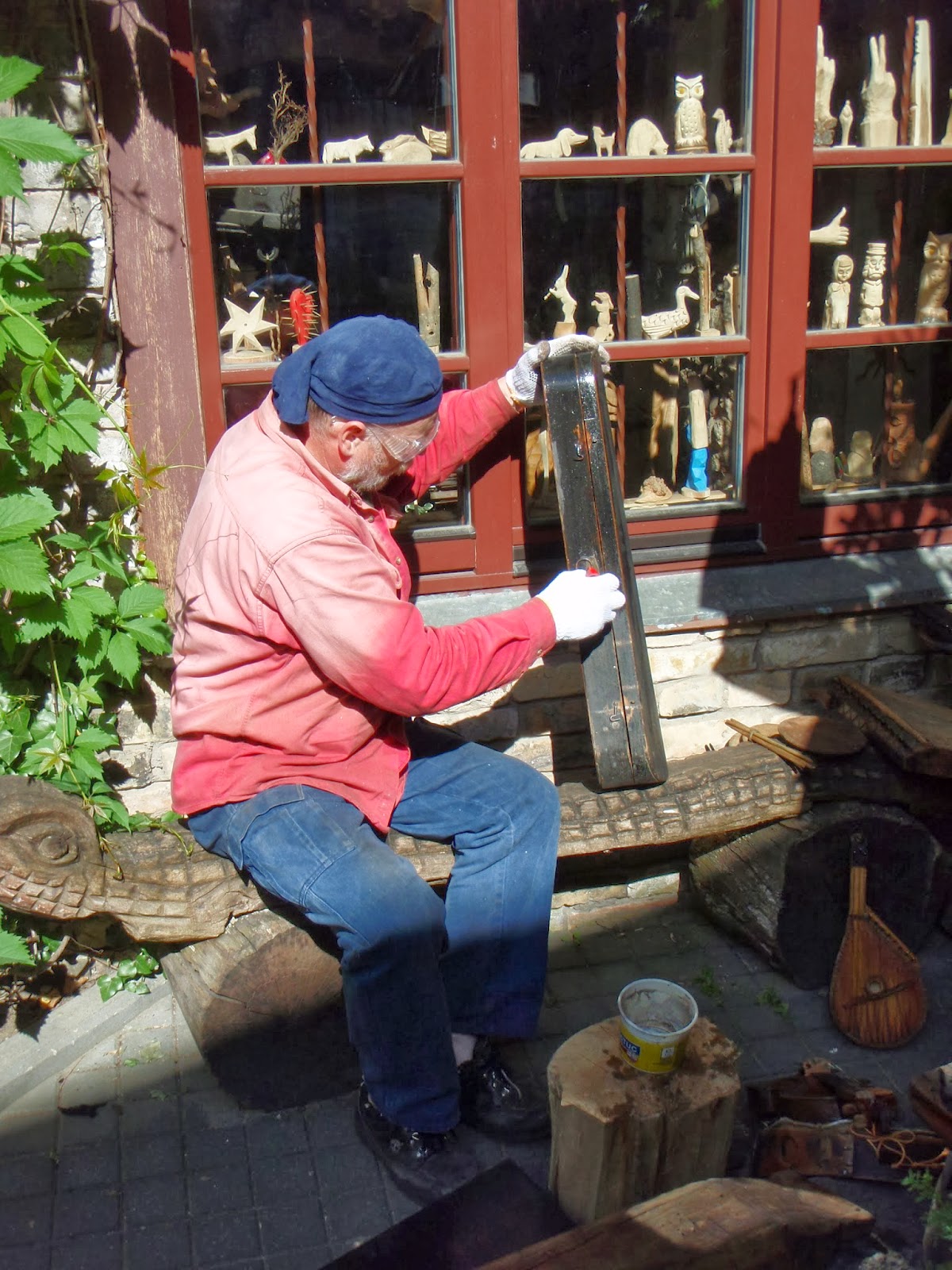
In a corner sits a white-haired man in a bandana, oiling a violin. I step past him into an art gallery, whose doors are studded with curious wooden sculptures resembling hands and insects.

The interior reveals more of these rough-hewn carved pieces, mostly resembling folkloric figures: animals, mythical creatures, stars, and villagers.

There’s something very appealing about their simple, primitive look. I’d read that Lithuania was the last country in Europe to give up pagan worship, and these figures seem to be a link to an era of belief in spirits and nature.

It’s something to ponder as I enter St Teresa’s, an extravagantly decorated church a little further on. Vilnius is famous for its numerous baroque churches, and this one doesn’t disappoint.

Outside it’s impressive, inside it’s spectacular. Gilt paint is lavished everywhere, especially on the elaborate frames highlighting statues and paintings of saints.

As I sit and take it in, visitors come and go, each footstep echoing through the cavernous space.

To my left, a small group of women, some wearing colourful headscarves, are making a procession from one statue to the next around the walls, chanting as they go.

The combination of the chanting, the natural light and the gilt splendour is surprisingly moving, and I’m surprised how calm I feel. I’m not at all religious, but I can see how this atmosphere aids a meditative state of mind.

But the material world awaits just down the street...

[Next post: Passport pouches, a miracle tile, and the den of the KGB...]