Showing posts with label South America. Show all posts

Thursday, 21 March 2019

Eccentric Orbit: Santiago’s Barrio Bellavista

In Santiago, Chile, some years ago, Narrelle Harris and I enjoyed the vibe of the lively Barrio Bellavista district. The story I wrote about it for a newspaper is no longer online, so I've republished it here...

Princess of my feelings
Butterfly of my flowers, of many colours
That I find now in my garden
Birdsong reminds me of your laugh


It’s amazing what 2000 Chilean pesos ($5) will buy you. Walking through the night-time streets of Barrio Bellavista, a district of Chile’s capital, Santiago, Narrelle and I are accosted by a smooth-talking man.

He claims to be a poet, supplementing his high university fees by selling photocopied examples of his work in Spanish and English to passers-by.

He blames his plight on ex-dictator General Pinochet, and asks if I know him. I nod. Then we discuss his uncle's time in Melbourne, he comments on how tall Australian women are, I give him some money for the above poem, and we part the best of friends.

And the night is yet young. There’s never a dull moment in this bohemian entertainment area just to the north of the city centre, across the Mapocho River. It may be pushing midnight on a Tuesday, but it's all happening at the Barrio.

Restaurants are serving food to patrons sitting outside in the balmy spring air, bars are doing a brisk trade, helped by resident solo guitarists, and yellow-jacketed officials keep the peace by sorting out visitors’ parking problems.

Along the street, two young men play the drums and juggle, with a view to extracting financial compensation from passing motorists and pedestrians.

Barrio Bellavista does a good line in perky black-clad waitresses, along with energetically mad beggars, folk who loom over your outside table or harangue you with a smile as you try to use a public phone.

It's all part of the local colour, and we take a tolerant view of their unscripted interventions.

The only real danger lurks in the cholesterol content of the parillada we order from the Galindo, a haunt of the late Chilean poet and Nobel Prize winner, Pablo Neruda. Promised to be tipicamente Chileno (typically Chilean) and indicated as a meal for two, the dish turns out to be a mixed grill of gigantic proportions that would keep a vegetarian gibbering for a week.

The pan it’s served in contains two chops, two steaks, two chicken breasts, three sausages of various descriptions, and several steamed potatoes. This is a meal you could share with your extended family, with everyone satisfied by the end.

But maybe the locals need to fuel up to keep pace with Bellavista’s non-stop energy.

While Santiago has often been seen by travellers as one of South America’s less interesting destinations, and certainly one of the most polluted, this neighbourhood is the focus of much that is worth seeing in the city.

Behind its attractive grid of narrow, tree-lined streets filled with theatres, bars, and eateries, looms the Cerro San Cristobal.

This middle-sized mountain is home to a funicular railway, zoo and the sprawling green parkland of the Parque Metropolitano.

At its summit there’s a lookout under the benevolent gaze of a giant statue of the Virgin Mary, arms outstretched, resembling an opera singer about to burst into an aria.

But the major drawcard of the district is Neruda’s former home, La Chascona. As eccentric as its owner, the property is a riot of separate rooms cascading down a lush hillside, linked by walkbridges.

Each is oddly-shaped, brightly painted, and full of curious objects collected by its owner: bottles, Toby mugs, paperweights, ashtrays, dolls, ships’ figureheads, and representations of horses, watermelons and fertility gods. Much of it was smashed after the coup in 1973, not long before Neruda died, but now it’s been restored and is much-visited.


Gonzalo Iturra, a guide employed by the Pablo Neruda Foundation, is fond of the great man’s quirks.

“The house is important because it is very much like him,” he says. “It reflects his obsession with ships, and with hidden things like secret passages. One of the steps in the staircases was made from a sleeper from a railroad. That’s a reference to his father, who used to work at a train station.”

And the dining room filled with luridly coloured glassware?

“He believed that coloured glass would make things taste better,” says Iturra, smiling.


La Chascona seems like the anchor of the district which surrounds it, a bohemian refuge never conquered by the yuppie invaders who are the kiss of death to such suburbs in the West. But are its days as an alternative hangout numbered?

Iturra doesn’t think so.

“When you make money in Chile, you don’t want to live in a bohemian neighbourhood downtown where things are happening; you want to go where no-one else is,” he says. “Bellavista can be hip and cool, but can also be very unpretentious.”

Neruda, as an ardent communist and a poet who immortalised the mundane objects of everyday life, would no doubt be happy to hear it.

Friday, 16 February 2018

A Travel Reading Holiday in Lorne (Part 2)


Every couple of years I take a short summer holiday in the seaside town of Lorne (see above photo), and do a lot of travel reading.

Last post I talked about two travel books I read there in late 2017, each regarding Africa. Now here are two more reviews of travel books among my holiday reading, set in South America and Europe...

1. Turn Right at Machu Picchu; by Mark Adams

The basic premise here is that Adams, an adventure travel magazine editor who rarely gets to do anything adventurous, decides to conquer the Inca Trail. in fact he goes much further than this, seeking to replicate the exploratory quests of Hiram Bingham a century ago.

It was Bingham who visited Machu Picchu and popularised its existence in the West, but he also explored several other significant sites over the following years. In the course of the book Adams visits these while detailing Bingham's expeditions, providing us with parallels between then and now.

It's an entertaining set-up, particularly as the writer is no hardened hiker; it makes it easy for us to identify with him when he struggles with the journey's demands.

The most entertaining element by far is the Aussie guide enlisted by Adams, an eccentric hardened bushman who seems like a real-life version of Crocodile Dundee; just as Bingham was said to have inspired Indiana Jones.

This was a thoroughly good read about a destination I'm not familiar with.

[see this book at Amazon]

2. Border; by Kapka Kassabova

Finally I struck a book with a style of travel more in tune with my own.

Kassabova is a Brit who was born in Bulgaria during the Cold War. In this book, she flits along and over the borders between three Balkan countries: Bulgaria, Greece and Turkey. Along the way she explores the history and folklore of the region, as much at home with relating ancient myths as detailing 20th century events.

This work had much less of the driving linear narrative that was present in the other travel books I read on my Lorne getaway. Instead, the author moves here and there, back and forth, sometimes staying in one village for an extended time.

As a result the book reads like a series of vignettes based on specific villages or border sub-regions, with local people and landscapes at their heart.

It's not as much a page-turner as a traditional travelogue, but Border does lend a lot of insight into the far southeast corner of Europe and the cultural and historical forces which have shaped it.

[see this book at Amazon]

That was my Lorne reading list in 2017. What should I read on my next tech-free travel reading holiday? Feel free to make suggestions in the comments section below.

Friday, 26 January 2018

Chile Summer Series: Glacier Cruise (Part 2)

Last post I described the beginning of a glacier cruise I took in southern Chile in 2006. Now the adventure continues...


On the second morning of the cruise we awoke to find the Pio XI glacier right outside our window. This is the largest glacier in South America, stretching back some 70 kilometres into the mountains.

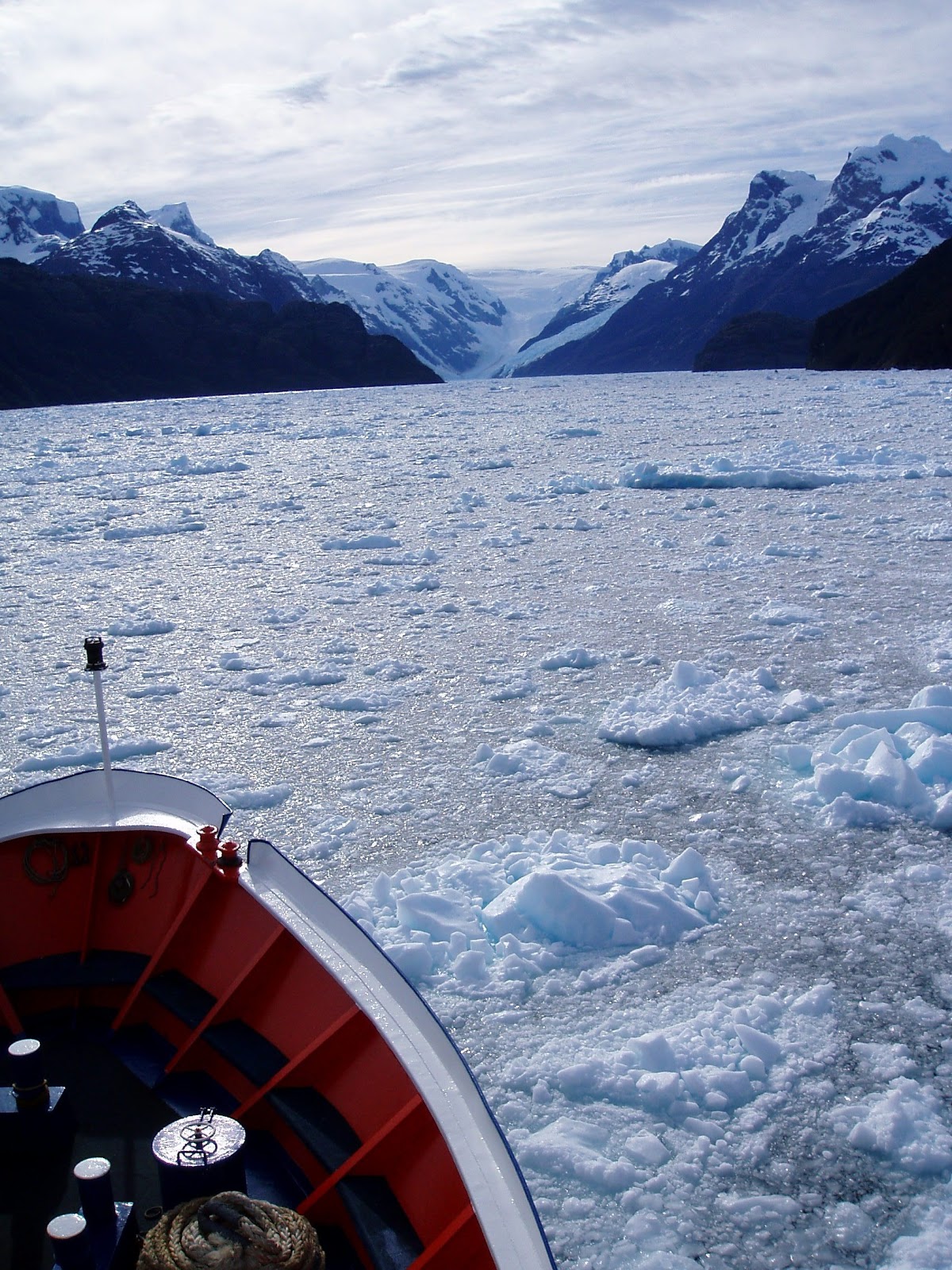
If you saw this in a movie, you'd assume it was a special effect. Filling our field of vision is a cathedral of ice, ranging from pure white through blue shades to almost indigo depths.

Great vertical cracks resemble caves, promontories look like spires.

On its upper surface are projections like great crystals, and gigantic cracks hint from where the next giant chunk of ice will fall into the sea as the glacier makes its way down from the heights.

After a run in the ice-filled fiord in the excursion boat, we return to the ship and stand on the top deck as the Skorpios cruises parallel to the glacier’s cliff-like surface.

Every so often a chunk of ice breaks away and hits the water, with a deep crash and ensuing waves.

Standing there with a quiet sense of reverence, we all feel we’ve seen a major highlight of our travelling careers.

"Just look at it," says one of the Australian women. "Forget about photos. Look at it and carry it in your mind".

So we put down our cameras for a moment and just look.

And as we look, a barman sidles up with the inevitable brightly-coloured cocktails on a tray.

And so to Eden. Puerto Edén that is, a fishing village set in the middle of this chilly beauty.

It's strange to come across a settlement after travelling for days through areas with no evidence of human activity.

There are no roads in this part of Chile, and not even any streets in the town; instead, it has a series of raised boardwalks which lead around the village and up to a nearby lookout.

It's an attractive place, even in its obvious poverty. Fishing boats lie high and dry on the shore, brightly coloured with hand-painted names; fishing nets sit piled, ready for use; and the different coloured roofs are pleasing as they follow the curve of the bay.


The locals supplement their incomes by selling handcrafted souvenirs to visitors, mostly woven baskets and model boats made of wood or hide. We buy a few to pay our way.

Back on the ship, afternoon tea is served as Puerto Edén slips away in our wake, disappearing from sight as if it were never really there: like a South American Brigadoon.

Over the next few days we see more ice than you’d ever hope to meet, in an assortment of breathtaking glaciers. Each has its own distinctive formation: one even looks like a giant frozen meringue.

The mix of onboard treats and external adventure continues, typified by the Captain’s Ball whose buffet features animals carved from butter

Then for our final excursion, we go ashore and walk right up to the face of a glacier.

This seems to be the hallmark of the cruise: a neatly-judged balance of comfort and adventure.

Aboard we have pleasant cabins and plentiful food and drink, which are contrasted by frequent excursions to the rugged, primal wilderness outside.

Although the passengers are mostly a middle-aged bunch, I think it would work well with a family group, as there’s enough activity to keep kids occupied. And there are no unexpected costs, as the tariff includes all food and drink, even the alcoholic variety.

But that special glass of Scotch we had earlier - chilled by 50,000 year old ice from a glacier - may have spoiled me. Where’s the fun in drinking whisky with day-old ice, when you’ve had the really old stuff?

Information about Skorpios cruises can be found at skorpios.cl.

Friday, 19 January 2018

Chile Summer Series: Glacier Cruise (Part 1)

Over January I'm running a series of my previously published print articles about Chile, South America.

This article was first published in 2006, so some details may have changed, though the destination is still spectacular. For we're heading south to the glaciers of Patagonia...

Salud, dinero y amor! (To health, wealth and love!)

This is no idle toast. We’re on the third day of a cruise through the glaciers and fiords of southern Chile, and have left the comfortable confines of the ship to get among the ice.

Passengers are lined up on the long benches of the open-air excursion craft, lifejackets on, as the boat grinds through the small floating bergs.

Without warning, the pilot sails up to an iceberg, rams into its flank, and extracts a large chunk with the aid of an ice-pick.

A few minutes later we’re milling around, clinking glasses as we toast each other - with 12 year old Scotch containing 50,000 year old ice.

Sure, it’s a gimmick - but what a gimmick.

Not that southern Chile needs any help to be impressive. Beyond the warm central portion of the country, where most Chileans live, the landscape changes dramatically.

The roads run out, and the terrain breaks up into a rugged collection of islands, mountains and glaciers, jumbled together in an almost uninhabited part of South America.

Beyond this, the land becomes flat again, home to grazing herds of domesticated sheep and wild llamas, as it approaches Antarctica.

This southern region is known as Patagonia, and is still one of the great frontiers of tourism.

But the journey needn’t be too hard. We’ve booked passage on the Skorpios III, a cruise ship which plies the inland waters and ice fields of Chilean Patagonia, offering one of the few ways to explore this glacial wilderness.

Arriving at the Skorpios dock by road from the southern city of Punta Arenas, we meet our fellow passengers at dinner.

There are Chileans, Venezuelans, Mexicans, and a big contingent of Brazilians among them, with Australians, French, Germans and Spaniards making up the numbers.


This diversity means the cruise lacks the sterile feel of a package tour conducted for Westerners only. All tour commentary is conducted in both Spanish and English.

But before the ship leaves the port town of Puerto Natales, we’re taken on a coach trip to the Torres del Paine National Park, one of Chile’s great natural treasures.

The Paine Towers that give the vast park its name are a spectacular group of craggy volcanic outcrops among distant snow-capped mountains. They’re an unlikely backdrop to the green tones of springtime which appear below the snowline.


On the way through the park, we have frequent sightings of local wildlife: nandus (South American ostriches), guanacos (cousins of the llama) and most impressive of all, black condors.

The weather is perfect: clear blue skies and uninterrupted sunshine. Not for the first time, I'm amazed by how warm it is here at 52 degrees south.

Then we stop for lunch, and get our first taste of this company’s catering arrangements. We’re expecting a stale sandwich and a soft drink. What we get is a waiter shaking cocktails, then serving them from a tray in real glassware, followed by a full-scale barbecue and Chilean wine.


Returned to the ship, we set sail through attractive, tree-covered green hills giving way to rocky slopes at the water's edge, with massive icy mountains beyond. As we progress toward the glaciers, chunks of ice float past us.

Picturesque though it is, I’m struck by the lack of human activity - there's simply no-one here. There’s something very relaxing in that thought. Not the first time, I'm glad I didn't bring my phone along...

Next: Much more ice, a remote village and the Captain's Ball...

Friday, 12 January 2018

Chile Summer Series: Bohemian Santiago (Part 2)

Here's the next instalment of my previously published print articles about Chile, South America.

Last post, I toured the former residence of poet Pablo Neruda in the company of guide Gonzalo Iturra. Now I find out more...

Gonzalo is so obviously fond of Neruda, and so knowledgeable about his house, that I arrange to meet up with him later over a beer to learn more about the poet and his neighbourhood.

Narrelle heads off to the riverside craft markets, while I kill a few hours hanging around the Barrio’s main drag, Pio Nono.

As it’s now late afternoon, the street has come to life, with university students filling the plastic chairs in the sun outside the corner pub I choose. Chileans love their outdoor drinking and dining, and it’s pleasant sitting among the good-natured crowd.


A waiter appears and I order cervezas (beer), to which he responds “Chico?” (“Small?”). As I’m considering this, he vanishes, to return with a half-litre stein of the amber fluid, obviously feeling that this large gringo had not got that way by consuming chico amounts of anything.

In due course I meet Gonzalo at Venezia, another long-term Barrio Bellavista survivor and a famous Pablo Neruda hangout.

It's so old and unrenovated that the dining room's floor is bowed down in the middle, just managing to bear its load of tables with sky-blue tablecloths, and straight-backed wooden chairs.

By now I’ve figured out that Neruda is a huge deal in Chile; but coming from a country where sportsmen matter way more than poets, I wonder why.

“He was the man who finally put Chile on the map,” explains Gonzalo. “Chile was a very isolated country, and people thought of us as a geographical accident.

"And then Neruda came and started thinking about the rivers and the mountains and the people and the workers and the fruit. He took small things from a poor background, and made them so big.”

What was he like as a person?

“He was a big kid in many ways, says Gonzalo. “He never took himself too seriously.

"When you met him, you were expecting this really important figure, and he’d be wearing a nightdress or something. He was an eccentric, and he knew that. He enjoyed it and people forgave all.”

As Gonzalo emphasises, the maintenance of his house is important not just as a memorial or museum, but as a glimpse into the poet’s mind.

“The houses are very much like him. They reflect his obsession with ships, and hidden things like secret passages. One of the steps in one of the staircases was made from a railroad sleeper. That’s a reference to his father, who used to work at a train station.

“He even believed that coloured glass would make things taste different; and when he ate, he should have lots of friends there, and never eat alone. That’s why there are lots of dining rooms in his houses.”

The reason we’re talking about more than one house, I discover, is because Neruda had three of these creations dotted across Chile.

In addition to La Chascona in Santiago, there’s La Sebastiana in the coastal port Valparaiso, and Casa de Isla Negra on the island of Isla Negra, each as colourful and unique as their former owner.


By settling in the Barrio and acting as the hub of its arty transformation, Pablo Neruda created a unique neighbourhood that symbolises the passion and energy of Chile and South America.

“The mix of people is what I like about this neighbourhood,” concludes Gonzalo. “You have people walking their dogs, TV celebrities, writers and intellectuals, and experimental artists. It’s like a bohemian oasis.”

La Chascona is located at Fernando Marquez de la Plata 0192, Santiago, Chile. Find ticket prices and entry times at fundacionneruda.org.

Friday, 5 January 2018

Chile Summer Series: Bohemian Santiago (Part 1)

Over January, I'll be running a series of my previously published print articles about Chile, South America.

This article was first published in 2009, so some details may have changed, though the destination retains its allure. For first up is the capital city of Santiago...

Que aventura! 

This simple Spanish catchphrase – What an adventure! – has been our signature expression since entering Chile.

We've applied it to all the usual traveller’s misadventures: missed buses, delayed luggage, queues at airports, language difficulties.

But now Narrelle and I are gazing at an amazing sight through the window of a central Santiago lunch bar.

Among the plastic replicas of its many dishes is the jaw-droppingly huge sandwich called lomo completo, a vast roll crammed with mounds of beef and various other ingredients.

It’d have to be almost 20cm across. This is clearly the place for a budget-friendly, value-for-money, throw-the-diet-out lunch.

It’s also frantically busy within. Sitting down at one of the dozens of small tables placed cheek-by-jowl is like taking part in a lively theatrical work.

Waiters dash rapidly along the narrow channels between tables in the vast interior of this ‘Restaurant Fuente de Soda’ (literally a fountain of soda, but actually a cafeteria), diners make their frequent entrances and exits, and the occasional near collision or dropped plate adds suspense.

Despite the pace, our waiter, like everyone else we’ve interacted with in the Chilean capital, is friendly, helpful and extraordinarily patient with our dodgy Spanish.

Forewarned by the window displays, we order a single Via Italiana sandwich stacked with chicken and guacamole, to share. The sandwich’s name is something of a mystery, guacamole being very un-Italian... though very South American, as avocado is a New World fruit. In any case, it’s only 2300 pesos, about A$5.


Replenished, we head for Barrio Bellavista, the city’s famously bohemian district, a humming zone of restaurants, theatres, bars and live music by night. By day it has a different atmosphere, quieter but scenic, with narrow streets housing compact, attractive homes and shops.

Behind the Barrio looms the Cerro San Cristobal, a mountain with a funicular railway running up to the peak, passing a zoo on the way. The funicular has been running since 1925, and has the old-fashioned air of a weekend attraction for families wondering what the hell to do with the kids. As you ascend, however, Santiago opens up beneath you.

At the summit is a huge white statue of the Virgin Mary, as no self-respecting South American city could be without a giant Biblical figure on a hilltop. We're standing at the base of the statue, when the outline of huge mountains emerges out of the haze, rising dramatically from the plain to extraordinary heights.

Smog makes the Andes difficult to see in the morning, but they usually appear more clearly in the afternoon, quite oblivious to the astonishing backdrop they create. But mountains this majestic need have little concern for the affairs of ants like us.

Back down at street level, near the foot of the Cerro, lies a museum devoted to the late poet Pablo Neruda, national icon and winner of the 1971 Nobel Prize for Literature.

The street it’s on is a tiny, serene cul-de-sac lined with colourful houses, including La Chascona, now housing the museum but formerly the poet’s home until his death in 1973.

The area in front of it has been turned into an attractive minimalist fountain, with narrow channels carrying water between blocks of burnt orange stone to a circular structure embedded in the street.

We’re taken through the house by tour guide Gonzalo Iturra, a man with an impressive moustache and smooth colloquial English. Neruda's house turns out to be delightful jumble of oddly-shaped rooms sprawling over different levels of the hillside, separated by cool, shaded sections of garden.

This disjointed home is filled with a most curious assortment of odds and ends. The great poet had the collector mania at its most acute: among his many objects of desire, he collected bottles, ship’s figureheads, paperweights, Toby mugs, dolls, ashtrays, and images of fertility gods, horses and watermelons.


Above all this, he was fascinated by the sea, and the house is peppered with items taken from ships. One room even has an angled floor especially constructed to creak, to imitate life aboard ship.

La Chascona is charming and colourful, reflecting a man with an extraordinarily creative and active mind. That he also liked to stroll around the house dressed as a sea captain, or even a nun, is neither here nor there - great men must be allowed their little foibles.

I suggest to Gonzalo that Neruda could be regarded as eccentrico, and he replies: "Si... or maybe loco." But he says it with a smile.

Next: I buy Gonzalo a beer, and learn more about Neruda and his 'hood...

Thursday, 16 December 2010

Eat, Write, Win 2: Peru

Earlier this month I ran a competition in which I asked my readers to relate their most memorable food/drink experiences while travelling. 

The prize, generously donated by Lonely Planet, is a copy of Lonely Planet's Best in Travel 2011.

While there were some fine entries which I ran last week, the winner is this week's evocative account of a day in Peru, walking through ruins and feasting on alpaca. 

Congratulations to winning writer Rosanne Bersten, and to all who entered! 

4. Alpaca for Afters, from Rosanne Bersten

It had been a long, long day. We were in Pisac, a lovely, tiny town of only 2000 souls in the sacred valley between Cusco and Macchu Piccu in Peru. The main square was entirely taken up by a colourful market selling everything from jewellery to backpacks and more.

It started to pour so we bought some rain gear from the nearby gear shop and I bought an alpaca wool backpack from a man wearing camposino traditional clothing.

In the afternoon, as the sun came out, we went to walk up the mountain to las ruinas, but a man we had bought a wall hanging from asked us where we were going and told us it was too far to walk.

He said we needed to get a taxi from near the bridge back through the town, but then a woman from the next stall said, “Taxi?” and he explained what we wanted and she said her husband drove a taxi.

They knocked on the door of the house we were in front of, and a guy came out. They asked him about the taxi, he named a price, we bartered down a bit because we only wanted a lift up not there and back and we walked 100 metres to his cab and were on our way.

As we wound our way around about 20 switchbacks we started to understand and appreciate the kindness of our stallholder. The ruins are at around 3200 metres above sea level and we were starting right at the river floor.

They are stunning feats of architecture: terracing down the mountainside for agriculture, enormous stones dragged into position for housing and a temple of the sun, tunnels in the mountainside.

After climbing one very steep staircase and coming over a hill, we encountered an incredible astronomical observatory, doorways carefully placed at 15 degree angles to withstand earthquakes and stones placed with amazing precision.

As we were marvelling at the Incan ingenuity, a schoolboy came up the hill from Pisac. “Hola,” he said. “Hola,” I responded. And still in Spanish, “Do you live up here?” “Yes, but higher.” “Is it good?” “Yes.”

He kept going. We soon encountered another. The same conversation, but then:
“How many people live up there?”
“In my village? 200.”
“And do you walk up this hill every day?”
“Yes, every day I go down and I return.” (This is a 4km walk he was talking about!)
“Do you like it here?”
“Yes. Don’t you?”
“Yes, but I’m from Australia and I live near the sea. This is very high for me.”
“Ah,” he said. “Do you know much about this place?”
“A little,” I said. “I know that this is the temple of the sun and I think it was built around the 15th century.”
“Could be,” he said.
“And I think that building there is older.”
“Yes,” he said. “I think it’s from around the 12th century.”
“Could be,” he said.
“Well, have a good day,” I said.
Ciao!” and he was off, climbing the way we had come.

We wended our way down the mountain, another hour or so down. The sun had set by the time we got to the bottom and we were happy and tired. This was bliss.

We definitely felt like we were on a honeymoon adventure now. We had learnt how to say we were newlyweds in Spanish and that this was our luna de miel and we were starting to get “Felicitations!” from the locals.

Back in Pisac, we wanted a drink for our tired muscles. I suggested we investigate Mullu, an alternative cafe recommended by our Lonely Planet bible. On the front of the building was a knotted snake eating its tail. We could hear the chill out music wafting down the stairs.

The room we were in was airy but cosy because of the dimmed lights and the rugs. It was hard to choose from the menu but I had a commitment to eating local meats, and I’d already had the guinea pig in Lima.

The food was amazing! For me, the most incredible alpaca ribs in sauco berry and red wine sauce, with mash and alpaca ravioli, with passionfruit dressing for my partner.

The alpaca was rich and soft, with every bite delectable. I never wanted the meal to end. As a cleanser, I had mandarin and lime juice with ginger and honey - mmm!

And then we went back to our gorgeous little hostel and snuggled in for the night, ready to wake early and catch the bus to Ollantaytambo. A wonderful, wonderful day.

Read Rosanne's blog.

Friday, 3 July 2009

Valdivia: Retro Chile

Valdivia, Chile, is everything promised by the glowing description in the Lonely Planet guide, a very beautiful city on the conjunction of three rivers.

We've had brilliant taxi drivers here, and have felt pleased at being able to manage conversations on Australia, travel and Chilean politics, all in our basic Spanish.

The guy who drops us off at the Museo Historico is named Omar, and he agrees his name might have a connection with the Middle East - maybe through Spain’s medieval Moorish rulers? He asks for an Australian coin for his collection, but unfortunately they’re all in the hotel room. So he shrugs and drives off with a smile.

Because we’re too early for the museum, we walk down to the riverbank. The museum, on Isla Teja, was the 19th century home of a successful German brewer, and has a magnificent view of the city opposite.

And directly below us, on a derelict jetty, is a delightful surprise: a group of sea lions draped across the timber, taking a break from their usual practice of haunting the fish market opposite for a free feed. Their resemblance to aquatic Labradors is stronger than ever, as they loll about on each other, occasionally lifting a head and giving us a lazy, unthreatened glance.

Once open, the museum proves to be an excellent collection of items relating to various periods: pre-Spanish, first contact, early independence and German migration. It’s intriguing to draw together Chilean events and prior knowledge - the timing of independence with the Napoleonic wars, for example.

Another surprise is the weather: a real Melbourne-like spring day, with steady rain and a slowly lowering temperature. The prospect of a boat excursion to the Spanish forts nearby, eagerly promoted by waterfront touts, recedes in likelihood as the day becomes wetter. So we retire to the Bar Bomba, one of the few places open for lunch on a Sunday afternoon in the centre of town.

The Bomba is a bit of a dive, much like an Aussie country pub with its front bar and dining room behind, and much in need of a lick of paint. But the waitress is good value, trying out her limited English and going to great lengths to explain what’s available on the menu (Narrelle later hears the staff pointing out the gringa on her way out of the loo).

For my main, I order a dish of a dozen beef empanadas, assured by the waitress that they’re quite small. In fact, each is the size of my fist! Luckily it’s OK to have half of them wrapped up to take home for dinner. We also share a decent bottle of Chilean red (aren’t they all?), labelled “Gato” with a picture of a cat. We’re getting slowly drunk, the rain is getting colder, so the Spanish forts are definitely off the schedule today.

Instead, we set out to investigate the city centre - which turns out to be more interesting than we expected. Throughout Chile, especially regional Chile, I’ve been experiencing a strong sense of nostalgia, a feeling of places and practices still caught in the 1970s.

But the king of all retro remnants is the splendid Cafe Palace, a coffee house where 1974 never ended. Inside, rugged-up locals sip coffee from cups with gilt-edged saucers. The decor is brown - brown cushioned vinyl chairs, tables, tiles, and aluminium ceiling beams; and brown shag carpet on the walls, which clings unnervingly to my shirt as I lean against it.

This tan masterpiece is finished with mirrored pillars and light fittings resembling science class molecular models: shiny chrome rods ending in multiple spheres like mirror balls.

The retro decor is so complete that I smile with delight - it’s like a finely-detailed movie set. The menu extends the illusion. I have a toasted cheese sandwich which takes me back to childhood shopping trips with my mother to the one shopping centre in a Western Australian country town, where we’d stop for refreshment at the centre’s ‘coffee shop’ (well before the rise of Australian cappuccino).

I cap my visit with an insanely huge tip to the loo lady - 1000 pesos - because I don’t have change. But of course, it’s only $2.50. Valdivia’s prices are another welcome blast from the past.

As this article is based on personal experience from a few years ago, the author takes no responsibility for readers’ reliance on the information within. Always check on the current retro cafe situation before travelling to Valdivia.

Friday, 10 April 2009

The Sound of Wanderlust

Melbourne singer and songwriter Andrew McUtchen recently released his debut album, Down With Wanderlust. A provocative title, I thought, as I regularly bang on about the love of travel right here on this blog. So I asked Andrew to explain himself...

Q: Why the title? What inspired it?

A: The title refers to what I had to do to make the album. It was Down with Wanderlust, and Up with Songwriting, Recording and Sitting Still! Travel is phenomenally inspiring, but I suppose as a writer, or a creative generally, you have to watch that you don’t end up with a shelf full of notebooks and no finished works.

Travel provides the flashpoint of inspiration, but returning home for me is about processing what you’ve seen and experienced and then re-expressing it in words or music.

Q: Do you think a love of travel can be a harmful thing?

A: I reckon travel is an intoxicant and should be treated as such. Travelling keeps you in a childlike state of awe at the world, which is so refreshing after a period of routine. But for me, the movement needs a counterpoint to have real value.

Was it Wordsworth who said “Emotion recollected in tranquillity”? I think it only becomes harmful if your love of travel, like your love of single-malt whiskey or hard drugs, is just an escape from boredom, responsibility, or real, deeply rooted relationships with the people around you.

Q: How can you balance travel with putting down roots? (And would you agree it’s ironic that you left for South America just after the album was launched?)

A: Some pointers:
  • Get a job that relates to travel;
  • Get a girlfriend who loves travel as much as you do;
  • Find a vocation that can be developed on the road;
  • Write quality, PERSONAL emails to your best mates and family (CCs do as much damage as good, I hate getting CC:ed travel emails). I actually became closer to one mate of mine through our epic correspondence. He ended up writing our joint memoirs into a novel.
Yes, true, I left for South America less than 12 hours after my record launch at Pure Pop in St Kilda! I designed a quick international getaway in order to feel like a rockstar on a world tour. But no, I beg to disagree, it’s not that ironic, it was my first major OS trip in ages; I’d managed to push my wanderlust down for three whole years!

Q: Which of the tracks on the album address travel most directly?

A: Probably Freedom Hymn. The chorus has a chanted refrain of “Freedom is anywhere you want it to be”, which is intended to mean that true freedom is a mental state, not a dusty suitcase, a plane ticket and a passport. Though these things, in concert with an unencumbered mind, is the ultimate combination.

Sand Dunes
is the epic travel song though, in the sense that it’s really long, and is, lyrically speaking, a travelogue about a guy trapped inside Bruce Springsteen’s Thunder Road (incidentally, probably the best song ever).

Q: Does your day job involve travel?

A: Yes, I’m the managing editor of two high-end in-room hotel magazines: Destinations Victoria and Destinations Australia.

Q: Where have you travelled most recently?

A: Uruguay. I much preferred it to Argentina. Cleaner, greener, less corrupt and the coastline is studded with great little Mexican-style seaside villages. Did I mention the horses? Lots of horses!

Q: Is there a place you long to return to?

A: I probably shouldn’t mention it, because it’s quite busy enough, but my mind always goes back to Český Krumlov in the south of the Czech Republic. There’s something about the softness of the light in summer, the taste of the beer and the way the afternoons pass as slow as the waters of the Vltava River that runs through it; it’s just magical.

Not to mention that if you get a room with a wooden windowsill you are looking, every day, at a real-life Van Gogh painting; all those rustic golds, fields and swirling blue skies!

Q: How has the album been received so far?

A: So far so good. For me, the best thing about reviews is hearing who people think my influences are and what my music ‘sounds like’ to them. False humility aside, as a singer you honestly have no idea how the sound that’s coming out of your mouth settles in other people’s ears.

Some references are difficult to take (John Mayer always smarts a bit, but I know it’s the “air” my voice) and some are flattering (Cat Stevens, Paul Simon, Nick Drake, Ryan Adams), but all interest me for their subjectivity.

More info:
  • Down With Wanderlust can be purchased online via iTunes; or order the CD from Rare Records.
  • In Melbourne, the CD is also available from Rare Records, 82 Acland Street, St Kilda; Pure Pop Records, 221 Barkly Street, St Kilda; and Greville Records, 152 Greville Street, Prahran.
  • You can read more about Andrew and his music here.

Friday, 19 December 2008

Santiago Dreaming

As a travel writer, I'm a firm believer in keeping a detailed daily diary of my impressions while on the road. The result is often a lively piece of writing that evokes the feeling of actually being there that day.

As an example, here's a (suitably edited) extract that I wrote at the end of a warm November day in the Chilean capital, Santiago...


In the Barrio Bellavista district of Santiago, Chile, near the foot of the Cerro San Cristobal mountain, lies La Chascona.

This was once the home of Chile’s Nobel Prize winning poet Pablo Neruda, and is now a museum devoted to his memory. The street it’s on is a tiny cul-de-sac lined with colourful houses, a peaceful backwater under the midday sun.

As we wait within a small courtyard for the next English language tour, we overhear an elderly American lady saying to a Chilean: “Everything is growing here. In the States everything is closing down and I don’t like it. But here everything is growing. Maybe it’s the new frontier.”

And it’s true, there is a subtle but palpable energy to the city, and signs of prosperity are everywhere; it’s not that hard to imagine yourself in Europe.

Our guide to the house is Gonzalo, a small energetic man with a splendid moustache. La Chascona, we discover, is actually a collection of rooms of varied shape, set at different levels of the hillside and separated by areas of vegetation.

But the interior of the rooms is the most interesting facet of La Chascona. The poet collected many things, including bottles, ship’s figureheads, Toby mugs, paperweights, ashtrays, dolls, and representations of horses, watermelons and fertility gods. He also loved the sea, and a had a room built with a sloping floor to remind him of life under sail.

Sadly, much of his fascinating collection was smashed by right-wing thugs connected with the 1973 coup, venting their rage at Neruda’s hard-left politics. Slowly though, the foundation which manages the house has been able to either repair items, or repopulate it with those of Neruda’s belongings which escaped damage.

Neruda was a highly creative and intelligent man. He was also somewhat unconventional, walking through his home in the garb of a sea captain, and sometimes even a nun. I suggest the adjective eccentrico to Gonzalo, and he agrees with a smile: “Si... or maybe loco.”

Lunch is at El 125, a nearby bar. Here we discover the secret of a big cheap meal in Chile: ignore the printed menu and check out the lunch special, usually on a blackboard near the door. For a mere 3900 pesos (AUD 10) we have a pisco sour, a cold roast beef and capsicum entree, a choice of beef or fish, and a glass of wine. My steak comes a lo pobre (literally “poor man’s steak), with fried onions and two eggs.

I ask for it muy echo (well done), but it arrives rare. This is no problem; the waitress presents a side plate, I place the steak on it, and she takes it away for further immolation. I much prefer this to the Australian method of removing the entire plate while your companion eats on; at least I can continue with my eggs. I actually ended up with a completely new steak, and a better cut at that.

When the bill comes out, she makes a point of asking if we wanted to add the tip to the credit card or pay it in cash, which undermines our first waitress’ advice that tipping is not compulsory. But we’re happy to tip after the steak resolution.

A few minutes later in the street, slightly intoxicated, I realise I’ve left my camera bag at the restaurant, and dash back at high speed to retrieve it. It’s still under the table, thank god - smiles all round.

Later in the afternoon we suddenly notice the Andes as the smog dissipates, and go out to take photos. We end up at a table outside a pub on the corner of Dardignac and Pio Nono, where the evening’s festivities have started with a curtain raiser of socialising, drinking, and general good humour.

Latin people use their public spaces so well, and it’s extremely pleasant sitting among the good-natured after-work crowd.

A waiter appears and we order cervezas (beer), to which he responds “Chico?” (“Small?”) As I’m pondering this, he disappears, returning with two half-litre steins of the amber fluid. He obviously feels that these two large gringos had not got that way by consuming chico amounts of anything.

To dilute the alcohol, Narrelle orders a completos, the Chilean hot dog with its sausage, onions and mustardy mayonnaise. It costs just 500 pesos (AUD 1.25), but you get what you pay for: a cold sausage in a stale roll does not a gourmet treat make. Still, it’s washed down nicely by the beer.