Showing posts with label Vilnius. Show all posts

Friday, 9 November 2018

Užupis: The Improbable Republic Within Lithuania

This article from my 2008 visit to Lithuania appeared in Sydney's Sunday Telegraph newspaper, but is no longer online: so here it is, lightly revised for your enjoyment. Užupis forever!

 
A dog has the right to be a dog.

I’m standing on a quiet side street in Vilnius, Lithuania, looking at this point on a 41-point document displayed on a large mirrored sign. Other unlikely sentences assert that “Everyone has the right to make mistakes”, “Everyone has the right to be idle”, and “Everyone has the right to die, but this is not an obligation.”

It’s an unconventional list; but nothing is conventional in the district of Užupis. The document is the self-proclaimed constitution of this bohemian enclave, whose resident artists declared independence from Lithuania in 1997.

The prequel to this artistic revolt happened in the early 1990s, after Lithuania had achieved independence from the Soviet Union. A group of artists declared that the time for political statues was over - and commissioned a statue of musician Frank Zappa as a quirky symbol of freedom.

The dynamic bust, bearing Zappa’s distinctive features and flowing long hair, still stands atop a pillar on the western side of Vilnius’ historic Old Town.

Fresh from this triumph, it didn’t take the artistic community long to declare Užupis independent. But this isn’t a Russia versus Ukraine situation. The Republic has an honorary president, no standing armed forces, and a commitment only to art.

When you learn that its national day is April 1st, you can see why the Lithuanian government casts an indulgently amused eye over Užupis, seeing its “independence” as a great tourist attraction.

Not far from the constitution wall is the Angel of Užupis, another impressive statue. It’s the most well-known symbol of Užupis, and it’s easy to see why. As I turn the corner and catch my first sight of the angel, I can’t help but smile. He’s perfect.

Not too big, not too small, he stands on a column high above the pedestrians, emphasising his lofty detachment. Facing toward the downhill slope, trumpet raised high, hair swept back as if blown by the wind, the Angel seems to embody the pride of this reborn district, and is frankly inspiring.

Stepping across the street, I enter Prie Angelo, a cafe facing the plaza. Its name and decor seem a tribute to the Angel - or, in fact, all angels. The pale, old-fashioned interior with its bare floorboards and deep-set windows is decorated with a variety of heavenly spirits in the shape of candleholders, vases, and busts poking straight out of the walls.

As angels watch over me and sunlight softly illuminates the space, I struggle to believe Užupis was once a dangerous, dilapidated district of the USSR.


However, proof is at hand. Following small side streets off the plaza, occasionally ducking through arches into residential buildings’ courtyards, It becomes clear that Užupis is still a work in progress. Some of the courtyards are in a terrible state - crumbling stonework, rusted railings, rubbish strewn around. In another, I see an old car up on blocks, missing its tyres.

Then I stick my head into the gallery of the Vilnius Potters’ Guild. I’m not sure it’s somewhere I should be - piles of newspaper-wrapped objects are being packed into boxes, and it looks like I’d be underfoot.

But a woman ushers me in, explaining that they’re preparing for a medieval fair, and encourages me to look at their work. The pieces I can view have a rustic simplicity, a smooth but organic look that’s very appealing.

I head uphill away from the Angel, into the heart of Užupis. It’s only when I reach the restaurant Tores, and step through to its backyard terrace, that I realise how high I’ve risen above the city. Lunch is a pizza and a stein of Švyturys, a pale golden beer which packs a fair punch.

Beneath the terrace, the hill drops away dramatically toward the river, and across the valley is a fine view of Vilnius’ Old Town: a beautiful collection of red-tiled roofs and baroque church spires.

Walking back down to the river, I spot yet another statue down an alley to my right. At least, I think it’s a statue. On closer inspection, it turns out to be a indeterminate shape on a pedestal, wrapped and taped within black plastic. Very arty.


Passing the object, I arrive at a gallery called the Užupis Art Incubator. It’s the essence of a bohemian artists’ community, housed in decaying riverside buildings covered in a jumble of colourful paintings of outlandish figures.

Beyond it is a fantasy land of painted trees and more open-air artwork. Overlooking the water are a young couple, funkily dressed and talking quietly - either discussing postmodern art trends, or slowly shaking off the effects of a late night.

Approaching the attractive small iron bridge that crosses the river, I find myself unable to finish my Užupis adventure just yet; I’ve become attached to its quirky charm.

So I seat myself at an outside bench at Užupio Kavine, a pub overlooking the shallow, swift-flowing water, and nurse another beer.

Within the stone retaining wall which forms the opposite riverbank, there’s a statue of a mermaid seated inside an alcove, gazing longingly across to Užupis. I meet her gaze, then glance up to the busy roadway in the “real world” beyond the artistic republic.

I have to go back there, but... not yet. As the green-and-white Užupis flag flutters gently from the pub’s wall, I sip my beer and smile at the light-hearted absurdity of the place.

Friday, 27 December 2013

Europe Summer Series: Vilnius, Lithuania (Part 2)

The last post ended with me strolling along the streets of the Lithuanian capital, Vilnius. Here's what happened next...

The material world awaits just down the street as it dramatically opens onto a broad, triangular square fronting the town hall.

To one side, the cafe Amatininku Uzeiga stands out like a movie set, its bright floral tablecloths on tiny external tables presenting a huge contrast with the grey-brown paving scheme.

It’s an irresistibly textbook piazza cafe, so I sit down and order an arbata (tea).

The view across the square may be attractive, but the waitresses here are competitively distracting, wearing an unlikely uniform of tiny tartan aprons over denim miniskirts.

It’s not something that a proprietor back home could possibly get away with issuing his staff; another reminder that I’m not in Kansas anymore (so to speak).


Walking further north I enter Pilies Street, ground zero of tourism in Vilnius. I check out the craft stalls outside another impressive church, browsing Russian dolls and amber jewellery.

Having spent time in the bustling markets of the Middle East, I automatically try haggling over some craftwork passport pouches. They’re marked as 15 Litas each, so I suggest “Two for 20”.

The smiling stallholder responds with “Many work!”, then shrewdly asks “American?”, her mind clearly on the sliding US dollar exchange rate. Not wanting to give Australia a bad name, I quietly withdraw.

Lunch brings more gastronomic surprises. I’ve heard that kepta duona is the perfect snack to go with beer, so I order some.

It turns out to be composed of sticks of fried rye bread with an accompanying garlic dip.

They’re very solid and chewy, like eating small pieces of wood. But they are admittedly excellent with beer. And then, thinking of my arteries at last, I order a light chicken salad.

But there’s a darker side to Vilnius’ history, beyond the improbable snacks and the beautiful churches.

West of the centre, I get a taste of it at the KGB’s former local headquarters - now turned into the grimly-named Museum of Genocide Victims.

This grand 19th century building on a prominent boulevard features the names of the Soviets’ victims carved into the stonework of its facade.

The exhibitions, well labelled in English, chart the Lithuanians’ misery under the Soviet regime, the text punctuated by displays of uniforms, equipment and original documents. For such a small nation, the number of exiles, prisoners and executions in its tragic history are staggering.

But the worst is yet to come. In the basement, the KGB Prison is less intellectual and more gut-wrenching.

Left as it was when the secret police departed, its cells present a terrifying insight into the methods the regime used to silence its critics. And the really disturbing thing is how recent this all is - the interrogators only moved out in 1991, after Lithuanian independence was achieved.

Outside again, blinking in the sunlight, I walk along Gedimino Prospect, now a shining renovated street that’s full of swanky shops and eateries.

I take a seat at Avilys, a chic restaurant that serves a dark beer with ginseng, brewed on the premises.

Around me are smartly dressed locals at other tables, grabbing some food before proceeding to shopping or work.

It could be any posh strip in any European city, and it’s hard to reconcile it with what I’ve just seen in the KGB’s former digs.

As someone who grew up with Cold war fears of nuclear war hanging over my head, it’s more than startling.

I shake my head, trying to wrap my mind around the contrasts, then head down the street to Vilnius Cathedral. This vast white building looks more like a Roman temple than a church, decorated with enormous pillars and giant statues resembling Olympian gods.

I turn to glance toward the separate belfry in front of the cathedral; and then I find the stebuklas, the “miracle tile” embedded in the pavement between the two.


In 1989, a human chain was formed all the way from Tallinn in Estonia to this very spot, uniting two million people over 600 kilometres in a protest against Soviet rule.

The final footfall of the chain was marked by this colourful tile, and its name is no overstatement.

It must have seemed a miracle to Vilnius’ citizens when Lithuania became free two years later; and it’s a fittingly low-key monument to a little city in a little country that’s a delight to the eye. 

And as Lithuanians do, I turn clockwise on the tile and make a wish.

Friday, 20 December 2013

Europe Summer Series: Vilnius, Lithuania (Part 1)

Through December and January, I'm running a series of my previously published print articles on Central and Eastern Europe. Welcome to Lithuania...


There’s a dumpling on my plate the size of a miniature football.

In fact, it’s the shape of a football - which is why it’s called a cepelinas (zeppelin), after the famous airships of a century ago. The pale, doughy exterior is made of potato, and it’s wrapped around a meat filling. On top is a sauce involving sour cream and pork crackling.

It may not be the lightest meal I’ve ever ordered, but it is one of Lithuania’s most distinctive dishes, so it would clearly be an unforgivable international snub not to try it.

Actually, accompanied by a stein of local beer, it tastes quite good - though I suspect my doctor would advise me to eat them only in moderation.

On my way back from the restaurant to my hotel along the cobblestone streets of central Vilnius, I encounter a busker singing a capella near a beautiful baroque church in the twilight.

I stop, unexpectedly entranced by his voice. The music is haunting and indescribably beautiful, giving an impression of a language intriguing, deep and very old.

It’s a delightful introduction to Lithuania’s capital, especially since I know very little about the former Soviet republic.

Its cuisine may not be set to sweep the world, but Vilnius’ beautiful UNESCO-listed Old Town is grabbing the attention of an increasing number of visitors from Western Europe and beyond.

Fortified by my zeppelin encounter, I decide to stroll off some of the calories through the Old Town, starting at the Gates of Dawn.

It’s a beautiful sunny day, though cool in the shade, and this remnant of the medieval city walls stands out attractively white against the blue sky.

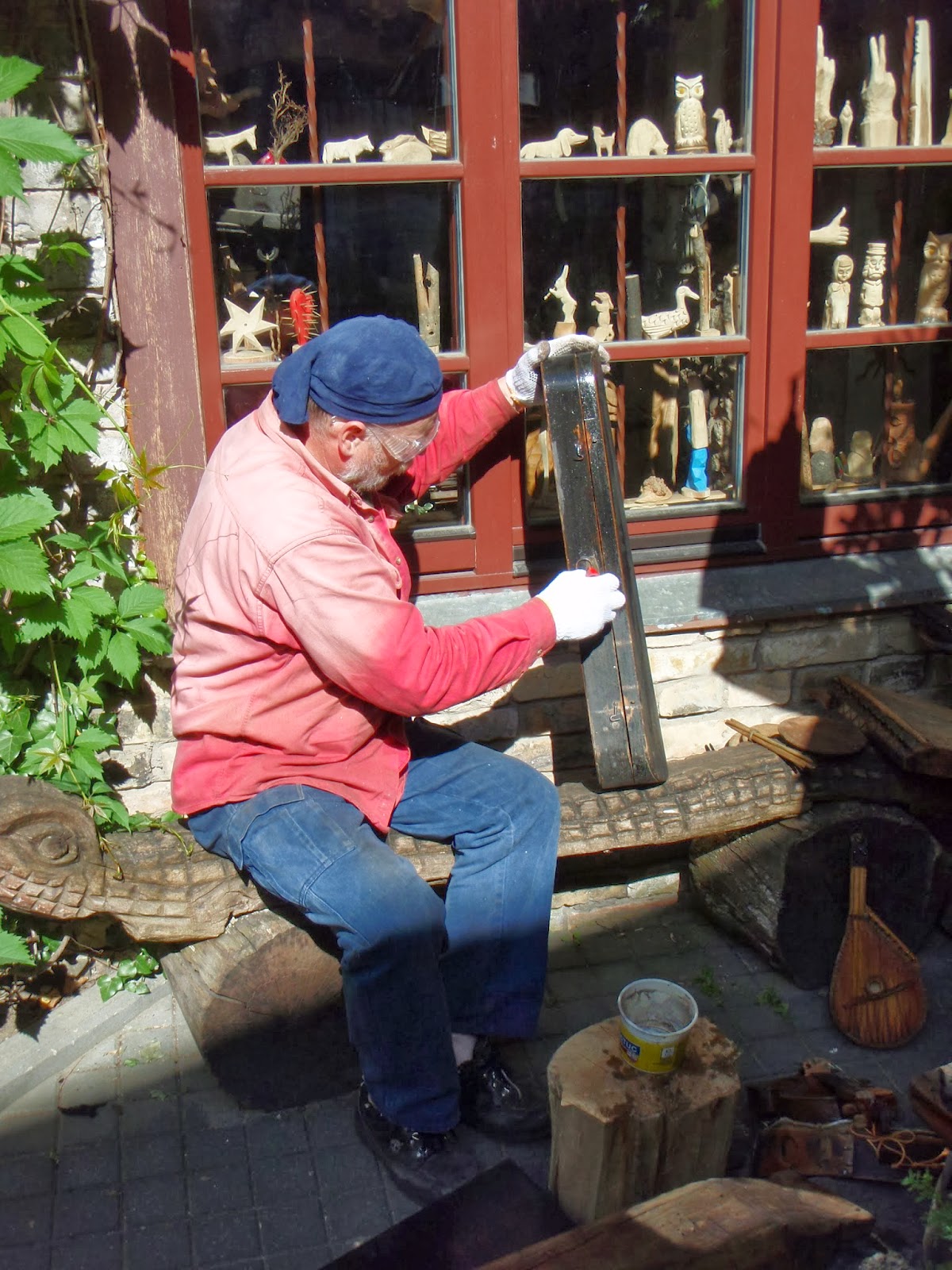
Passing through, I spot a carved wooden dwarf set back from the street, and am drawn by curiosity into a beautiful compact courtyard dotted with shady trees.

In a corner sits a white-haired man in a bandana, oiling a violin. I step past him into an art gallery, whose doors are studded with curious wooden sculptures resembling hands and insects.

The interior reveals more of these rough-hewn carved pieces, mostly resembling folkloric figures: animals, mythical creatures, stars, and villagers.

There’s something very appealing about their simple, primitive look. I’d read that Lithuania was the last country in Europe to give up pagan worship, and these figures seem to be a link to an era of belief in spirits and nature.

It’s something to ponder as I enter St Teresa’s, an extravagantly decorated church a little further on. Vilnius is famous for its numerous baroque churches, and this one doesn’t disappoint.

Outside it’s impressive, inside it’s spectacular. Gilt paint is lavished everywhere, especially on the elaborate frames highlighting statues and paintings of saints.

As I sit and take it in, visitors come and go, each footstep echoing through the cavernous space.

To my left, a small group of women, some wearing colourful headscarves, are making a procession from one statue to the next around the walls, chanting as they go.

The combination of the chanting, the natural light and the gilt splendour is surprisingly moving, and I’m surprised how calm I feel. I’m not at all religious, but I can see how this atmosphere aids a meditative state of mind.

But the material world awaits just down the street...

[Next post: Passport pouches, a miracle tile, and the den of the KGB...]

Thursday, 23 July 2009

Red Menace: Communist-Era Relics

I was recently writing an article on Vilnius, Lithuania, which started me thinking about all the former communist countries I've visited in Central and Eastern Europe.

I love those places.

For me, coming from Australia, it feels just like encountering stereotypical "Europe", with its ruined castles, cobblestone squares and art treasures - but it's an alternative Europe in a strange parallel dimension, which includes curious relics of the communist era, left high and dry when the socialist tide ran out in 1989.

That's why I often recommend that visitors to Europe skip the well-trodden tourist paths in the west and go straight to the good stuff. I'm talking about the weird and wonderful cities of the former communist bloc, with their gigantic concrete monuments, vast housing blocks and oversized cultural institutions.

It's freaky and it's fun. Or maybe I'm just perverse. In either case, here's a countdown of the top ten communist relics I've visited in my travels - with images!

10. Hideous Hotels across Poland. The now-privatised travel organisation Orbis controlled Poland's major hotels in the days of the communist regime, and added some fairly ugly additions to the existing stock. Below, for example, is the exterior of the Hotel Arkona in Szczecin, sadly demolished since I took this photo in May 2008 (watch it go!).


The management hoped the new trouser press would raise the tone of their hotel.

9. Soviet Trains, Vilnius, Lithuania. Judging from my day trip to the attractive castle at Trakai, Lithuania is still operating trains inherited from its enforced stay within the Soviet Union. They're big, clunky, and kinda cool to look at. Because the USSR had a completely different rail gauge from the rest of Europe, possibly aimed at foiling invaders, it's caused no end of hassle in linking the three Baltic states to the rest of the EU by rail.


"The struggle of class against class is a political struggle," said Thomas the Revolutionary Engine.

8. Fallout Shelter, Szczecin, Poland. This sprawling complex of tunnels, entered by a nondescript door beneath a platform at Szczecin Główny train station, was originally built by the Nazi regime when Szczecin was the German city of Stettin. But the Polish communists converted it into a Cold War shelter, and today you can go on a tour through the eerie labyrinth, which looks much as it did in the good old days of prospective nuclear annihilation.


Marek thought he might have overdone it a bit with the low-carb diet.

7. Green Bridge, Vilnius, Lithuania. This bridge, constructed in the 1950s, is a rare example of socialist realist art still in its original location. At each of its corners, a pair of statues stands forth, proud and purposeful, showing the way to the socialist future. They're extremely irony-inducing, given their placement near the most fashionable shopping boulevard in the city, and make excellent photographic subjects.


Piotr longed for Dimitri to realise they were more than special friends.

6. Socialist Realist Gallery, Kozłówka, Poland. This tiny village north of Lublin plays host to the Zamoyski Palace, once the home of 18th century aristocrats. But it's the Socialist Realist Gallery which is our focus here. This museum was originally an annexe of the palace, used as a storage area for truckloads of Stalinist art when the dictator was repudiated after his death. Arranged in an attractive jumble, with stirring anthems playing over the sound system and heroic statues dotted through the gardens, the collection makes an entertaining side-trip.


Lenin wondered if he should improvise a little twirl at the end of the catwalk.

Next week: The countdown continues - what will be named the top communist relic? Be here for the socialist showdown!

[To see the final five relics, click here]

Wednesday, 22 October 2008

Familiarity Breeds Content

I was in a train station when the revelation hit me.

But before I get to that, let me backtrack to the previous evening. I’d been in Vilnius, the capital of Lithuania for a few days, and was waiting outside the main train station for the overnight bus to Warsaw, Poland.

There were no benches nearby so I seated myself on a lower step. It was an interesting place to loiter.

It was an early Saturday evening so young people were on their way out of the station for a night on the town, others were returning home after a day out, and in front of me a steady stream of trolleybuses was picking up and dropping off passengers, including the occasional trademark Eastern European old lady with a scarf around her head.

After a while, a few more people started hanging around the bus stop sign. First up was a young slim guy with a long ratty ponytail, and what appeared to be his mother and younger sister, towing a lime green suitcase. I drifted into eavesdropping range and detected Polish being spoken, so dropped in a few words about going to Warsaw. We all nodded.

It is strange how little change of perspective is needed to make people into kindred spirits. In Poland I was the foreigner, trying to understand the place and its people; but in Vilnius the Poles and I were all outsiders, having to get by with English because we didn’t know the local language.

The bus tore off through the night about 10pm, scheduled to stop only at Lithuania’s second city Kaunas and the eastern Polish city of Bialystok on its way to Warsaw. I was awake as we crossed the border, and was amazed to see the complex of customs houses, sidings and truck bays I’d dozed through a few days earlier.

What was more remarkable was the way in which we ignored these empty buildings and joined a convoy of trucks threading their way between them. As both nations are now part of the border-free Schengen zone, there are no border crossing formalities between them. Bypassing the redundant border checkpoints was an exhilarating experience – as borders are imaginary lines set by humans, so may they dissolve.

But that wasn’t the moment of revelation. About 5.30am we pulled into the bus bay behind Warszawa Centralna, Warsaw’s communist-era main train station. I walked into the lofty ticket hall, bought a ticket to Lublin, the next city on my Polish itinerary, then took the escalator into the labyrinth of corridors that run beneath the station.

Low-ceilinged, lined with dozens of shops, and linked to further pedestrian tunnels leading to tram and bus stops, these corridors are inherently disorientating. But I realised, as I walked through them, that I’d finally (after many years) worked out their basic configuration.

I strode unerringly to a particular cafe I was looking for, and stepped in just as they were opening. I ordered the same coffee I always ordered there, then sat in the same chair at the same table I always sit in when I’m killing time before a train journey from Warszawa Centralna.

That’s when I realised how completely at ease I felt there. I was so used to the place and how it worked, that I might as well have been a resident of Warsaw. And, it occurred to me, I visit Warsaw more often than a lot of places closer to home – I’ve visited the city on four occasions, for example, compared to the one time I’ve been to Brisbane.

So I seem to have lost the mild unease that usually accompanies travellers when they head into a foreign country – that frisson of irrational fear when surrounded by an alien culture.

I assumed, on reflection, that I’d now travelled widely and often enough that it had withered away, leaving behind a lively but assured interest. Also that I now felt experienced enough with new places to deal with their differences without any conscious effort.

It was an interesting moment. But one I rather liked.

Saturday, 7 June 2008

Lithuania: Comfort Food Central

I've taken a short break from the Lonely Planet job in Poland, to venture across the border into Lithuania. It's a breeze now the two countries have joined the Schengen Agreement... my overnight bus just sped past the empty customs booths into Lietuva (as the locals call it).

It's my first foray into the territories of the defunct Soviet Union. And it's been a pleasant surprise. Vilnius, the capital, is a very likeable and attractive city. Its Old Town area is a maze of winding cobblestone laneways opening onto scenic squares dominated by baroque churches. This historic part of the city has clearly undergone major renovation and renewal since the drab days of the USSR.

The local food, however, is in a class of its own. I never thought I'd encounter a cuisine that makes Polish food look light and healthy, but this is it. Lithuanian food is weighty, filling and heavy on the pork and potatoes.

The prize exhibit is the cepelinas, a Lithuanian rendering of zeppelin, and this large football-shaped potato dumpling with a meat filling does indeed resemble a vintage airship. It's served with a choice of sauce, usually something involving butter, sour cream and pork crackling.

Even the local bar snacks are not for the fainthearted. Which would you prefer with your beer: deep-fried sticks of rye bread, or a smoked pig's ear?

Yes, it's comfort food with a vengeance. Which made me reflect on the comfort food items (heavy and filling, but not necessarily nutritious) I've stumbled across in other countries. Here's a quick selection:
  • Empanadas (Chile): Especially the deep-fried ones filled with tuna and cheese.
  • Placki Ziemniaczane (Poland): Thick, hot potato cakes wrapped around a goulash filling.
  • Bacon Sandwich (UK): Very simple, but for some reason no one can make these like the British can.
  • Pad Thai (Thailand): Tasty noodle dish that's often served with a fried egg on top.
  • Pannekoeken (Dutch, but eaten in Poland): Hefty pancakes cooked with ingedients like bacon or cheese embedded within.
  • And finally... my own country weighs in with the Pie Floater (Australia): Peculiar to Adelaide, a meat pie floating in a thick pea soup.
Hmm. If you'll excuse me, I'm off to order a green salad and a mineral water.