Showing posts with label cruise. Show all posts

Friday, 26 January 2018

Chile Summer Series: Glacier Cruise (Part 2)

Last post I described the beginning of a glacier cruise I took in southern Chile in 2006. Now the adventure continues...


On the second morning of the cruise we awoke to find the Pio XI glacier right outside our window. This is the largest glacier in South America, stretching back some 70 kilometres into the mountains.

If you saw this in a movie, you'd assume it was a special effect. Filling our field of vision is a cathedral of ice, ranging from pure white through blue shades to almost indigo depths.

Great vertical cracks resemble caves, promontories look like spires.

On its upper surface are projections like great crystals, and gigantic cracks hint from where the next giant chunk of ice will fall into the sea as the glacier makes its way down from the heights.

After a run in the ice-filled fiord in the excursion boat, we return to the ship and stand on the top deck as the Skorpios cruises parallel to the glacier’s cliff-like surface.

Every so often a chunk of ice breaks away and hits the water, with a deep crash and ensuing waves.

Standing there with a quiet sense of reverence, we all feel we’ve seen a major highlight of our travelling careers.

"Just look at it," says one of the Australian women. "Forget about photos. Look at it and carry it in your mind".

So we put down our cameras for a moment and just look.

And as we look, a barman sidles up with the inevitable brightly-coloured cocktails on a tray.

And so to Eden. Puerto Edén that is, a fishing village set in the middle of this chilly beauty.

It's strange to come across a settlement after travelling for days through areas with no evidence of human activity.

There are no roads in this part of Chile, and not even any streets in the town; instead, it has a series of raised boardwalks which lead around the village and up to a nearby lookout.

It's an attractive place, even in its obvious poverty. Fishing boats lie high and dry on the shore, brightly coloured with hand-painted names; fishing nets sit piled, ready for use; and the different coloured roofs are pleasing as they follow the curve of the bay.


The locals supplement their incomes by selling handcrafted souvenirs to visitors, mostly woven baskets and model boats made of wood or hide. We buy a few to pay our way.

Back on the ship, afternoon tea is served as Puerto Edén slips away in our wake, disappearing from sight as if it were never really there: like a South American Brigadoon.

Over the next few days we see more ice than you’d ever hope to meet, in an assortment of breathtaking glaciers. Each has its own distinctive formation: one even looks like a giant frozen meringue.

The mix of onboard treats and external adventure continues, typified by the Captain’s Ball whose buffet features animals carved from butter

Then for our final excursion, we go ashore and walk right up to the face of a glacier.

This seems to be the hallmark of the cruise: a neatly-judged balance of comfort and adventure.

Aboard we have pleasant cabins and plentiful food and drink, which are contrasted by frequent excursions to the rugged, primal wilderness outside.

Although the passengers are mostly a middle-aged bunch, I think it would work well with a family group, as there’s enough activity to keep kids occupied. And there are no unexpected costs, as the tariff includes all food and drink, even the alcoholic variety.

But that special glass of Scotch we had earlier - chilled by 50,000 year old ice from a glacier - may have spoiled me. Where’s the fun in drinking whisky with day-old ice, when you’ve had the really old stuff?

Information about Skorpios cruises can be found at skorpios.cl.

Friday, 19 January 2018

Chile Summer Series: Glacier Cruise (Part 1)

Over January I'm running a series of my previously published print articles about Chile, South America.

This article was first published in 2006, so some details may have changed, though the destination is still spectacular. For we're heading south to the glaciers of Patagonia...

Salud, dinero y amor! (To health, wealth and love!)

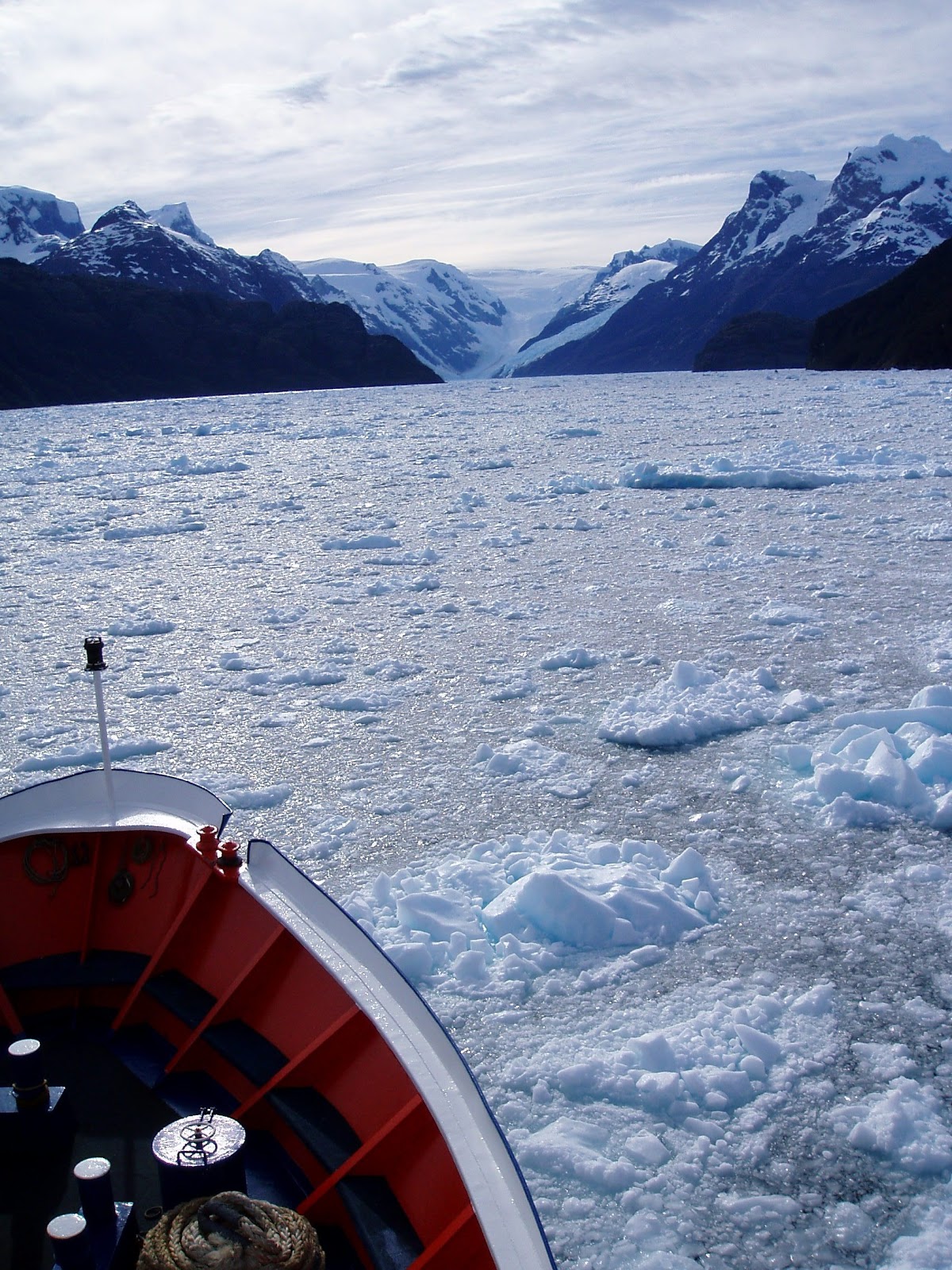
This is no idle toast. We’re on the third day of a cruise through the glaciers and fiords of southern Chile, and have left the comfortable confines of the ship to get among the ice.

Passengers are lined up on the long benches of the open-air excursion craft, lifejackets on, as the boat grinds through the small floating bergs.

Without warning, the pilot sails up to an iceberg, rams into its flank, and extracts a large chunk with the aid of an ice-pick.

A few minutes later we’re milling around, clinking glasses as we toast each other - with 12 year old Scotch containing 50,000 year old ice.

Sure, it’s a gimmick - but what a gimmick.

Not that southern Chile needs any help to be impressive. Beyond the warm central portion of the country, where most Chileans live, the landscape changes dramatically.

The roads run out, and the terrain breaks up into a rugged collection of islands, mountains and glaciers, jumbled together in an almost uninhabited part of South America.

Beyond this, the land becomes flat again, home to grazing herds of domesticated sheep and wild llamas, as it approaches Antarctica.

This southern region is known as Patagonia, and is still one of the great frontiers of tourism.

But the journey needn’t be too hard. We’ve booked passage on the Skorpios III, a cruise ship which plies the inland waters and ice fields of Chilean Patagonia, offering one of the few ways to explore this glacial wilderness.

Arriving at the Skorpios dock by road from the southern city of Punta Arenas, we meet our fellow passengers at dinner.

There are Chileans, Venezuelans, Mexicans, and a big contingent of Brazilians among them, with Australians, French, Germans and Spaniards making up the numbers.


This diversity means the cruise lacks the sterile feel of a package tour conducted for Westerners only. All tour commentary is conducted in both Spanish and English.

But before the ship leaves the port town of Puerto Natales, we’re taken on a coach trip to the Torres del Paine National Park, one of Chile’s great natural treasures.

The Paine Towers that give the vast park its name are a spectacular group of craggy volcanic outcrops among distant snow-capped mountains. They’re an unlikely backdrop to the green tones of springtime which appear below the snowline.


On the way through the park, we have frequent sightings of local wildlife: nandus (South American ostriches), guanacos (cousins of the llama) and most impressive of all, black condors.

The weather is perfect: clear blue skies and uninterrupted sunshine. Not for the first time, I'm amazed by how warm it is here at 52 degrees south.

Then we stop for lunch, and get our first taste of this company’s catering arrangements. We’re expecting a stale sandwich and a soft drink. What we get is a waiter shaking cocktails, then serving them from a tray in real glassware, followed by a full-scale barbecue and Chilean wine.


Returned to the ship, we set sail through attractive, tree-covered green hills giving way to rocky slopes at the water's edge, with massive icy mountains beyond. As we progress toward the glaciers, chunks of ice float past us.

Picturesque though it is, I’m struck by the lack of human activity - there's simply no-one here. There’s something very relaxing in that thought. Not the first time, I'm glad I didn't bring my phone along...

Next: Much more ice, a remote village and the Captain's Ball...

Saturday, 15 July 2017

The Curious Case of Juneau, Alaska

In Juneau I was hosted by Travel Juneau, and I travelled there courtesy of the Alaska Marine Highway.

I've just spent three nights in one of the oddest little cities I've ever visited: Juneau, located in the southeast strip of Alaska that stretches alongside Canada's province of British Columbia.

Why is it such a curious delight? Let me give you some examples.

1. You can't drive to Juneau.

Although it's Alaska's second-largest city, you can only reach it by air or sea - the mountains around it have so far proved impenetrable to road-builders. So I arrived aboard the ship you can see below, the MV Matanuska. Built in the 1960s, it's one of the vessels of the Alaska Marine Highway, a network of ferry routes which stretches from Washington state all the the way north and west to the far-flung Aleutian Islands.

img-alternative-text

2. The gardens grow upside-down.

Well, not exactly. But at Glacier Gardens just outside Juneau, the gardeners have utilised upturned old tree trunks to create these strangely alluring elevated flower beds. It's also worth visiting for the golf cart tour they offer, heading high up along the slopes of the surrounding rainforest.

img-alternative-text

3. It's the political hub of Alaska.

Although Juneau can't be reached by road, and is located in the far southeast of the state, the city is the capital of Alaska. It's held that status since the 19th century, though there have been attempts to move the seat of government elsewhere. For the time being though, the State Capitol stands proudly in the heart of the city - a city often visited by bears in the middle of the night.

img-alternative-text

4. Its location used to be in Russia.

In the late 19th century, concerned about the vulnerability of its North American possession, the Russian Empire agreed to sell Alaska to the USA. In 1867 the territory was handed over with due ceremony in the Russian-era capital of Sitka - an event duly recorded in the exhibitions of the Alaska State Museum in Juneau (see below).

Naturally, as the museum notes, the indigenous Native Alaskans protested the sale; as the Russians were giving away a place they had never fully conquered, and which had seen millennia of prior occupancy.

img-alternative-text

5. The Russian presence lingers.

Across southeastern Alaska there are traces of Russia's time in Alaska, most visibly the presence of Russian Orthodox churches. The oldest still standing is St Nicholas' Church in Juneau, a picturesque timber structure above the city's commercial core.

img-alternative-text

6. There's a shop selling a comprehensive range of Hawaiian goods.

I don't even begin to understand this. But here it is.

img-alternative-text

Friday, 24 March 2017

Symphony on Port Phillip Bay

I was hosted by Crystal Cruises for this visit.

I'm not much of a fan of large sea-going cruise ships, though I've been on some smaller river cruises that I've enjoyed.

That doesn't mean I won't have a peek aboard a large cruise ship when I get the chance. In January I was invited with a bunch of other travel writers aboard the Crystal Symphony, which was anchored at Port Melbourne's Station Pier preparatory to a major cruise.

It's a big vessel:


After going through security and boarding the ship, we were split into groups and were led on an informal tour. Our tour leader was a Swiss musician who performs for the passengers by night, and had volunteered to show us around.

The attention to detail in the vessel's interior design was impressive; evolving the golden age of ocean liners with a hint of Art Deco, but not so much as to make it look like a movie set:


I particularly liked the "@" symbol set in marble at the entrance of the computer room:


And the cinema looked pretty cool as well:


We ended up in this ambient bar, having a afternoon tea:


Looking out from the deck, I could see this lettering on the roof of the pier way below:


Seems an appropriate message for those arriving at Station Pier, where many new arrivals in the great postwar wave of migration had their first glimpse of Australia. Passengers on the Crystal Symphony are more well-heeled, but the message still applies. 

For more about the Crystal Symphony, visit this link.