I was hosted on this trip by the Hong Kong Tourism Board.
When I visited Hong Kong last year, I spent an afternoon at PMQ.
Opened in 2014, this arts and design hub is housed within the former Police Married Quarters from the British colonial era.
The complex contains workshops, galleries, pop-up shops and food outlets, housed within two seven-storey blocks remaining from the original institution.
These wings are linked by a modern structure called QUBE, which has a rooftop garden.
It's interesting to wander around the complex, up and down between the floors. There's always something new to see in each shopfront.
For an article I was writing, I talked to some young designers who were able to get a start in otherwise-expensive central Hong Kong by taking on a shop in PMQ.
One, Coney Ko [pictured left], designs and sells jewellery with a retro look reminiscent of Art Deco. Another, Yeung Chi, is an award-winning fashion designer.
It's a fascinating place to visit, both for its outlets and its heritage. To learn more about the latter, you can join a regular free PMQ Heritage Interpretation Guided Tour.
For tour bookings and more information, visit the PMQ website.
Showing posts with label China. Show all posts
Friday, 8 June 2018
Friday, 17 March 2017
Comics in Hong Kong
I was hosted on this trip by the Hong Kong Tourism Board.
On my final day in Hong Kong, I had most of the day free before I needed to head to the airport. I'd researched all the stories I was commissioned to write, so the question was: what to do?
First up, I needed coffee, so I headed to Espresso Alchemy in Quarry Bay (4 Hoi Wan St). I'd been tipped off to this small coffee chain by the day before, and had let them know I'd be dropping by.
Even so, I was surprised to discover its owner had an Aussie accent. I had a coffee with Ambrose Law, the owner, who was brought up in Australia and has done well building up his roastery and cafes in Hong Kong:
Being suitable caffeinated (and I liked Espresso Alchemy's coffee, they know what they're doing there), I headed west via Hong Kong's crazy double-decker trams to Wan Chai.
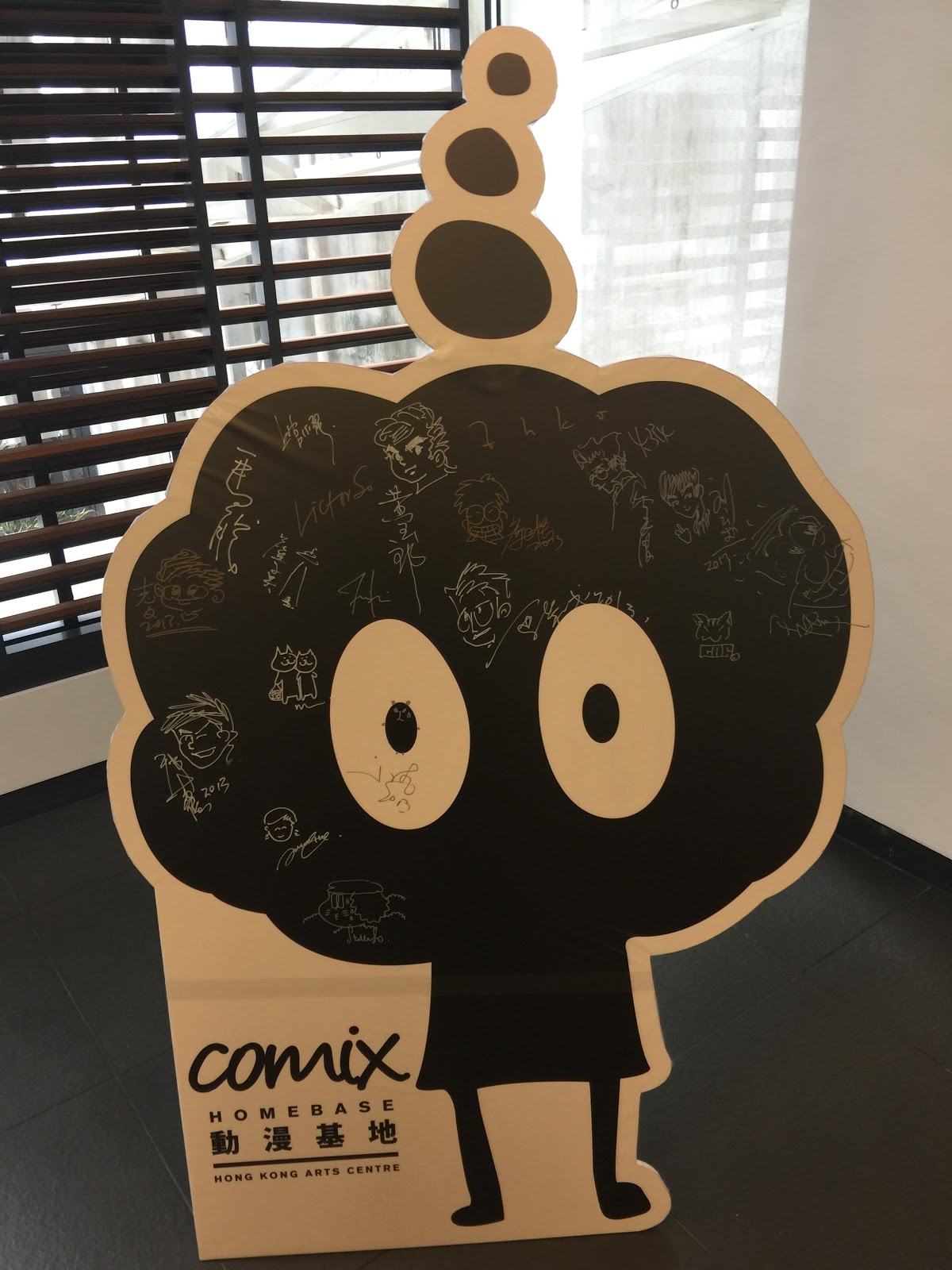
I'd remembered this was where I'd find Comix Home Base, a place I'd stumbled across earlier in my research.
As a comic book fan, this place was always going to be of interest. Devoted to both traditional comic books and animation, it's a small arts hub arranged around a light-filled courtyard.
The architecture is of more than passing interest, because the complex was created within the facades of ten tenement houses which were built a century ago, between 1916 and 1922.
Constructed under British colonial rule, the houses had an interesting combination of Chinese and western architectural features, such as Chinese tiled roofs and French doors. Some of this original style can be seen by crossing a walkbridge from the main block to the facades on the opposite side:
Inside the main building there are various rooms used for exhibitions and conferences, not all of them open to the general public. However, there are always anime movies playing, which you're welcome to sit down and enjoy:
The other great facility for visitors is the Comix Salon, down a passage from the viewing area:
This marvellous haven is a small reading room, its shelves stacked with comic books from around the world - Asia, Europe, North America:
I picked out a few collections of my favourite characters (I'm a DC guy from way back, not Marvel) and settled down for a read.
On the way out I passed Old Master Q, a character created by Hong Kong artist Alfonso Wong under the pen name Wong Chak:
The character first appeared in print in 1962, and his humorous adventures acted as a medium by which to indirectly explore political and social issues. The character stayed popular throughout the artist's life, which only ended recently; he passed away on 1 January 2017.
So that was Comix Home Base - a rest stop and an education all in one. If you're a comic book or animation fan, I recommend it when you visit Hong Kong.
Comix Home Base is located at 7 Mallory St, Wan Chai, Hong Kong, China. Open 10am-8pm daily (Comix Salon noon-8pm, closed Monday). More details at its website.
On my final day in Hong Kong, I had most of the day free before I needed to head to the airport. I'd researched all the stories I was commissioned to write, so the question was: what to do?
First up, I needed coffee, so I headed to Espresso Alchemy in Quarry Bay (4 Hoi Wan St). I'd been tipped off to this small coffee chain by the day before, and had let them know I'd be dropping by.
Even so, I was surprised to discover its owner had an Aussie accent. I had a coffee with Ambrose Law, the owner, who was brought up in Australia and has done well building up his roastery and cafes in Hong Kong:
Being suitable caffeinated (and I liked Espresso Alchemy's coffee, they know what they're doing there), I headed west via Hong Kong's crazy double-decker trams to Wan Chai.
I'd remembered this was where I'd find Comix Home Base, a place I'd stumbled across earlier in my research.
As a comic book fan, this place was always going to be of interest. Devoted to both traditional comic books and animation, it's a small arts hub arranged around a light-filled courtyard.
The architecture is of more than passing interest, because the complex was created within the facades of ten tenement houses which were built a century ago, between 1916 and 1922.
Constructed under British colonial rule, the houses had an interesting combination of Chinese and western architectural features, such as Chinese tiled roofs and French doors. Some of this original style can be seen by crossing a walkbridge from the main block to the facades on the opposite side:
Inside the main building there are various rooms used for exhibitions and conferences, not all of them open to the general public. However, there are always anime movies playing, which you're welcome to sit down and enjoy:
The other great facility for visitors is the Comix Salon, down a passage from the viewing area:
This marvellous haven is a small reading room, its shelves stacked with comic books from around the world - Asia, Europe, North America:
I picked out a few collections of my favourite characters (I'm a DC guy from way back, not Marvel) and settled down for a read.
On the way out I passed Old Master Q, a character created by Hong Kong artist Alfonso Wong under the pen name Wong Chak:
The character first appeared in print in 1962, and his humorous adventures acted as a medium by which to indirectly explore political and social issues. The character stayed popular throughout the artist's life, which only ended recently; he passed away on 1 January 2017.
So that was Comix Home Base - a rest stop and an education all in one. If you're a comic book or animation fan, I recommend it when you visit Hong Kong.
Comix Home Base is located at 7 Mallory St, Wan Chai, Hong Kong, China. Open 10am-8pm daily (Comix Salon noon-8pm, closed Monday). More details at its website.
Posted by
Tim Richards
at
06:00
Friday, 3 March 2017
Bloody Mary of Macau
As research for this post, I was shouted drinks by the St Regis Macao. It's a tough job etc.
We're all familiar with the Bloody Mary. It's a cocktail containing vodka, tomato juice and various combinations of spices or and/or sauces.
French barman Fernand Petiot claimed to have invented it at Harry's New York Bar in Paris in 1921, though that has been disputed.
What seems clear, however, is that Petiot refined the Bloody Mary into its modern form in 1934, in his stint as a barman at the King Cole Bar at New York City's St Regis Hotel (a bar which still exists today).
Since then the St Regis has taken a particular pride in the drink, with each of its hotels around the world creating its own version.
This man in the bar of the St Regis Macao whipped up the local variant for me:
And here it is close up, the Maria Do Leste - a Bloody Mary inspired by the former Portuguese colony which is now China's casino hub:
There was quite a bit going on, on that tray. Firstly, the tray itself, which resembled the wavy cobblestoned squares of Macau's historic Old City.
Secondly, there were food items associated with the region's Portuguese heritage, including a warm lobster egg tart and a slice of chouriço.
Thirdly, the spices (both inside and outside the drink) include pink peppercorns from Brazil, piri piri from Africa, cinnamon and paprika from India, black vinegar and black peppercorns from China, and sea salt.
If you're wondering what the connection might be between these geographically diverse ingredients, it's this: they were all from places where Portugal had colonies, and thus drifted into Macau's local cuisine via trade.
Although that tray did seem a bit busy, I enjoyed the invitation to add the vodka, Tabasco sauce, lime juice, sea salt and pink peppercorns to the level of my own liking (OK, I did add all the vodka).
I enjoy a bit of local innovation in hotel cocktail menus. A couple of years ago I was staying at the the famous Raffles in Singapore, home of the Singapore Sling, when it launched a new set of cocktails commemorating key moments in the hotel's long history.
If you're heading to Macau, I recommend the Maria Do Leste to you. Cheers! Or even À nossa!
You can find the St Regis Macao at Estrada Do Istmo S/N, Cotai, Macau.
We're all familiar with the Bloody Mary. It's a cocktail containing vodka, tomato juice and various combinations of spices or and/or sauces.
French barman Fernand Petiot claimed to have invented it at Harry's New York Bar in Paris in 1921, though that has been disputed.
What seems clear, however, is that Petiot refined the Bloody Mary into its modern form in 1934, in his stint as a barman at the King Cole Bar at New York City's St Regis Hotel (a bar which still exists today).
Since then the St Regis has taken a particular pride in the drink, with each of its hotels around the world creating its own version.
This man in the bar of the St Regis Macao whipped up the local variant for me:
And here it is close up, the Maria Do Leste - a Bloody Mary inspired by the former Portuguese colony which is now China's casino hub:
There was quite a bit going on, on that tray. Firstly, the tray itself, which resembled the wavy cobblestoned squares of Macau's historic Old City.
Secondly, there were food items associated with the region's Portuguese heritage, including a warm lobster egg tart and a slice of chouriço.
Thirdly, the spices (both inside and outside the drink) include pink peppercorns from Brazil, piri piri from Africa, cinnamon and paprika from India, black vinegar and black peppercorns from China, and sea salt.
If you're wondering what the connection might be between these geographically diverse ingredients, it's this: they were all from places where Portugal had colonies, and thus drifted into Macau's local cuisine via trade.
Although that tray did seem a bit busy, I enjoyed the invitation to add the vodka, Tabasco sauce, lime juice, sea salt and pink peppercorns to the level of my own liking (OK, I did add all the vodka).
I enjoy a bit of local innovation in hotel cocktail menus. A couple of years ago I was staying at the the famous Raffles in Singapore, home of the Singapore Sling, when it launched a new set of cocktails commemorating key moments in the hotel's long history.
If you're heading to Macau, I recommend the Maria Do Leste to you. Cheers! Or even À nossa!
You can find the St Regis Macao at Estrada Do Istmo S/N, Cotai, Macau.
Wednesday, 22 February 2017
A Walk on the Kowloon Side: History Tour of Hong Kong
I was hosted on this tour by the Hong Kong Tourism Board.
If there's something we travel writers like, it's the word "new". If something is new there's a good chance it hasn't been written about much, and that turned out to be the case with Asiascene's new Stories of the Place tour.
Rather than being a walking tour, it's a bus tour with a fair amount of leisurely walking within the sights it visits. It loosely links together four historic places on the Kowloon side of Hong Kong's Victoria Harbour, all attractions that could easily be overlooked by the traveller.
The first, and most interesting to me, was Kowloon Walled City Park. I knew nothing about Kowloon Walled City before researching this trip, but it turned out to one of those weird quirks of history which I find absolutely fascinating.
Basically, the site started as an Imperial Chinese fort, which was retained by China in 1898 after it leased the New Territories north of Kowloon to Britain. This left a little island of Chinese sovereignty within a sea of British colonial rule.
As the decades rolled on, the Chinese emperor was deposed, there was civil war, the Second World War, and various other shocks such as the Cultural Revolution. This drew China's attention away from Kowloon Walled City, and it found itself unable to exercise its rule there.
At the same time, the British authorities were loathe to interfere within its walls. So the walled city became a strange, lawless enclave, being built ever higher (and more dodgily) as time went on and it filled with refugees from the mainland.
By the 1980s, just before it was cleared out and levelled by agreement between the UK and China, it housed 30,000 people and looked as this model on the site suggests:
Once this strange shanty city was demolished, archaeologists were able to undertake digs to locate fragments of the site's military past, and I saw evidence of this through the park:
Intriguing. There were more recent memories on display in buildings throughout the park, including a series of audiovisual recordings of former residents discussing their lives in Kowloon Walled City.
Our second stop was at another serene set of greenery, the Nan Lian Garden. This land belonged to an adjacent Buddhist nunnery which bought it over eighty years ago. They'd always planned to develop a traditional garden here, but China's troubles again meant the space became home to refugees from diverse conflicts.
In the fairly recent past the land was cleared of its structures and finally the garden could be developed, in the style of China's Tang Dynasty. A very beautiful and peaceful place it is too; as is the attached Chi Lin Nunnery which we walked through to after the garden:
The final stop of the tour was the Tin Hau Temple. This Taoist temple is dedicated to the god of the sea, a very relevant deity to a people living near a shore from which they fished and set forth on trading ships.
It's a small but spiritual place, full of the aroma of incense and the bright colours of its decor:
This historic structure, the smallest and oldest of the sights on the tour, provided an appropriately humble finale to a tour reaching back into Kowloon's relatively recent and eventful past.
The Stories of the Place tour takes place on Tuesdays and Thursdays, fee HK$490 (about A$80) per person. Find more information and make bookings at this link.
If there's something we travel writers like, it's the word "new". If something is new there's a good chance it hasn't been written about much, and that turned out to be the case with Asiascene's new Stories of the Place tour.
Rather than being a walking tour, it's a bus tour with a fair amount of leisurely walking within the sights it visits. It loosely links together four historic places on the Kowloon side of Hong Kong's Victoria Harbour, all attractions that could easily be overlooked by the traveller.
The first, and most interesting to me, was Kowloon Walled City Park. I knew nothing about Kowloon Walled City before researching this trip, but it turned out to one of those weird quirks of history which I find absolutely fascinating.
Basically, the site started as an Imperial Chinese fort, which was retained by China in 1898 after it leased the New Territories north of Kowloon to Britain. This left a little island of Chinese sovereignty within a sea of British colonial rule.
As the decades rolled on, the Chinese emperor was deposed, there was civil war, the Second World War, and various other shocks such as the Cultural Revolution. This drew China's attention away from Kowloon Walled City, and it found itself unable to exercise its rule there.
At the same time, the British authorities were loathe to interfere within its walls. So the walled city became a strange, lawless enclave, being built ever higher (and more dodgily) as time went on and it filled with refugees from the mainland.
By the 1980s, just before it was cleared out and levelled by agreement between the UK and China, it housed 30,000 people and looked as this model on the site suggests:
Once this strange shanty city was demolished, archaeologists were able to undertake digs to locate fragments of the site's military past, and I saw evidence of this through the park:
Intriguing. There were more recent memories on display in buildings throughout the park, including a series of audiovisual recordings of former residents discussing their lives in Kowloon Walled City.
Our second stop was at another serene set of greenery, the Nan Lian Garden. This land belonged to an adjacent Buddhist nunnery which bought it over eighty years ago. They'd always planned to develop a traditional garden here, but China's troubles again meant the space became home to refugees from diverse conflicts.
In the fairly recent past the land was cleared of its structures and finally the garden could be developed, in the style of China's Tang Dynasty. A very beautiful and peaceful place it is too; as is the attached Chi Lin Nunnery which we walked through to after the garden:
The final stop of the tour was the Tin Hau Temple. This Taoist temple is dedicated to the god of the sea, a very relevant deity to a people living near a shore from which they fished and set forth on trading ships.
It's a small but spiritual place, full of the aroma of incense and the bright colours of its decor:
This historic structure, the smallest and oldest of the sights on the tour, provided an appropriately humble finale to a tour reaching back into Kowloon's relatively recent and eventful past.
The Stories of the Place tour takes place on Tuesdays and Thursdays, fee HK$490 (about A$80) per person. Find more information and make bookings at this link.
Saturday, 18 February 2017
My Favourite Place in Macau
I travelled to Macau courtesy of the Macao Government Tourism Office and Cathay Pacific.
I've just spent four days in Macau, the former Portuguese territory which returned to Chinese rule in 1999, along the same lines that Hong Kong had two years before that.
You wouldn't think four days would be long enough in a new place to adopt a favourite spot. But I did, on my first afternoon there.
For the first two days I was based in the Old City, the oldest part of the territory on the Macau Peninsula. After that I moved to the conjoined islands of Taipa and Coloane, with the casino zone of Cotai between them.
On my first afternoon I had some free time, so I wandered around the heart of the Old City. This area, with its key landmarks of the Monte Fort, the ruins of St Paul's and Senado Square, is packed with tourists. That's understandable, as it's a very scenic district.
To the immediate southwest, however, the tourists largely vanish. That's probably because the terrain suddenly becomes quite steep. But my Lonely Planet guide said there was an interesting building up there, the Sir Robert Ho Tung Library; so I started trudging upward.
Sir Robert was a gent from Hong Kong who once lived in this attractive house, then left it to Macau to be used as a library.
It was indeed a beautiful building, inside and out. But what truly caught my eye was the square it faced: Largo de Santo Agostinho, or St Augustine's Square. It was a lovely little space, serene on this sunny Monday afternoon.
But it was the square itself I couldn't help returning to. Later in the week, I grabbed another hour to head up that steep slope to the Largo de Santo Agostinho, and sat writing postcards which the kiosk girl sold me from a dusty curling pile of neglected stock.
I've just spent four days in Macau, the former Portuguese territory which returned to Chinese rule in 1999, along the same lines that Hong Kong had two years before that.
You wouldn't think four days would be long enough in a new place to adopt a favourite spot. But I did, on my first afternoon there.
For the first two days I was based in the Old City, the oldest part of the territory on the Macau Peninsula. After that I moved to the conjoined islands of Taipa and Coloane, with the casino zone of Cotai between them.
On my first afternoon I had some free time, so I wandered around the heart of the Old City. This area, with its key landmarks of the Monte Fort, the ruins of St Paul's and Senado Square, is packed with tourists. That's understandable, as it's a very scenic district.
To the immediate southwest, however, the tourists largely vanish. That's probably because the terrain suddenly becomes quite steep. But my Lonely Planet guide said there was an interesting building up there, the Sir Robert Ho Tung Library; so I started trudging upward.
Sir Robert was a gent from Hong Kong who once lived in this attractive house, then left it to Macau to be used as a library.
It was so serene, in fact, that one occupant of the benches against St Augustine's Church was dozing, her head supported by her backpack:
There was a little kiosk at one end of the square, that sold odds and ends such as instant coffee and sweets. And off to one side there was a thoughtful amenity for canine locals, a dog WC:
Beyond this facility, beneath apartments, I could see a cafe named Bless. It seemed an apt name for a cafe facing a church.
I sat inside for a little while, and had a very creditable cheese and avocado sandwich, which this industrious guy put together for me:
No one sends postcards anymore I suppose. But somehow this square, with its generous shaded seating, its seemingly unprofitable kiosk and its sleepy vibe felt like a holdover from a more peaceful age.
Posted by
Tim Richards
at
01:56
Friday, 19 December 2014
Asia Summer Series: Shanghai, China (Part 2)
Over December and January, I'm running a series of my previously
published print articles on Asia. Last week I described my journey to Shanghai's Old Town. The adventure continues (there will be dumplings. And tea.)...
Old Street is in constant motion, with crowds of eager shoppers crowding the narrow pavements, cars and bikes passing through, and young men politely assailing me with sales pitches.
They brandish picture cards with images of items including suits and watches, so I can indicate what they should lead me to. Shopkeepers also call out as I pass by, though I’m surprised to find that they’re not overly pushy and will take no for an answer.
There are also food stalls, and strolling vendors selling a popular treat on a humid day - melon on a stick. It’s really as straightforward as that, a long slice of watermelon threaded onto a piece of wood.
On my way along the street I spot shops selling tea, clothing, and products involving Chinese calligraphy. Then I strike the mother lode - a stall containing a range of items from the attractive to the frankly ridiculous. Many of the latter involve Mao Tse Tung, China’s communist leader from 1949 to 1976.
Never one to avoid an amusingly tacky gift, I pick up a small red wind-up alarm clock featuring an image of Mao, with his arm frantically waving his Little Red Book at the masses.
I also fancy a set of playing cards with interwar Shanghai posters, another set depicting a bizarre 1970s ballet involving women with guns, and a relatively tasteful set of worry balls featuring a dragon and a phoenix. There’s also a dragon bracelet that’ll be too small for Narrelle, but will sit well in her collection of decorative dragons.
The ensuing bout of haggling is carried out by myself and the cheerful saleswoman passing a calculator back and forth, taking turns to punch in our bids. As is traditional everywhere in the markets of the developing world, these figures are accompanied by expressions of mock-anguish and gasps of disbelief. Finally, the bargain is struck, somewhere halfway between our opening amounts.
Having exhausted my desire to shop, I wander further along the street, fending off offers of antiques and dodgy Rolexes. Then I notice a sign above a doorway, inscribed “Old Shanghai Tea House”.
One floor up, in a long narrow room above several shops, is a magnificently atmospheric tea house, with jade-green tables on timber floorboards, lined with small windows overlooking the busy street. On the far wall is an eclectic collection of objects from pre-World War II Shanghai, including vinyl records, posters and a Singer sewing machine.
There are some mysteries I have to work out here. On the menu, the tea looks expensive, but the waitress refills my cup of fresh jasmine with hot water several times during the afternoon. The dumplings arrive on a decorative green plate, matched with a small white bowl of vinegar sauce, and are excellent.
I’m leaning against the windowsill, writing postcards and thinking that life is pretty good, when I receive a surprise of a musical nature. Halfway along the room, a man is setting up two traditional instruments- one a long stringed instrument called an erhu, the other a dulcimer-like arrangement known as a yangqin.
At first I’m not sure whether he’s playing an abstract tune or just tuning the equipment, but his purpose soon becomes clear. He dons a traditional robe, is joined by an accompanist, and they launch into a series of melodious Chinese tunes.
This is a bonus; I thought I was just getting a cup of tea and some dumplings. I sip my jasmine tea while I listen to this beautifully played music within a homage to Shanghai’s past, and feel truly delighted.
Then there’s an odd moment. After a series of Chinese melodies, the duo break into an instrumental version of Click Go the Shears.
I look up sharply in surprise, and the erhu player catches my eye. My expression says “I know where that song really comes from,” and his says “Let’s just keep that to ourselves”. And we exchange knowing smiles.
In this increasing cosmopolitan city with a vibrant international past, perhaps I shouldn’t be surprised to come across unexpected influences from abroad, moulded into a Chinese form.
Even a transplanted Australian folk song about shearers, played in the heart of Shanghai’s Old Town.
[Back to Part 1]
Disclosure time: On this trip I travelled courtesy of Shanghai Municipal Tourism and Helen Wong’s Tours.
Old Street is in constant motion, with crowds of eager shoppers crowding the narrow pavements, cars and bikes passing through, and young men politely assailing me with sales pitches.
They brandish picture cards with images of items including suits and watches, so I can indicate what they should lead me to. Shopkeepers also call out as I pass by, though I’m surprised to find that they’re not overly pushy and will take no for an answer.
There are also food stalls, and strolling vendors selling a popular treat on a humid day - melon on a stick. It’s really as straightforward as that, a long slice of watermelon threaded onto a piece of wood.
On my way along the street I spot shops selling tea, clothing, and products involving Chinese calligraphy. Then I strike the mother lode - a stall containing a range of items from the attractive to the frankly ridiculous. Many of the latter involve Mao Tse Tung, China’s communist leader from 1949 to 1976.
Never one to avoid an amusingly tacky gift, I pick up a small red wind-up alarm clock featuring an image of Mao, with his arm frantically waving his Little Red Book at the masses.
I also fancy a set of playing cards with interwar Shanghai posters, another set depicting a bizarre 1970s ballet involving women with guns, and a relatively tasteful set of worry balls featuring a dragon and a phoenix. There’s also a dragon bracelet that’ll be too small for Narrelle, but will sit well in her collection of decorative dragons.
The ensuing bout of haggling is carried out by myself and the cheerful saleswoman passing a calculator back and forth, taking turns to punch in our bids. As is traditional everywhere in the markets of the developing world, these figures are accompanied by expressions of mock-anguish and gasps of disbelief. Finally, the bargain is struck, somewhere halfway between our opening amounts.
Having exhausted my desire to shop, I wander further along the street, fending off offers of antiques and dodgy Rolexes. Then I notice a sign above a doorway, inscribed “Old Shanghai Tea House”.
One floor up, in a long narrow room above several shops, is a magnificently atmospheric tea house, with jade-green tables on timber floorboards, lined with small windows overlooking the busy street. On the far wall is an eclectic collection of objects from pre-World War II Shanghai, including vinyl records, posters and a Singer sewing machine.
I’m leaning against the windowsill, writing postcards and thinking that life is pretty good, when I receive a surprise of a musical nature. Halfway along the room, a man is setting up two traditional instruments- one a long stringed instrument called an erhu, the other a dulcimer-like arrangement known as a yangqin.
At first I’m not sure whether he’s playing an abstract tune or just tuning the equipment, but his purpose soon becomes clear. He dons a traditional robe, is joined by an accompanist, and they launch into a series of melodious Chinese tunes.
This is a bonus; I thought I was just getting a cup of tea and some dumplings. I sip my jasmine tea while I listen to this beautifully played music within a homage to Shanghai’s past, and feel truly delighted.
Then there’s an odd moment. After a series of Chinese melodies, the duo break into an instrumental version of Click Go the Shears.
I look up sharply in surprise, and the erhu player catches my eye. My expression says “I know where that song really comes from,” and his says “Let’s just keep that to ourselves”. And we exchange knowing smiles.
In this increasing cosmopolitan city with a vibrant international past, perhaps I shouldn’t be surprised to come across unexpected influences from abroad, moulded into a Chinese form.
Even a transplanted Australian folk song about shearers, played in the heart of Shanghai’s Old Town.
[Back to Part 1]
Disclosure time: On this trip I travelled courtesy of Shanghai Municipal Tourism and Helen Wong’s Tours.
Posted by
Tim Richards
at
06:00
Friday, 12 December 2014
Asia Summer Series: Shanghai, China (Part 1)
Over December and January, I'll be running a series of my previously
published print articles on Asia. First up, fabulous Shanghai...
I step out of the South Huangpi Road Metro station into 21st century China.
Nearby Huaihai Road, one of Shanghai’s stylish shopping streets, is filled with classy brand label stores, a Porsche dealership, and people clutching expensive-looking shopping bags.
Across the road, to my surprise, there’s even an Australian wool promotion taking place on an outdoor catwalk.
Then there’s a sudden movement in the vicinity of my shoes, so I divert my gaze from glamorous shopfronts to pavement level – where there’s a blob of black stuff on my right boot, and a man in a cheap blue suit smiling up at me.
It’s an arresting smile, as he’s missing several top teeth, which have been replaced by a gold bridge. The black blob is the calling card of the shoeshine man.
I may not have needed a shine before, but I do now, if only to remove the complimentary shoeshine. But this little piece of robust salesmanship is negotiated in good humour; we smile, haggle a little, and determine a fee of 10 yuan ($2.25) for the shining of my boots.
I lean on a handy advertising sign while the man places my feet alternately on a portable wooden platform, shining away to his heart’s content - all in the shadow of the Gucci store behind him.
Is this the Shanghai I expected? To be honest, my preconceptions of China are being challenged.
On the previous day I’d been bussed around modern Shanghai as part of a conference group.
We inspected huge modern buildings with quirky architecture, a dominating observation tower overlooking the historic buildings of the riverside Bund district, a soaring new bridge across the Huangpu River, and an exhibition devoted to an exhibition (Shanghai’s 2010 World Expo).
It was a day devoted to the large-scale and ultra-modern aspects of the city.
But what about human-scale Shanghai, the city where 20 million people live and shop and eat? Today I’m heading for the Old Town, to have a look at the remains of the coastal town that existed long before today’s rapid development.
After Britain’s victory against China in the Opium Wars of the mid-19th century, Shanghai evolved quickly into an international trading city. Silk, tea and opium flowed in and out of its port, making traders rich.
To facilitate this commerce, France, America and Britain ran their own colonial settlements along the Huangpu, known as concessions.
In walking east along Huaihai Road I’m leaving the former French Concession, with its attractive tree-lined avenues, and entering the Old Town. This district, contained within a perimeter of curving roads that echo its long-vanished city walls, is the oldest part of the city and a repository of tradition.
And it doesn’t take long for the old Shanghai to appear. As I turn off Huaihai Road and head south, the designer labels drop away and the streets narrow.
Bicycles and scooters weave between taxis, and crossing the road becomes an exercise in Zen-like concentration - one must sense the space opening up between vehicles and calmly step through it.
Turning east onto Dajing Road, I enter an older world of crumbling pavements, and roadside sales of fruit and vegetables. Passing an old Taoist temple and a nearby pavilion, I’m finally on Old Street, a long, bustling street packed with small shops.
The low buildings are decorated in the style of the Qing dynasty, with the distinctive tiles and upturned eaves synonymous with traditional Chinese architecture.
Though many of the buildings are newly restored, the narrow alleyways leading off the street are the real thing, funnelling strollers, deliverymen and bicycle riders through crooked routes linking major roads.
Old Street is in constant motion, with crowds of eager shoppers crowding the narrow pavements, cars and bikes passing through, and young men politely assailing me with sales pitches.
They brandish picture cards with images of items including suits and watches, so I can indicate what they should lead me to.
Shopkeepers also call out as I pass by, though I’m surprised to find that they’ll take no for an answer...
[Next: Mao novelties, tea, dumplings, stringed instruments and a surprising Aussie folk song...]
Disclosure time: On this trip I travelled courtesy of Shanghai Municipal Tourism and Helen Wong’s Tours.
I step out of the South Huangpi Road Metro station into 21st century China.
Nearby Huaihai Road, one of Shanghai’s stylish shopping streets, is filled with classy brand label stores, a Porsche dealership, and people clutching expensive-looking shopping bags.
Across the road, to my surprise, there’s even an Australian wool promotion taking place on an outdoor catwalk.
Then there’s a sudden movement in the vicinity of my shoes, so I divert my gaze from glamorous shopfronts to pavement level – where there’s a blob of black stuff on my right boot, and a man in a cheap blue suit smiling up at me.
It’s an arresting smile, as he’s missing several top teeth, which have been replaced by a gold bridge. The black blob is the calling card of the shoeshine man.
I may not have needed a shine before, but I do now, if only to remove the complimentary shoeshine. But this little piece of robust salesmanship is negotiated in good humour; we smile, haggle a little, and determine a fee of 10 yuan ($2.25) for the shining of my boots.
I lean on a handy advertising sign while the man places my feet alternately on a portable wooden platform, shining away to his heart’s content - all in the shadow of the Gucci store behind him.
Is this the Shanghai I expected? To be honest, my preconceptions of China are being challenged.
On the previous day I’d been bussed around modern Shanghai as part of a conference group.
We inspected huge modern buildings with quirky architecture, a dominating observation tower overlooking the historic buildings of the riverside Bund district, a soaring new bridge across the Huangpu River, and an exhibition devoted to an exhibition (Shanghai’s 2010 World Expo).
It was a day devoted to the large-scale and ultra-modern aspects of the city.
But what about human-scale Shanghai, the city where 20 million people live and shop and eat? Today I’m heading for the Old Town, to have a look at the remains of the coastal town that existed long before today’s rapid development.
After Britain’s victory against China in the Opium Wars of the mid-19th century, Shanghai evolved quickly into an international trading city. Silk, tea and opium flowed in and out of its port, making traders rich.
To facilitate this commerce, France, America and Britain ran their own colonial settlements along the Huangpu, known as concessions.
In walking east along Huaihai Road I’m leaving the former French Concession, with its attractive tree-lined avenues, and entering the Old Town. This district, contained within a perimeter of curving roads that echo its long-vanished city walls, is the oldest part of the city and a repository of tradition.
And it doesn’t take long for the old Shanghai to appear. As I turn off Huaihai Road and head south, the designer labels drop away and the streets narrow.
Bicycles and scooters weave between taxis, and crossing the road becomes an exercise in Zen-like concentration - one must sense the space opening up between vehicles and calmly step through it.
Though many of the buildings are newly restored, the narrow alleyways leading off the street are the real thing, funnelling strollers, deliverymen and bicycle riders through crooked routes linking major roads.
Old Street is in constant motion, with crowds of eager shoppers crowding the narrow pavements, cars and bikes passing through, and young men politely assailing me with sales pitches.
They brandish picture cards with images of items including suits and watches, so I can indicate what they should lead me to.
Shopkeepers also call out as I pass by, though I’m surprised to find that they’ll take no for an answer...
[Next: Mao novelties, tea, dumplings, stringed instruments and a surprising Aussie folk song...]
Disclosure time: On this trip I travelled courtesy of Shanghai Municipal Tourism and Helen Wong’s Tours.
Posted by
Tim Richards
at
12:15
Wednesday, 8 August 2012
Floating Down the Yangtze
It's October 2008. I’m sitting
on the observation deck of the Victoria Queen cruise boat, trying to write some
notes about our progress down the Yangtze River. However, I’m getting nowhere –
the scenery is too compelling to concentrate on anything else.
The
riverbanks present a constantly changing blend of nature and civilisation: a
succession of green hills, one crowned with what looks like a lighthouse-shaped
temple.
Occasionally we pass under vast bridges, replacing structures that were
too low for the water level raised by the massive Three Gorges Dam up ahead.
One city we pass has several new apartment blocks towering above the new
waterline. So far, everything in China has appeared as I’d expected it to: big,
big, big.
But all
stories, in the end, are about people, and that’s something that China has no
shortage of. Dragging myself away from the scenery back into the comforts of
the cruise boat's bar one deck below, I talk to bar supervisor Steven Xu about
what it’s like to work on this floating hotel.
Steven is symbolic of the new
China that’s economically open to the West; describing himself as a “country
bumpkin”, he’s the first of his family to leave the farm for a job in
hospitality.
“My parents are farmers outside Chongqing,” he
explains. “They grow corn, sweet potatoes and rice. But it’s not the big farm
you imagine, there are not more than ten pigs.
“They feel proud of me, because I’m the only family
member with a job related to English,” he continues. And Xu is clearly one of
those lucky people who have an ear for new languages. “I only started learning
English two and a half years ago in vocational school. Since I got a job on the
Yangtze, I’ve practised a lot and improved a lot.”
In some
ways, this cruise could be happening anywhere in the world – it follows the
international standard profile of cruises, with onboard lectures, excursions
ashore, a captain’s banquet and a cheesy cabaret night with acts from the crew
and passengers.
The cabins are compact but neat and functional, with the
unexpected bonus of bathtubs, and private balconies from which to survey the
passing scenery.
On the
other hand, the cruise boat is a fascinating fusion of China and the west, one
of the many intersection points between the two cultures as more tourists head
to China. There are also Chinese passengers aboard, part of a new middle class
exercising its right to sightsee in comfort.
Another
pleasing result of this cultural crossover is the diverse stock behind the bar.
“Chinese
people like the strong liquor we call spirit, distilled from wheat, sorghum,
rice and all kinds of stuff,” says Xu. “It can be 52% alcohol, even 60%
alcohol. We make a cocktail called Yangtze Rapids, with this spirit and
curacao, mixed with orange juice. It’s good.”
Of course,
I didn’t travel to China to drink cocktails (though as they’re cheaper than the
boat’s espresso coffee, I feel a certain licence to do so).
On the second day we leave the boat to visit the Ghost City of Fengdu. It’s called a ‘ghost city’ because traditionally the Chinese believed that this place was where their ghosts would pause for judgement on the way to their final reward.
Built over centuries, it’s an attractive complex of temples, gates, bridges and
other structures tapering over and around a high green peak.
At the summit we pass monstrous statues depicting deadly sins, to reach the place where the lord of the underworld resides. This is a truly intimidating figure in robes within a sanctuary illuminated by candlelight.
Around the corner is
something more macabre, a set of statuary showing what happens to various
evil-doers in the afterlife. The corrupt government official’s fate is
particularly gruesome – he’s being sawn in half, longways, through a
particularly sensitive anatomical region.
Returning,
I decide the boat is really quite splendid. There’s something delightful about
ending a sweaty hillside slog by stepping back onto waterborne luxury, welcomed
by red-coated staff who hand you a warm towel and a cup of hot ginger tea.
The next
day we start to pass through the famous Three Gorges, and the river appears
much cleaner than it was at Chongqing. This area seems much less populated, and
nature takes centre stage as the rocky riverbanks rise dramatically, often at
steep angles.
Then we
step aboard a river ferry which takes us up an arm of the gorges, passing
increasingly spectacular cliff faces and the occasional hanging coffin in
high-up caves, legacies of the ancient Ba culture.
Eventually
we end up at a floating platform from which we board sampans along a narrow lesser
gorge. The boats are piloted by men in straw hats and straw cloaks. I’m struck
by how cheerful the locals are, helping haul us in and out of boats, and
clearly enjoying their jobs running tourists up and down the gorges.
Controversy aside, it’s an astounding thing to
see, as are the locks the boat passes through during the night, dropping us
down a hundred metres to the water level beyond the dam.
After
breakfast on the last morning of the cruise, we board a bus to take us to the
visitor centre above the dam. Our guide is Kevin, who delivers a spirited
patter along the lines of being “a good dam guide or a damn good guide”.
I tell
him about an Australian prime minister named Kevin who speaks
Mandarin, and he responds “But mine is better - you can't beat a native
speaker”.
Posted by
Tim Richards
at
16:11
Wednesday, 14 March 2012
Asia Memories 2: The Clarinet & the Long Crotch
Here's the winning entry, Erin Matthews' account of an unforgettably hot day in Tiananmen Square, Beijing:
So you want to hear my most memorable Asian travel experience?
I was playing clarinet with the official Beijing Olympic orchestra and we had a performance on Tiananmen Square.
It was a big deal because we were the first non-Asian performing group to ever play there.
Only problem… it was 40+ degrees and 100% humidity on the day, and musicians were dropping like flies. About 100 of the 1,800 musicians, in fact.
Unfortunately I was one of those flies, and it wasn't pretty.
They put me in an ambulance with about five Chinese nurses and a doctor. They were all screaming at each other over the top of me while I dropped in and out of consciousness. The only comfort I had was one nurse speaking to me in the only English she knew "It's ok, girl. It's ok."
For those of you have never been in a Chinese ambulance, they're… small. I'm not a short person but my ankles marked the end of the bed with my feet flopping over the edge, and my head was resting on a pillow they had put on the table behind the bed. It was small.
We got to the hospital and they settled me into a room with some other Australians. Once I had calmed down a bit I was bombarded by four Chinese nurses. They were all trying to get me out of my spectacular snot-green and red marching pants and shirt (with a cape), in order to get me into a robe.
So then I was settled.
I then had a visit from one of the guys from my band who I hardly knew (I was very new to the band at that point).
His opening statement was... "So the crotch in these pants, right?" It's true that the pants did have an unusually long crotch… but really?
It turned out this guy had had a choice to go with me, the unconscious girl, or another girl with a dislocated thumb. He chose the latter.
This whole scenario became the topic of many mocking conversations later on. The crazy boy talking about the crotch in his pants became my boyfriend, and is now my very best friend.
It made the whole shambles worthwhile.
[Read the second-placed entry here]
Posted by
Tim Richards
at
15:43
Friday, 9 March 2012
Asia Memories 1: Confusion on the Beijing Express
Last month I asked readers to enter a competition for a copy of Lonely Planet's Vietnam guidebook, to celebrate my accumulation of over 1000 followers on my Twitter feed.
Here's the second-placing entry, Fran Watson's entertaining tale of the difficulties involved in finding one's train in a busy Chinese railway station (edited from the longer version on her blog):
In hindsight, I possibly didn’t choose the best route for my first solo train trip in China: Taiyuan to Beijing. Even forearmed with my ticket, the whole experience is overwhelming.
Here's the second-placing entry, Fran Watson's entertaining tale of the difficulties involved in finding one's train in a busy Chinese railway station (edited from the longer version on her blog):
In hindsight, I possibly didn’t choose the best route for my first solo train trip in China: Taiyuan to Beijing. Even forearmed with my ticket, the whole experience is overwhelming.
Taiyuan station is quite a large hub for the area. It’s not
a little regional station. I should have tried to do this from a small, two
platform station but noooooo, I've chosen the crossroads of a zillion communities.
Although Taiyuan Station is quite the hub, it’s not quite up to the standard of
the big city stations. Beijing and Shanghai have stations like airports
(and they’re bilingual!), but not Taiyuan.
Numbers and pictures
Airports in China are pretty much
bilingual. Everything is stated twice, once in Chinese and once in English.
Stand in front of a board long enough and you will find where you need to go. I
stand in front of the big flashing LED board at the station long enough. I
still have absolutely NO IDEA where the hell I'm going.
Finally I see my train number and time flash up. There it is D2006, departing at 11:30 for 北京 - that would be Beijing. This much I can ascertain from comparing
squiggles on my ticket.
Unfortunately, there’s not much else I can glean from the
magic light board. It does indicate that I need to go to a waiting room that
looks like this 四 and another unidentifiable
symbol.
I look for help. Damn near every worker in China has an official looking uniform, so it’s not necessarily helpful to approach
someone who may LOOK like they are an authority figure, because you’re just as
likely to find that they are the local dog walker.
Crouching tiger, hidden platforms
Well I have my ticket so let’s rule out all the windows
labelled ‘ticket’ and assume that there’s no baggage check.
That leaves one door. Here’s hoping this is the right
direction. Through I go. Baggage x-ray machine and more people in uniform, this
time waving wands. Well, it seems to be progress. No point having a security
check just for the hell of it. Bags through, me through, wand waved in a rather
non-effective way.
At the top is a big corridor with what appears to be
waiting rooms breaking off at regular intervals.
Sill no signs in English, numbers that mean nothing, people
swarming all over the place carrying neat little suitcases and enormous bundles
of unidentifiable food. I am yet to even see a TRAIN let alone a platform, or
tracks, or anything that vaguely identifies this as a station. In fact, all I
have done is gone UP to the second floor.
Enter the waiting room
I spot a sign at the end of an enormous hall. This is the
only way I can describe this waiting room: it’s like a giant ballroom of rows
of chairs … and people, thousands of people! Well … it looks like I am going to
have to go through each waiting room one by one. I stand in the corridor and
take a deep breath. I am completely lost.
Do you remember that feeling you had as a child that first
time you got lost in the supermarket? For me there is no recollection of
conscious thought, it’s just a feeling of utter despair and fear. As an adult I
don’t feel this far out of my comfort zone often. I rarely feel this utterly
lost. Today though, I am almost at the point of sobbing.
I consciously tell myself not to cry. I actually mutter it
under my breath: “I will not let this beat me! I have got this far in a foreign
land and I’ll be damned if a fricking railway station is going to beat me.”
Form a disorderly queue
I have now pushed my way through the barrier into three
other waiting rooms. I have discovered that the LED ticker sign at the end of
each waiting room is above a bank of stairs and escalators leading down to …
OMG! PLATFORMS! Thank God, sign of trains!
Finally in waiting room number four I see my train number,
D2006, departing 11:30am for 北京.
There are people forming a queue over to the far left
of the room. This is in front of a bank of stairs and escalators; however, my
LED ticker is over on the right side of the grand hall. Does this mean they
lead to different places? Is that the queue I should be in?
The big mob seems closer to my ticker than the neat queue in
the far left of the room, so I’m going to go with that. I weave my way through
the crowd to what, I think, is the ‘end’ of the ‘queue’, and I stand. I am
pretty sure I am in the right place. Although I am still somewhat curious about
the smaller line near some ‘nice chairs’.
The secret of the nice chairs
Now I have a first class ticket, and I am wondering if I
have access to the ‘nice chairs’ and the small queue. I sure as hell am not
going over there to find out though.
I decide to try and communicate with a fellow mob member.
After some charades and ticket pointing, neither of us are any the wiser as to
what the other is saying. Then, from behind me, a rather proper, somewhat
hesitant voice says "Hello, may I help you?"
I turn to see a young Chinese man
who has clearly had to think about his words. It’s not his native language. It
is music to my ears though.
“Am I in the right place?” He looks at my ticket. He points
to the smaller queue and the ‘nice chairs’. “You may go over there if you
like.”
The gate opens
I am pretty sure I tread on some toes, I think I drag my
bag over the odd foot, I try ever so carefully to be polite.
Anyway, I finally get to my more civilised queue… and I
wait. This queue is far less of a seething mob than the other… until the gate opens.
One person through is enough to show sign of movement
and chaos ensues. Everyone seated is now pushing into the queue. A grand
ballroom of people just started pushing forward. It would not surprise me if
people die doing this!
Finally my bag and I make it through the barrier in one
piece, then down the escalator to the platform. I know that I am on carriage
16, seat 51. Once I figure out which direction the numbers go, I start
heading down the platform … carriage six, carriage seven, carriage eight … I am
starting to run out of train here. Ten minutes and ten carriages later, I get
to carriage 16.
To Beijing and beyond
From here, it’s easy. Just like a plane. Seat numbers are
clearly marked. Perfect. Bag stowed, I find my seat. Relax. Deep
breath. I made it.
The trip is uneventful and three and half hours later I am
in Beijing. Thank whichever deity you care to, I chose the right train.
And that folks, was my introduction to train travel in China.
Next week's winning entry: The dramatic day the music died in Tiananmen Square...
Posted by
Tim Richards
at
16:28
Labels:
Asia,
Beijing,
Běijīng,
blogsherpa,
China,
Shanxi,
Shānxī,
Taiyuan,
Tàiyuán,
train travel
Subscribe to:
Posts (Atom)