Showing posts with label Britain. Show all posts

Friday, 21 February 2020

A Cornish Day Gone Wrong... Then Right

On this trip I was hosted by Visit Britain.

Everyone has a day on their travels that doesn't go to plan. Many days, possibly. Even travel writers have days that don't go to plan - we have a self-mocking expression for it on Twitter: "I'm a travel expert, ask me anything!"

One day that didn't go to plan for me was in late May, in Cornwall, UK. I'd arrived in Penzance the previous day by train from London, and the day before that I'd taken trains all the way from Zürich to London, via Paris.

Unfortunately I'd brought something with me from Switzerland - a nasty cold. So I set out by foot from my hotel in Marazion, outside Penzance, hoping I could shrug it off as I walked to the big local attraction, St Michael's Mount - which I could see from my hotel, the Mount Haven:


It was a pleasant stroll through the village, down to the shore, then across the stone causeway which is accessible at low tide:


Once I was on the island, I pottered around looking at displays about its history, from its medieval monastery era through to the present day. I then sat down on the grass in the sunshine, bracing myself to ascend the uneven stone steps which led to the castle at the top of the island.


Except... I couldn't. Sitting on the grass in the sun, listening to storytellers telling kids about the legend of the mythical giant of the island, I realised I felt far too ill to clamber up the steps, especially on this busy long weekend when there was a long wait time to proceed through the castle's decorative interiors.

So I wandered around to the gardens on the far side of the island instead, enjoyed the sloping greenery as best I could, then walked to the harbour to catch a boat back to the mainland with a bunch of Brits and a dog.


I felt a bit defeated by my inability to fully explore the island, but I also felt sorry for myself for being ill. Then, on the way back to the Mount Haven, I passed a pub which was far enough from the Mount to be outside the tourist crush - the Fire Engine Inn:


I couldn't have asked for a better place to heal. I took a comfortable seat facing the bar, was served fish & chips and beer by the friendly staff, and sat quietly; still feeling ill, but less harrowed by crowds.

It was good. Sometimes a British pub is the best place in the world to be.

Friday, 15 November 2019

Cairns of Inverness

On this trip I was hosted by Visit Britain and Visit Scotland.

As part of my recent visit to Scotland, I visited the battlefield at Culloden, where the rebellious Jacobites were finally routed by British troops in 1746. (And for the Doctor Who fans out there, where the Doctor first met Jamie McCrimmon, who travelled with him for a while.)

That's a story for another day. What I wasn't expecting was the nearby site I was taken to by my guide afterward, somewhere he thought I'd find interesting.


He was right. Where we stopped was the Balnuaran of Clava, which contains a series of three Bronze Age cairns dating back to 2000 BCE. I'd never heard of these before, but they were intriguing.

The cairns are low grey circle of stones, two of which have passages into their centres. The entrances to these seems to be aligned toward the setting sun in midwinter, and separate standing stones are dotted around each cairn.


It's fascinating stuff. No one's sure what the meaning of the cairns' layout is, or who was buried there, but the layout of circles in the green space is an impressive piece of artistry in itself. As an arrangement, it seems both creative and deeply embedded in the environment.


It was an interesting place to wander through, the most accessible of more than fifty such cairns scattered around Inverness. Without remaining records, we'll never know who precisely were the people who built them there, or why. But we can admire what they left behind.


Learn more about the Clava Cairns at the Historic Environment Scotland website.

Friday, 2 August 2019

The Practicalities of Penzance

On this trip I was hosted by Visit Britain.

For all the glamour of travel, there comes a time when you have to stop admiring the scenery and get down to some practical travel admin.

One of these necessary tasks is doing laundry, especially if you travel as light as I do. I only take a backpack with me, so it's essential to do a regular wash.

On Wednesday 29 May I caught a train from London to Penzance, having the previous day caught two trains over the very long route of Zürich to London via Paris.

When I arrived in the Cornish city about 3pm, I was very tired from all that travel. But crucially, I didn't have anything else on my itinerary that day. So when I stepped out of Penzance Station and saw on opposite corners a) a laundrette; and b) a pub, I took it as a sign.

Washing had to be done, right then, and as much as possible while I had time to take advantage of the opportunity. So I stepped into the Suds & Surf laundrette and found out what I'd need in the way of coins, and how long it'd take.

Then I walked back to the train station loos, and re-dressed in order to get as much laundry done as possible. I walked out wearing an outfit which consisted of (in its entirety) my black jacket over a fleece jacket, my good black trousers, and my boots without socks. Everything else was going in the wash.

This is where the pub came in. Having put on a laundry load that would take 45 minutes in the industrial-scale machines, I stepped across the corner to The Longboat Inn. Under the guidance of the barman I ordered a local brew, a Tribute Cornish Pale Ale from the St Austell Brewery (see photo top right).

It was excellent, and I sat sipping it on a sofa while engaging in conversation with an English and American couple who were travellers in Cornwall themselves.

After 45 minutes, I asked the barman to mind my backpack, then stepped across the road to put my clothes in the dryer. Then back to the pub for another beer. I can't see how this system could be beaten.

I spent the next two days sightseeing and researching, visiting the island icon of St Michael's Mount and the wonderful hillside sculpture garden at Tremenheere. But I also visited the Penzance post office for another useful chore - posting a load of stuff home.

This is another travel chore I regularly undertake, in order to keep the backpack's weight bearable. When it's ballooned from 8 kilograms to 10 kg, you really feel it. And having come to Cornwall via Germany, Liechtenstein, Switzerland, Paris and London, I had a lot of added items such as brochures and souvenirs.

They were worth keeping, but not needed till I got home. So I posted them to Australia, and was glad to offload their 1.5 kg weight. To be frank, by the time the backpack reaches 10 kg I feel like I don't care if I never see those items again, as long as they're gone.

So that was my practical Penzance travel admin. Hardly rock 'n' roll travel, but all quite necessary and a pleasure to have completed. And the ale eased it along.

What are your essential-but-strangely-pleasurable tasks when you're travelling? Leave a comment below (treat it as a useful chore).

Monday, 17 June 2019

Remote Access: Catching a Train from Corrour, UK


I was hosted in Scotland by Visit Scotland.

The last thing I did on my visit to Scotland last week was perhaps the most interesting. Certainly the most surreal.

I caught a train from Corrour.

This may sound like no big deal, but Corrour is not that easy to reach. Located on the edge of the sprawling Rannoch Moor in the Scottish Highlands, it's a private estate with a history of hosting visitors for hunting and fishing. In addition to enabling these activities, and providing onsite cottage accommodation, the estate also has its own mainline train station.


Corrour Station, the UK's highest mainline station at 408 metres, is not somewhere you can simply drive to. It has no public road access, so the only way to reach the station is by train (of course) from Glasgow or Fort William, or on foot. As Rannoch Moor is a starkly beautiful wilderness popular with hikers, it's a useful place to start or finish a walk.

Intriguingly, though there aren't many trains that pass each day, all of them stop at Corrour. You can even catch the Caledonian Sleeper train all the way to or from London from here, which I was intending to do the day I arrived at the station.

There's also accommodation at the station, with B&B rooms available inside the old signal box building.


The minor miracle which ties together all these uses is the Station House Restaurant. Though the station is in the middle of nowhere, its restaurant is open all day from breakfast to dinner. It's not uncommon for diners to come out on an early evening train from Fort William, have dinner then head back on the last train of the night.

I had a few hours to kill before the sleeper arrived on the way to London, so I had a late lunch at the restaurant, which has a marvellously warm and cosy interior. I could imagine it seeming an oasis to hikers on a cold day. Indeed while I was relaxing on a sofa a pair of walkers arrived who'd just trekked for some distance to meet a friend at the station, the latter arriving by train.


After lunch I donned some warm clothing (there was a chill in the air, despite it being June), and walked part of the way toward Loch Ossian, about two kilometres east of the station. At the loch there's a hostel with dormitory beds, inside a building which was once a boathouse.


It was good being out in the open. With the station's buildings hidden behind a rise, it felt properly remote, with impressive rugged hills on the horizon.

Returning to the station I whiled away a few hours reading, and chatting to the friendly staff between customers. Every table was booked for dinner that night, and as dinnertime approached there was a sudden rush of new arrivals, coming by train either from Fort William, from the adjacent accommodation, or from the hostel.

This lively group of revellers gave this unlikely remote eatery a festive mood, and I felt a bit regretful leaving them behind to walk upon the cold platform as I waited for the London train.


But then the Caledonian Sleeper arrived, I jumped aboard, and Corrour was lost to sight as we began the long haul south. Though I had a strange feeling that I would be back.

Sunday, 9 June 2019

Review: The Beaumont, London, UK

I stayed in London as a guest of The Beaumont.


Good ol’ Jimmy Beaumont. When Prohibition hit the USA, he moved to London and gave Mayfair the swellest, swankiest hotel that it had ever seen.

Or... did he?

When I arrived at The Beaumont last week for a two-night stay, I was impressed from the start. Everything in my room harmonised in a stylish, Art Deco way, which spoke of decades of devotion to a consistent interwar style:


The 20th century elegance extended throughout the hotel, including the marvellous Magritte Bar and Colony Grill Room, the latter lined by large paintings depicting 1920s New York City and other parts of the USA:


It was delightful. Except, of course, that Jimmy Beaumont was a myth. The Beaumont was not pushing a hundred years old either - it opened just five years ago, in 2014, within (get this) a former parking garage serving customers of the nearby Selfridges department store. 

The garage which opened in 1926 had, fortuitously, a beautiful facade which could be put to other uses - including the addition of Room, a sculpture which looks like a sleeping robot but is in fact the exterior of an unusual hotel room:


This bit of cheeky fun - inventing a colourful founder and then designing the hotel around his imagined tastes and personality - is an approach I thoroughly approve of. As a writer, the storytelling has great appeal; it makes The Beaumont a stimulating place to stay in, as you glance over its interiors with an eye to its fictitious founder.

And if Jimmy never existed, I doubt any of the people depicted in portraits on its corridor walls existed either. Sorry, random naval officer:


Just the Facts:
The Beaumont
Brown Hart Gardens, Mayfair, London, UK
Web: www.thebeaumont.com
Rates: Rooms from A$780 per night.

Friday, 1 February 2019

Stirred, Not Shaken: The London of James Bond

In 2008 I visited London and attended a James Bond memorabilia exhibition at the Imperial War Museum, entitled For Your Eyes Only. 

To flesh it out into a travel feature, I then arranged to join tour guide Simon Rodway's on-demand James Bond tour of Mayfair and St James.

I met Simon [pictured right] a few times over the years after that, taking his 2011 tour about the history of the area around the new Olympic stadium, and corresponding about other matters. 

We got on well, so it was a shock when I discovered last year that he'd passed away from cancer in 2015; you can read his obituary in The Guardian.

As a tribute to Simon's memory, here's the account of his James Bond tour I wrote up in 2008...

Simon Rodway of Silver Cane Tours is a one-man walking tours company, an agent with a licence to stroll. Among his repertoire of walks around the British capital is The London of James Bond, though it focuses more on the life of author Ian Fleming than his fictional creation.

“I don’t know if many people read the books now,” says Rodway as we meet outside Marble Arch tube station, pointing out the author’s work has been overshadowed by the cinematic James Bond’s adventures.

As a result, the walk through well-to-do Mayfair and St James gives Rodway an opportunity to highlight the connections between Fleming’s lesser-known life and the literary 007.


Starting on Park Lane, we head into Mayfair, passing the house where Fleming was born. After that, we pass by Grosvenor Square, home of the American Embassy, a surprisingly hideous concrete fortress.

It’s not hard to imagine spymasters and their agents meeting in this neck of the woods during the Cold War days. In fact, forget the Cold War – Rodway points down the street to the hotel where Russian ex-spy Alexander Litvinenko was poisoned with a radioactive substance in 2006.

A stop outside the Royal Navy Volunteer Reserve club prompts Rodway to speak of Fleming’s wartime role and the way it planted the seeds of James Bond in his mind.

Particularly influential was Fleming’s role as planner for an elite unit of commandos who specialised in intelligence gathering.

According to Rodway, the author was also inspired by Sydney Cotton, a Queenslander in the RAF who was well known for his technical brilliance and innovative gadgetry.

Cotton may well have been the author’s model for Bond’s gadget man ‘Q’.

We stroll through Berkeley Square, beneath its attractive plane trees, to the Fleming Collection.

This family-owned art gallery usually showcases the work of Scottish artists, but today is hosting an exhibition of Bond novel covers from around the world, as part of the the centenary of Fleming's birth. It’s a striking visual reminder of how far and wide 007 has been received over the decades.

As we pass from Mayfair into St James, Rodway mentions an old saw: “St James for the gentlemen, Mayfair for the ladies”.

It’s true that St James Street has a certain masculine identity, with solid, dignified buildings housing gentlemen’s clubs like Boodles, of which Fleming was a member.

It also contains a series of shops outfitting said gentlemen with handmade shoes, fine wine, and hats.

There's even an outlet of Italian firm Beretta, a name familiar to Bond fans as the first gun favoured by the secret agent. There's no sign of weaponry through the ground floor windows - only clothing – but Rodway tells me there’s a gun shop upstairs.

Finally, we reach Dukes Hotel, a tasteful establishment discreetly tucked into a side street.

There's an elegant restraint about the hotel’s decor, its cocktail bar featuring low blue velvet chairs at small circular tables.

It’s a cosy refuge, much favoured by Fleming as he sipped cocktails here, chatted to the waiters and devised the famous line “shaken, not stirred”.

Intriguingly, our waiter, a tall white-jacketed Italian from Elba, tells us firmly that their signature Bond-related cocktail should be stirred, not shaken.

Apparently the agitation would spoil the flavour of the vermouth in the Vesper, a martini devised by Fleming for the first Bond novel.

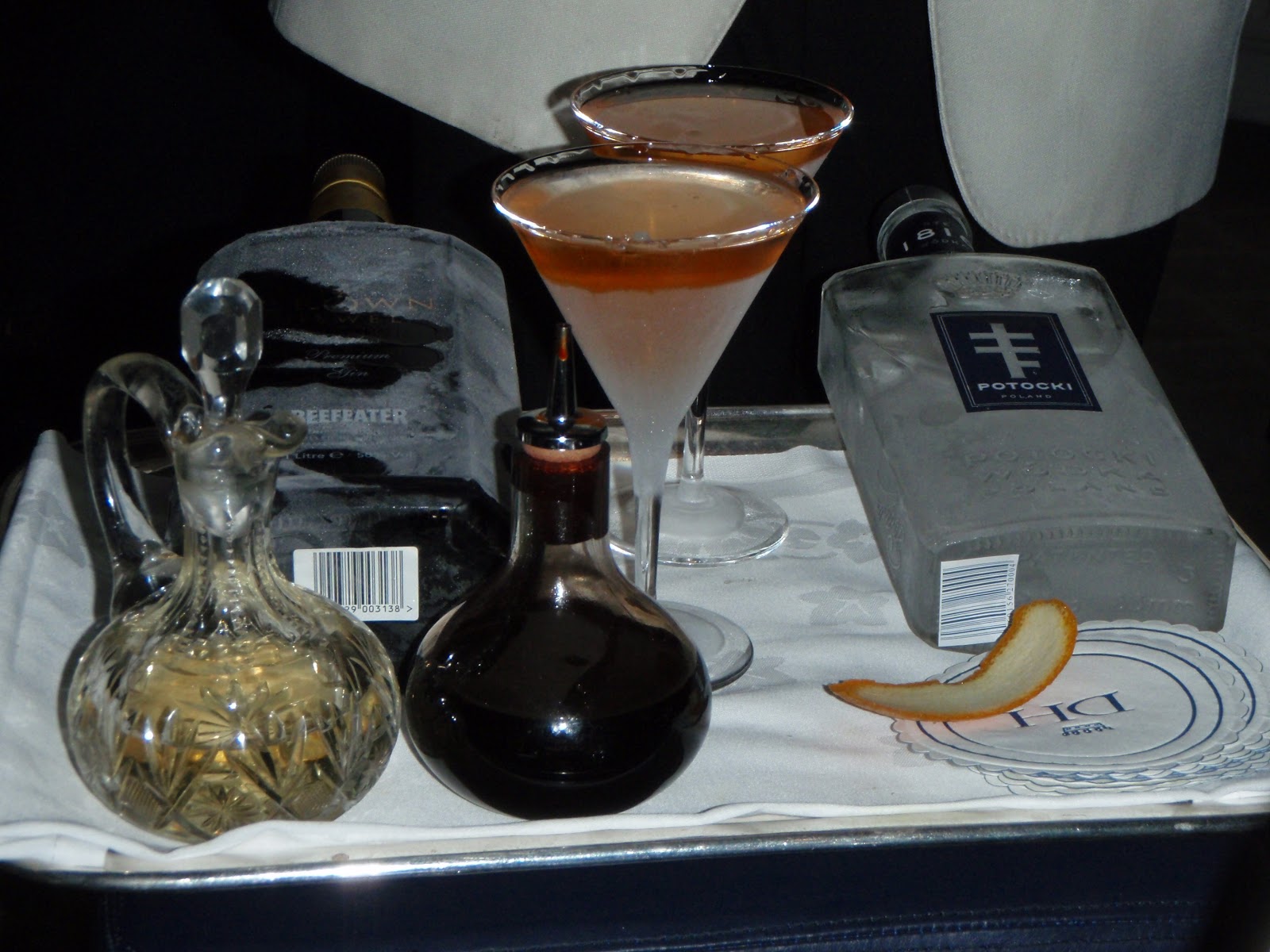
He then proceeds with a flourish to make the concoction at our table, pouring from vast frosted bottles of Beefeater gin and Potocki vodka from Poland.

It’s a potent brew, a strong, bitter cocktail for sipping rather than gulping, served with style (and some tasty green olives).


“This bar was where Sean Connery came in 1961 when he’d landed the movie role, for one of these babies,” says Rodway, holding his cocktail aloft. “Then Pierce Brosnan followed in 1995.”

As I sip my Vesper, I decide I'd rather be a hero than a  Bond villain. Heroes don't get to take over the world, but they do enjoy the better drinks.

Friday, 23 November 2018

Time & Time Again: Doctor Who’s Cultural Connections

As today is Doctor Who Day (this year marking the 55th anniversary of the BBC TV show's first screening on 23 November 1963), I hope you'll indulge a departure from travel to revisit the article I wrote for the program's 50th anniversary. It originally appeared on the Issimo Magazine site, but as that version is no longer online I'd like to share it with you here...

River Song, Rory, the Doctor and Amy in the American west.
Photo courtesy of the ABC.

One of my earliest memories of Doctor Who is the five-part story The Mind Robber, which screened in 1968. After a fascinating 25 minutes trapped in a pure white void (a cheap-to-make episode created at the last moment due to scheduling issues), the Doctor and his companions Jamie and Zoe arrived in the Land of Fiction.

For a television series that had become famous for encounters with scary rubber-suit monsters in a nominally science fiction setting, this was a surprising change of tack.

Jamie and Zoe among the White Robots in The Mind Robber.
Photo courtesy of the BBC.

Challenged first by Gulliver, who could only speak the lines Jonathan Swift gave him and was therefore somewhat cryptic, the time travellers met numerous mythical and fictional beings – a unicorn, the Minotaur, Medusa, Rapunzel, D’Artagnan and Lancelot among them – before defeating the master of the land.

It was a lively foray into the realms of myth and literature, but not the first or last such excursion. Though commonly dismissed in those days as a children’s show of no substance, Doctor Who has often borrowed from literature and other cultural forms.

The basic conceit of the show – a ship’s crew travelling to distant lands full of strange and wonderful creatures – is an age-old concept, employed by Homer in The Odyssey.

The Doctor meets legends of Greek myth in
The Myth Makers
. Photo courtesy of the BBC.
This resemblance was particularly apt during the tenure of the First Doctor, played by William Hartnell, who kidnapped his first travelling companions and had no control over where the his space-time vessel, the TARDIS, would take them.

Like Odysseus, the Doctor and his companions were cursed to wander to far lands, encountering villains and monsters on the way.

The two sagas intertwined in 1965 in the story The Myth Makers, in which the TARDIS crew met the great figures of Greek myth; in fact the time machine’s sudden materialisation was a crucial distraction which allowed Achilles to slay Hector.

After encounters with Agamemnon, Cyclops and Odysseus, it was – somewhat inevitably – the Doctor himself who suggested the use of a wooden horse to defeat the Trojans.

Literary retellings or appropriations continued over the years, no doubt one of the factors in Doctor Who’s remarkable adaptability to changing times; a mutability no other TV series could match.

In the 1967 tale The Evil of the Daleks, the series crossed science fiction with a Victorian setting in a foreshadowing of steampunk.

Three years later, its “bases under siege from assorted monsters” formula having grown tired, Doctor Who completely reinvented itself along the lines of the then popular “spy-fi” genre, with a new Doctor, Jon Pertwee, fighting villainous Earth-bound masterminds and invasions along the lines of James Bond or The Avengers.

The Docttor and Sarah Jane Smith in The Pyramids of Mars.
Photo courtesy of the BBC.

The best, however, was yet to come. With the arrival of Tom Baker as the Fourth Doctor in 1974, the program embarked upon an enormously popular series of stories explicitly borrowing from Gothic horror.

In this bracket of classics were adventures drawing on The Strange Case of Dr Jekyll and Mr Hyde, Frankenstein and The Phantom of the Opera, along with aspects of the Sherlock Holmes canon and cinematic mainstays such as malevolent Egyptian mummies.

Doctor Who also adapted the detective/murder mystery concept more than once in such stories as 1977’s Asimov-style The Robots of Death and 1982’s Christie-esque Black Orchid. Later in the 1980s Sylvester McCoy’s Doctor would get to hob-nob with the Arthurian legend’s Mordred and Morgaine, being intriguingly identified by them as Merlin.

The Doctor and shipmate in The Curse of the Black Spot.
Photo courtesy of the BBC.

The revived Doctor Who, launched to instant success in 2005, has borrowed cultural templates less overtly; though it couldn’t resist a walk-the-plank pirate yarn in 2011’s The Curse of the Black Spot, nor a full-blown Western in A Town Called Mercy in 2012. Christmas specials have also drawn on the work of Charles Dickens and CS Lewis.

In the new version of the show the Doctor is much more likely to meet the great writers and artists of the past, than emulate their work. In recent years the Doctor has bumped into the likes of Dickens, William Shakespeare, Agatha Christie, and Vincent van Gogh, not to mention those two influential authors Winston Churchill and Adolf Hitler.

The Doctor and Donna meet Agatha Christie in The Unicorn and the Wasp.
Photo courtesy of the BBC.

It’s been pointed out that Doctor Who is basically an anthology series linked by continuing characters; and even they change regularly, including the Doctor as he regenerates into new bodies with subtly different psychologies.

This flexibility may form part of its remarkable durability. A humble teatime TV program launched in 1963 when such things were seen as utterly disposable, has certainly managed to fashion itself into an ongoing saga of heroic proportions.

The Doctor broods in the TARDIS. Photo courtesy of the BBC.

As Philip Sandifer has pointed out in his TARDIS Eruditorum series of critical essays on the program, there is literally no story which cannot be told within Doctor Who, given its remit is the entirety of space and time.

Sandifer posits a fascinating theory in the volume in which he discusses the Second Doctor, as played by Patrick Troughton. In referencing The Mind Robber, Sandifer cheekily suggests this story may supply the true origin of The Doctor, above and beyond his identity as a Time Lord.

What, asks the author, if the Doctor is actually an escapee from the Land of Fiction, a story writer gone rogue? From this angle, the Doctor has slipped his bounds to gallivant through space and time as a literary catalyst, creating new stories wherever he goes.

I have to say, I like that explanation. Happy birthday, Doctor.