Showing posts with label Ballarat. Show all posts

Friday, 25 October 2019

Lola Montez: Un-Victorian in Victoria (Part 2)

Lola Montez and Henry Seekamp,
depicted in
Melbourne Punch in 1856.
Courtesy of State Library of Victoria
From last post: In 1855, the notorious courtesan and entertainer Lola Montez visited the Colony of Victoria, shocking many with her saucy 'Spider Dance'. Her story continues...

Moral reaction came quickly. In Melbourne, Dr John Milton, head of the City Court Mission, appointed himself as Montez’s arch-enemy.

After her first performance of the Spider Dance, he demanded a warrant be issued for her arrest, to prevent any repetition of the affront.

He was unsuccessful, perhaps due to mayor and theatre-builder John Smith being in the chair as presiding magistrate. Worthy citizens of Geelong also tried to shut her act down, without success.

Things were easier for Montez in gold mining country.

“Bendigo and Ballarat were turning into settled towns, but their goldfields still held large migratory male populations,” says historian David Goodman. “Entertainment was very welcome, so touring companies and other entertainers quickly got onto a circuit through the area.” Ever the canny self-publicist, Lola visited Ballarat miners at their diggings, and shouted them at local bars.

Her time in Ballarat included a violent incident that was reported in newspapers around the world. After a disapproving letter to the Ballarat Times described Lola as possessing “notoriety of an unenviable kind”, she laid into the newspaper’s editor, Henry Seekamp, in the bar of the United States Hotel, with a whip she’d just won in a raffle (see cartoon above).

Seekamp had been a hero of the 1854 Eureka Stockade revolt through his support for the rebel cause, and was known for his energy and temper; so he was unlikely to take the attack lightly. He replied with his own whip, and the two had to be separated by bystanders.

With highlights like these, Victorian newspapers used up plenty of newsprint on Lola. As they do now, the media loved a controversial woman for her ability to increase sales, whether they were praising or damning her. They were also happy to exaggerate existing stories about Montez, repeat unlikely rumours, and make new ones up, in an ever-expanding game of Chinese Whispers.

It was a situation that would suit her down to the ground. Lola thrived on controversy, often stoking the fires herself via letters to the editor, twisting facts to suit her public image.

She also gave the colony’s moral guardians a clear target, though they’d rarely seen the work they were complaining of, and the varied reactions of newspaper critics suggests the Spider Dance’s impropriety was very much in the eye of the beholder. But as we see today, outbreaks of moral panic have a lot to do with expressing the ego of the complainant, via the volume of his or her moral indignation.

Despite this sporadic resistance to her tour, accompanied by unsubstantiated rumours of intoxication and other unladylike behaviour, her audiences voted with their feet. They were happy to buy a ticket to be in close proximity to fame. They may also have sided with her dismissal of accepted authorities, not unlike the audiences who applauded Madonna’s critically panned West End stage debut in 2002.

Though Montez was only in the colony for a few months, she brought an air of international glamour to this remote part of the Western world. Did her success foreshadow the cultural cringe by which Australians sought validation from imported figures and culture?

No, says Goodman. “International entertainment was welcome, but ‘cultural cringe’ is anachronistic. Most of the population had only been here a couple of years, so they’re not thinking of themselves as Australian. Gold rush Melbourne is a very cosmopolitan society; more so than an English regional city like Bristol, for example.”

How significant was her visit to our developing colony? There’s no question that Lola Montez was one of the most colourful characters to visit Victoria, in the most colourful era of its history. But on the face of it, it’s hard to see her as anything more than a footnote.

Her outspoken commitment to liberal democracy was adopted for a New World audience, and her possibilities as a feminist icon are problematic. Though she was clearly a woman with a desire for an independent life, it was driven by her own demons rather than commitment to a cause.

Whatever her importance beyond the stage, Lola Montez is remembered. Even now, many Victorians recognise her name, some from history lessons at school. There’s even been a children’s book and a musical inspired by her tour. Why is she still so fascinating to the inhabitants of a post-modern era awash with celebrity scandals?

Maybe her memory lives on because, like Oscar Wilde, Lola Montez seems a contemporary figure trapped in an unforgiving earlier age. Or possibly, despite all our advances in equality between the sexes, we’re still fascinated by a woman who could break all rules of female propriety and get away with it.

Friday, 10 March 2017

A White Night in Ballarat

Last weekend, Narrelle and I headed to Ballarat to experience its very first White Night.

I'd already written a preview of the all-night arts event for Fairfax Media's Traveller section, so I was curious to see how it would play out on the night.

White Night/Nuit Blanche has traditionally been an event staged by big cities - St Petersburg, Toronto, Paris, Melbourne - not a regional city of 100,000 people. Would it work?


It looked good from the start. When we stepped out of our Lydiard Street hotel at 10pm after a strategic nap, White Night had been underway for three hours and the city centre was packed with people.

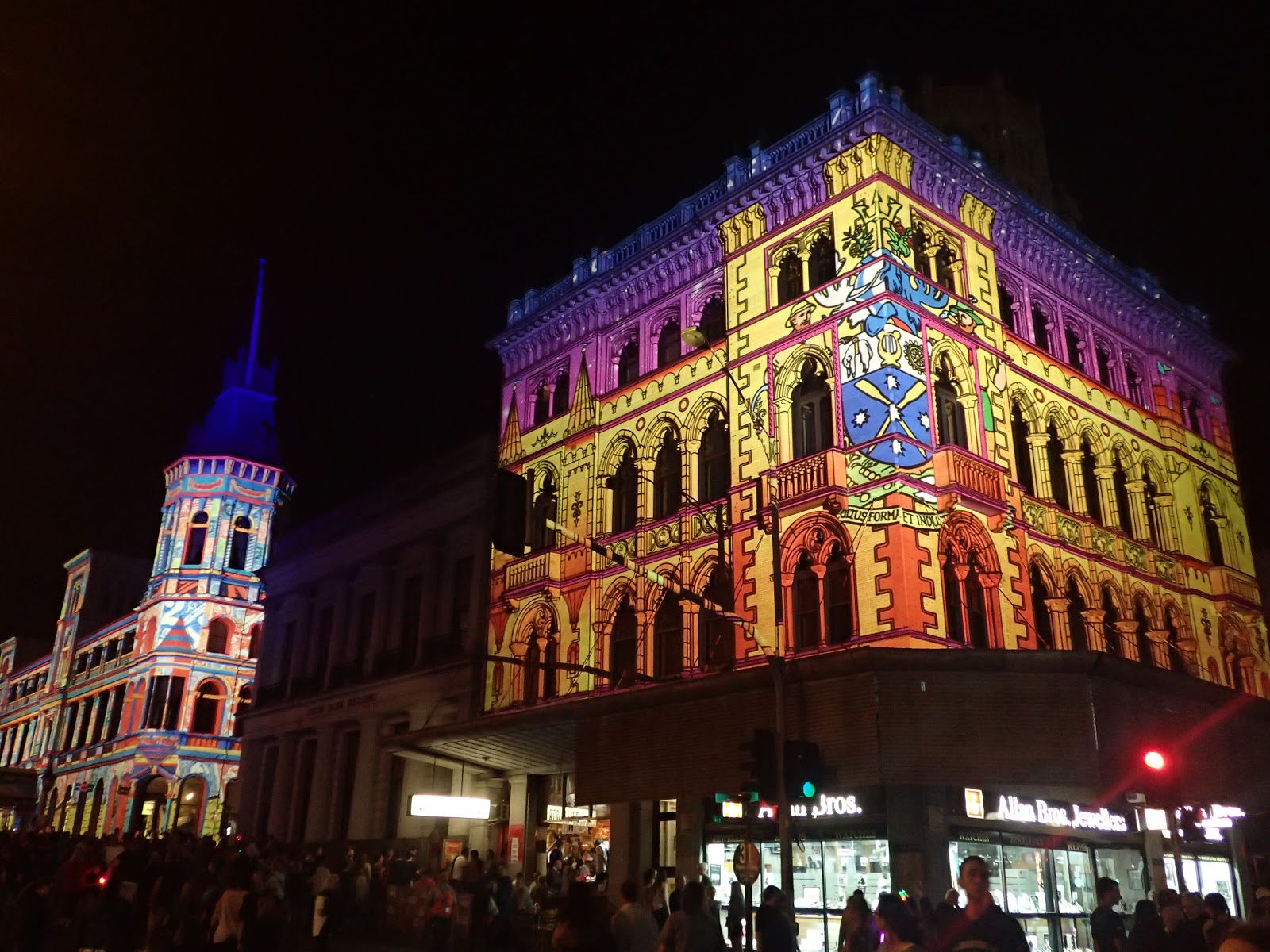
As at White Night Melbourne, people were moving from artwork to artwork, with the largest pieces being huge illuminations mapped to Ballarat's plentiful historic facades.

In fact, the first thing we realised was that our own accommodation, Craig's Royal Hotel, was one of the buildings acting as a canvas:


There were smaller works to be discovered in the side streets running off Lydiard. One of these, Do Not Go Gentle, was a mesmerising video presentation in a vacant lot, examining ageing and the gaining of wisdom:


There were many of these interesting smaller pieces - including a mobile work, Crate Expectations, a strange object made of crates which trundled around producing curious effects and items as it occasionally popped open...


... and this, a row of "Here's Johnny!" heads smirking maniacally on screens in the window of the Regent Cinemas:


But the star attraction of White Night was undeniable the set of illuminations along Lydiard Street. It was here that White Night Ballarat had several advantages over its Melbourne equivalent.


Firstly, it was much easier to navigate Ballarat's White Night zone, which was basically two connected stretches of the city's broad goldrush-era streets, Lydiard and Sturt. It was crowded, but never did we feel that we couldn't progress.

Secondly, the relatively compact area enabled a visual unity that's impossible in Melbourne's sprawling White Night zone. One could stand at one end of Lydiard Street and see a stretch of illuminated facades along both sides, a kind of magical avatar of the daytime city:


Another asset was Ballarat's tumultuous 19th century history, in which it rocketed into prominence as a rough-and-tumble gold mining community after the metal was discovered there in 1851. This lent a certain thematic unity to the illuminations, several of which drew on the city's past.

As an Australian history graduate I particularly liked this projection on the old post office building, which referred to the Eureka Stockade revolt of 1854:


On the other side of Lydiard was a work drawing on a much deeper past. More Than 1 Nation by local Aboriginal art group Pitcha Makin Fellas told the story of Australia's indigenous people, and wasn't shy about referencing the harsh realities of European settlement.

It was by far the best work of the night, an animated journey through centuries, and much admired by onlookers. It was good to see that such public art could still be frank and confronting.

Here are two clips I filmed on the night, the latter one dealing with more modern times:


The first White Night Ballarat was, to my eyes, a success both in crowd appeal and artistic merit.

The only flaw, it turned out, was the 12-hour timespan. While this made sense in Melbourne, where the huge crowds gave people good reason to enter the city in the wee small hours before dawn, in Ballarat it was easy to see everything during more reasonable hours.

As a result, when we walked back to our hotel at 3am, after drinks with friends at the buzzing Mitchell Harris wine bar, we found Lydiard Street almost deserted:


On reflection, it might have worked better to stage White Night Ballarat from, say, 7pm to 3am, rather than run all the way to the scheduled 7am.

Quiet finale aside, White Night Ballarat provided proof that successful big art events don't have to be the sole possession of big cities.

Whether there'll be a second such event in the goldfields city has yet to be decided, but I hope it happens. It was a great night out among the art, crowds, and colourful history.

Thursday, 20 August 2015

Wildlife of Ballarat

I've been to Ballarat, a regional city 100km west of Melbourne, many times.

I'm a history graduate who focused on Australian history, so it's not surprising that Ballarat would appeal to me. As the site of the massive 1850s gold rush which led to the Eureka Stockade rebellion of 1854, when miners resisted the corruption and authoritarian rule of the goldfields authorities, the city has a prominent place in history books.

As a result, I've always focused on the historic and cutural attractions of the place: the Ballarat Art Gallery, the historical village at Sovereign Hill, and the Museum of Australian Democracy (MADE) at the Eureka site.

Not far down the road from MADE, however, is the Ballarat Wildlife Park. Basically nestled in the Ballarat suburbs, it's an open zoo featuring Australian native animals.

I was surprised by just how open it was. Firstly, as I was walking toward the koala enclosure, I met this kangaroo dozing on the walkway:


Then I found I could get quite close to the koalas as they slept in their open-air zone (sharing it with some quokkas who wandered around at ground level):


By chance I'd arrived at the koala enclosure at 2pm, when one of the staff feeds the creatures milk supplements and answers questions from visitors:


While I was standing there, the kangaroo I'd passed earlier came up and sniffed around my pockets. He could smell the animal food I'd obtained at reception, a mix of grains. So I fed him some, as he stood up and hung onto my hand for balance. This was definitely a highlight of the visit:


Further on, I passed through a big open grassy area with gum trees, which sloped down to a lake. There were dozens of kangaroos here, with no barriers at all between them and the human passers-by:


There were a couple more memorable Aussie animals of the visit. First, Tasmanian Devils, well named as they have demonic teeth and an eerie growl...


... and finally, the wombat. You can't go past a wombat for solid good-natured cuteness. And it's related to the koala, one of the staff told me. I can see the resemblance.


Disclosure: I was a guest of Ballarat Regional Tourism and V/Line.

Wednesday, 20 August 2014

Are Museums Boring?

We were talking dull museums on Twitter today.

It started when someone enthusiastically endorsed this article from the UK's Daily Telegraph, "21 Reasons Why I Hate Museums".

Aside from wondering what had happened to articles structured around a mere five or ten points, I found myself in two minds about this piece.

On one hand, I kind of agree with its main point.

Too many people trudge around museums while on vacation out of a sense of duty, regardless of whether the exhibits are engaging or they're interested in its subject matter.

To my mind, this approach is a hangover from the 19th century idea that travel should always be educational and instructive.

By contrast, I've been in cities where I've read a description of the major museums, and then decided I'd rather go on a walking tour or hang out in an interesting neighbourhood.

I can't speak highly enough of this latter strategy, if thought and research is applied to the selection of neighbourhood. I've had some great articles result from simply exploring in this manner (eg my day hanging out in St Roch, Quebec).

On the other hand, I feel the Telegraph article is unfair in dismissing museum visits altogether.

For my money, there are two key elements which must be in place for a museum visit to be a highlight of your holiday:

1. The museum has a creative and stimulating approach to addressing its subject;
2. The subject is something you're personally interested in.

The second point is really the most important, as a personal interest in the subject matter will excuse a fair bit of dodgy presentation.

As proof that interesting museums exist (at least for me), here are twelve accounts I've written of museums which were personal highlights because the above elements were in play:


What about you? Which museums moved you, and why? Leave a comment below.

Sunday, 5 May 2013

Democracy: MADE in Ballarat

Ballarat has always been an unusual Australian regional city, in that its attractions are not largely based on its natural environment.

In fact the city's major drawcards are all historical, based on the central role the city played in the mid-19th century Victorian goldrush, one of the most glittering ever seen.

From the early 1850s Ballarat was a tumultuous hub of activity, with miners from around the world trying their luck on the diggings and being overseen by a stretched and sometimes corrupt police force.

From this period derives Sovereign Hill, an excellent historical village on the site of an original gold mine.

Ballarat's other great attraction connected with that era, the Eureka Centre, closed a few years ago for redevelopment.

Its building sat on the site of the Eureka Stockade, a makeshift fortification which in 1854 became a battleground between soldiers, and miners who had vowed to defy the authorities. As tension mounted, they pushed for representation in Parliament and the ending of the hated gold mining licence.

The short but bloody battle was lost by the miners, but they went on to win the war. With no jury willing to convict the insurrection's arrested members, the government was forced to back down.

Within a short space of time the rebels had secured sweeping democratic reforms in a new constitution. Their bloodied leader, Peter Lalor, went on to become a Member of Parliament and served for many years.

It's a great story and a crucial part of Australia's democratic evolution, hence the creation of a brand new museum which opened today. It's the Museum of Australian Democracy at Eureka, MADE for short.

Frankly, I was impressed. I entered just after its doors were open for the first time to encounter the above piece of art - the "Democracy Machine" which links the museum's logo to words such as PROTEST and REBEL.

That in itself was a good sign. There's long been a view from conservative quarters that the Eureka Stockade rebellion was something to be embarrassed about and hushed up, while more radical groups tried to claim the event for themselves. This ambivalence led to some awkward fence-sitting - I seem to remember a lot of "make up your own mind" commentary in the old Eureka Centre.

Not so here, it seemed - demonstration, protest and dissent were gaining recognition as legitimate tools in a democratic society (tools that the powers-that-be have tried hard to confiscate in recent years).

The main exhibition was wrapped in layers within a circular central hall. The inner tables, bearing horizontal touch screens, were devoted to the Eureka Stockade rebellion, along with progressive changes in Australia through the 20th century (women gaining the right to vote in 1902, for example, decades ahead of their sisters in the UK and USA).

Around the outside of the hall above head height was a backlit montage of pivotal events in the evolution of democracy across the world, up to and including the Arab Spring.

Around the walls below that were various sections devoted to aspects of protest, influence and change. This Incendiary Library was a screen with a rotating selection of books which had either wielded great influence or had been banned at some point. No idea, however, why Huckleberry Finn had been banned for the reasons noted here:

A section devoted to the power of words played audio sections of famous speeches, with the words animated to demonstrate their power as they tumbled onto the screen in unison with the sound:

This next marvellous section examined the power of numbers. It included an alcove in which music and images could only be unleashed by the audience standing together in front of screens depicting mass protest scenes from around the world:

Finally, after all the exhibits had been pored over and interacted with, I entered the special dimly lit chamber devoted to the display of the Eureka Flag. This was the original banner stitched for the miners' revolt which had flown above the stockade on this site in 1854, miraculously retained by the family of the trooper who cut it down after the battle:

Now here it was, back on the patch of ground where it had served as an inspiration to rebels almost 160 years ago. A piece of history, and a thing of beauty.

The free opening celebrations continue at MADE, Eureka Street, Ballarat on Sunday 5 May 2013. From Monday 6 May the museum will open daily from 10am-5pm. Full details at the MADE website.

Disclosure time... On this trip I was hosted by Ballarat Regional Tourism.

Tuesday, 10 April 2012

Geelong to Ballarat: All Aboard!

It's exactly 150 years today since the railway reached the Victorian gold mining town of Ballarat, on 10 April 1862.

Those were heady days for Ballarat: only 11 years since gold was discovered, creating a bustling settlement from nothing; and only eight years since the Eureka Stockade armed rebellion against the colonial authorities.

Nowadays there's a line directly linking Ballarat to Melbourne, but in 1862 the Ballarat route ran through Geelong, itself a busy port made busier by the gold rush.

It's many years since passenger services ran along the Geelong-Ballarat line, which still carries freight. But today, to mark the historic occasion, a special heritage train carried assorted local dignitaries, toffs and bigwigs (along with your humble correspondent) between the two regional cities to mark the occasion.

Here's a glimpse of what I saw on the way:

1. Here's our special train waiting at Geelong station, diesel-hauled but with early 20th century carriages:


2. Here's the interior of one of the second-class compartments. As attractive as it is, it struck me that there must have been a hell of a lot of maintenance required in those days for all the timber, both inside and outside the carriages:


3. There were a number of stations along the line in its passenger days, all solid constructions made of bluestone. Here's a glimpse of the station at Bannockburn, which I caught as the train sped past:


4. At a couple of stations along the way, the local government dignitaries disembarked in order to cut a ceremonial ribbon. Here they are using the Good Scissors at Lethbridge Station:


5. At our next stop, Lal Lal Station, I spotted this gent trying to influence the 19th century planning process. The inhabitants of Buninyong agitated for a station on the line, but to no avail:


6. Also at Lal Lal was this rather convincing 19th century couple. Station ghosts, perhaps?


7. Finally, about two hours after our departure from Geelong, we pulled into the impressive Ballarat Station. The grand tower dates from 1891:


8. Alighting, we were greeted by much pomp and ceremony, including catering, speeches, the unveiling of a commemorative plaque and the repertoire of this brass band. I caught a spot of Rule Britannia in there at one point...


If you're interested in taking this journey yourself, the Australian Railway Historical Society is operating a similar train from Melbourne via Geelong to Ballarat on Saturday 14 April 2012. More information is available at this link.

Disclosure time... On this trip I travelled courtesy of V/Line.

Sunday, 8 November 2009

Sovereign Hill: New Gold Mountain Remixed

Lola Montez and I have a history. In 1855 she scandalised Victoria’s polite society by performing her saucy spider dance across the colony.

Then in 2005, I wrote an article for The Age (which was dismissive of Montez the first time round) to commemorate the 150th anniversary of her all-conquering tour.

And finally, we met in passing today on the streets of Sovereign Hill, though the former mistress of the King of Bavaria was more concerned with trading blows with newspaper editor Henry Seekamp, who’d dared to imply that the dancer possessed uncertain morals.

It was, of course, a historical reenactment with a slight edit - Montez and Seekamp did test out horsewhips on each other in real life, but in the confines of the United States Hotel. I, coincidentally, am writing this at the long timber bar of the rebuilt United States Hotel, on the main street of this replica town, which recreates the lively and chaotic gold rush era of 1850s Ballarat.

Gold rush town

Got all that? Good. So while the folk band in the corner strikes up another tune and the barmaid pours another ale, let me give you my thoughts on the place.

The first time I came here, I’d expected a cheesy antipodean Disneyland, a kind of “Gold Rush World” complete with corporate branding and actors dressed in giant fibreglass heads resembling those of bearded, gap-toothed Victorian-era gold miners.

The reality was, to my surprise, quite different. There’s something about Sovereign Hill that’s both charming and very relaxing. It’s partly because it really does resemble a small country town - the inhabitants may be in fancy dress, but there are enough streets lined with dusty timber buildings and ragged miners’ tents that it has the right “feel”.

On top of that, it’s full of businesses selling items typical of the era - clothing, toiletries, candles, sweets - many of which are made here. As you wander away from the busy main street, there are more items of interest scattered through the side streets - market gardens, animals, a wheelwright’s factory - which you can often wander through on your lonesome.

Panning for gold


There are also activities to undertake, such as panning for gold at the diggings area below the main street. Here, crouching visitors agitate wide metal pans vigorously in the hope of retrieving a few flecks of gold. There is certainly gold present, by the way, as the management has thoughtfully salted the stream with a modest amount beforehand.

Watching the gold panners is theatre in itself; I sat and observed a tour group from China getting down and dirty at the stream, having a thoroughly good time sloshing the pans in the hope of scoring a speck of the fabled metal.

There were several Chinese tour groups here today, living proof of the reported big increase in Chinese arrivals at Melbourne Airport. And I noticed something I’d never seen before at Sovereign Hill - their Mandarin-speaking guides were themselves dressed in Chinese garb of the 19th century, featuring silk shirts and broad straw hats.

Chinese connection

And then the penny dropped - Sovereign Hill isn’t just another Australian peculiarity on the itineraries of Chinese tourists, like kangaroos and penguin watching. There’s a strong Chinese story here on the goldfields, via the thousands of Chinese miners who came to “New Gold Mountain”, as they named the Victorian goldfields, to try their luck on the diggings.

With that in mind, I had a look through Sovereign Hill's Chinese Camp, a recreation of the Chinese miners’ homes and lives in 1850s Victoria. To my surprise, the small temple contains an impressive audiovisual presentation, via suspended widescreen TVs placed strategically within (haven’t flatscreen TVs been a godsend to museum curators everywhere?).

The story of the Chinese miners is an intriguing element of the multi-ethnic Victoria of those days. It’s not a story, frankly, that reflects well on the European population, who did much to make the Chinese feel unwelcome; but seeing the crowds of newly prosperous Chinese tourists now visiting Sovereign Hill and panning for gold, there’s a sense that amends have been made.

Disclosure time... on this trip I travelled courtesy of V/Line's daily Goldrush Special train and Sovereign Hill. But I paid for all the sippin’ whisky myself (and soon hope to have my sight back). For accommodation, see my 2007 review of Sovereign Hill Lodge.

Also check out the Sovereign Hill post and Eureka Centre post of my friend and blogger Walter Lim, who accompanied us on this trip.