In March 2018, I spent a few days in the remote Queensland town of Normanton, awaiting the weekly run of the Gulflander train.
One morning, killing time, I visited the Three Tribes art gallery, and for the first time the ferocious dogs near the old town well declined to bark at me.
Were they asleep on the job, or was I slowly becoming accepted as a local?
The front of the gallery was locked, so I walked around the back and found an open-air shed with a dozen or so Aboriginal women creating art at tables.
Shenane was the gallery manager, who I'd met briefly the day before at the town's Visitor Centre. She had a no-nonsense manner I associated with the aunts of PG Wodehouse books.
“I don’t have a staff member to run the shop at the moment,” she said, opening up the gallery for me. She explained the women were mostly making art as part of a work for the dole scheme.
“Better than doing something pointless like weeding,” I said.
It struck me as a good idea, the artists building skills and creating works to be proud of, as well as earning a commission from sales. And it provided another way for tourists to spend their dollars in the town, which was always a consideration for remote places with limited amusements.
There was an array of work on the walls, in both contemporary and traditional styles. One large portrait with a lot of black was painted by a woman who’d suffered from depression, said Shenane.
I turned over a small glazed bowl shaped like a gumleaf (see image at left). It was $3, so I decided to buy it.
Then I noticed a framed painting on the wall above the till, about 50 centimetres square, featuring brightly coloured handprints framed by dots (see image top right). It was only $30. I bought that too.
While I was encasing it in some bubble wrap Shenane had found, she ushered in a young woman. This was the artist, Stella. We had a chat about the work and how she had created its elements, and she went away beaming.
“That was her first sale,” said Shenane, dropping the aunt-like demeanour and smiling.
I rarely make impulse buys when travelling, obsessed as I am with travelling light. Now I had to work out how to get the art back to Melbourne.
The staff at Normanton's general store gave me an empty cardboard box to encase it, which I bound with a large amount of post office adhesive tape. I dispatched it to the mercies of Australia Post, feeling good about my impulsive role as patron of the arts.
I returned home safely two weeks later. So did the painting.
Three Tribes is located at 85 Landsborough Street, Normanton, Queensland. See more details at the Bynoe Arts Centre website.
In March 2018, I spent a few days in the remote Outback Queensland town of Normanton, awaiting the weekly run of the Gulflander train.
I’d arrived early in order to leave plenty of wriggle room for delays caused by rain at the end of the wet season, and even so there was some doubt whether the train would run.
Killing time while I waited for news, one morning I walked to the site of the old river port which had once connected the town to the Gulf of Carpentaria.
I was surprised to find a well-marked cycling and pedestrian trail leading to the old wharf, 700 metres north of the town’s edge. Perhaps in the dry season people cycled along it in droves, but I was the only one using it today.
Though I was happy the rain had paused, with the sun out it was oppressively hot and humid. I was feeling grateful for my Akubra hat, as I walked along the exposed asphalt.
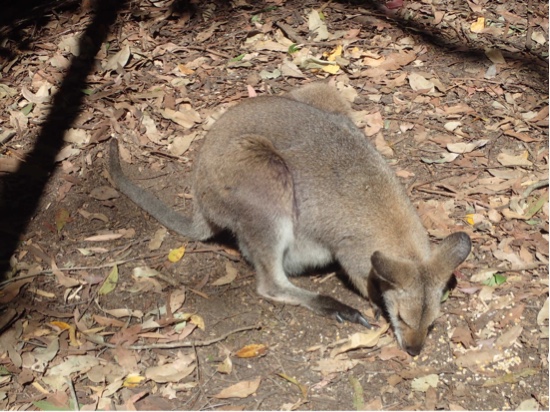
On the way I passed a flood marker which topped out at seven metres. No wonder the town was built at a slight remove. I could already see evidence that the Norman River didn’t keep to its course: to one side of the trail was a green-brown lagoon of half-submerged trees, and flowers blooming above floating pads. I heard a large splash, and braced myself to see what had caused it. Just a wallaby among the foliage, who hopped away ahead of me.
It was deserted at the riverbank, though two parked utes with empty trailers spoke of locals out on a Sunday fishing excursion. Two heritage sites were signboarded: the modernised boat ramp which had had a winch-operated punt from the 1880s to 1965, and the remnants of the old wharf, which had been wrecked by a flood in 1974. Powerful floods were something Alice Springs rarely had to endure, but it was a common hazard in this would-be Town Like Alice (on which that famous novel was based).
I was sitting in the shelter next to the boat ramp, taking notes, when my eye was caught by a sign by the water featuring “ACHTUNG” in black lettering. The German word was more noticeable than the red “WARNING” in English above it, and the gist of the sign was that a saltwater crocodile had been sighted here recently and people should keep away from the water’s edge.
I relocated to the picnic area several metres farther back, and scoped out a place to climb higher should a crocodile attack. What I’d taken to be a children’s playground next to the picnic area I now saw was an outdoor gym, a set of boards with rails and inclines.
If a crocodile appeared, I was probably doomed. But possibly I could scramble to the top of the inclined exercise bench. There was also an old crane set in concrete by the wharf. Though farther away, it would be easy to climb.
Escape route considerations aside, it was pleasant by the river, though never quiet - I could hear the call of birds in the trees around me, along with the deep croaks of frogs and the buzz of insects. Small black flies crawled annoyingly over my face when they felt they could get away with it, and at one point a kite flew under the canopy of the picnic area, right over my head, to land on a nearby vantage point.
Cooling breezes blew from the river in unpredictable patterns, and the occasional car pulled in to offload a boat on the ramp. Mostly I was alone. It was a soothing experience, despite the heat and my little insect friends.
Jake, a barman at the Albion pub, had given me a card for Gulf Getabout, a local transport service which acted like a taxi. Its card promised “Like a taxi, but BETTER!” I asked them to pick me up from the river. It beat walking.
Mel the driver chauffered me to the Big Barra, Normanton’s entry in Australia’s fabled pantheon of Big Things. It was a huge replica of a barramundi, standing upright on its tail, outside a motel. Barramundi fishing was a big thing around here.
On the way back into town, Mel swung onto the other side of the road to let me photograph the Welcome to Normanton sign:
Welcome to Normanton
Population small
We love them all
Drive carefully
When I remarked on the flexibility of road rules in small towns - I’d noticed a ute driving by without licence plates the day before - Mel said the local police had recently made themselves unpopular by actually enforcing the law, including the need for licence plates.
She dropped me at the Purple Pub, the Albion’s rival on the main street. It was an archetypal Aussie pub, except it was painted a distinctive shade of eggplant. I ordered a beer and asked the barmaid how it had ended up that way.
“One of the previous publicans ordered new paint,” she said, “But when it showed up it was the wrong colour. He was something of a tight-arse, and didn’t want to pay to freight to send it back. So now it’s purple.”
Fair enough. I ordered a beer, and waited for my train.
On my visit to Port Douglas I was hosted by the Bally Hooley Railway.
When visiting Cairns last year, I was unable to ride the Kuranda Scenic Railway because of cancellations due to rockslides. So I took a bus to Port Douglas to try out a substitute: the Bally Hooley Railway.
Parked at a platform at one end of the marina’s shopping arcade was an open-sided train. Its carriages’ bright yellow wooden benches, decorative wrought-iron doors, and firetruck red roof made it look like a funfair novelty, but it had an industrial heritage.
“The carriage beds are from real sugar cane bins,” said the young train driver wearing a baggy blue cap, referring to the carts hauled by narrow-gauge locomotives through the cane fields of the region.
These modified carriages were attached to an original loco from the cane fields, a blocky, blunt-nosed diesel workhorse that looked like it packed a lot of power for something that ran along track a mere 610 millimetres (two feet) wide. On this damp Sunday it was half-full of day-trippers waiting for it to chug down to its terminus and back, calling at three stops along the way.
The station was an attractive timber structure pained white, with a cafe serving meals at tables on the platform beneath ceiling fans and wicker light shades. Throw in a gin and tonic, and it could have been the Last Days of the Raj.
We pulled slowly out. “It averages 15 kilometres per hour,” said our guide via a microphone, providing a commentary as we progressed. As we passed the waters of the marina, he gave a sketch of the late disgraced businessman Christopher Skase, whose Sheraton Mirage Resort was largely responsible for Port Douglas’ transformation into an upmarket tourist town in the 1980s.
Then we passed the town’s waste water treatment plant, and a sign advising of a coming “sludge treatment upgrade”.
According to our host, this sugar cane line was built over a century ago to serve the sugar industry of inland Mossman, whose refinery still produced over a million tonnes of sugar per week. So Port Douglas had got its own railway eventually, even if it was for sugar rather than people.
Sugar was brought down by train to be loaded onto ships at Port Douglas, but improved road transport had made the railway redundant. Now it had become a brightly-painted tourist train, usually pulled by steam locomotives at weekends (though we’d lucked out because an accredited driver couldn’t be found that day).
Port Douglas is on a stumpy peninsula nosing into the Coral Sea, so as we moved south we could see the mountains of the Great Dividing Range across the water to our right. Closer to hand were eucalypts, and mangroves beyond them.
There were two stations between the Marina Station and the train’s terminus. The first was at the Mirage Country Club, where the railway was lined by immaculate if unused tennis courts. The second was at the QT Resort, whose long white building shared the marina’s colonial tropicana look.
We passed older blocks of housing built by Skase for his construction workers, then arrived at the terminus, St Crispin’s Station, which housed a cafe with water views.
I stood with other rail fans to watch the crew drive the locomotive onto a turntable (see video clip above), then turn it through 180 degrees using nothing more than physical strength. It then ran past our carriages on a parallel line, to position itself for the return run north. It was a delight to watch the operation, there was something pleasingly analogue about the simple technology involved.
Back aboard, I found myself seated with new fellow passengers, an affectionate couple on a day out.
“Pity it’s not steam today,” said the man, meaning the locomotive. I demurred, pointing out the diesel loco was just as much a part of sugar cane farming history. He didn’t seem convinced.
On the return leg, the host pointed out lipstick palms with their red trunks, and told us how expensive it was for the shire council to maintain the thousands of coconut palms in the area, which posed a potentially fatal hazard via falling fruit.
We passed more tennis courts and I noticed two of them were a dark grey.
“See that tennis court?” asked the voice. “That’s covered with algae. It’s a non-stop job keeping things clean in the Wet.”
He then detailed all the items in the 47 tons of equipment that Captain James Cook threw overboard from the Endeavour north of there in 1770, when the ship ran aground on a reef. National Geographic had led a recent expedition to recover it, and salvaged items were on display at the museum in Cooktown.
“It wasn’t until the 1960s that Port Douglas was linked to the electricity grid,” he said, moving forward in time. “Just up the road from here to the north, it’s still the same.”
He finished by detailing the recent acquisition of the marina by Syrian billionaire Ghassan Aboud, and his plans to bulldoze the current building and rebuild in an even more upmarket style, catering for super yachts (whatever they are). Port Douglas had lost some of its celebrity-fuelled glam since the global financial crisis a decade before, so this was a chance to revive it.
It was hard to imagine Port Douglas was once a serious contender for chief city of Far North Queensland, but if the Ranges railway had been built from here it would now be a glittering tropical metropolis. Instead, it had bumped along the decades as a sugar port, then a sleepy fishing village, and latterly a getaway place for the well-heeled and super-rich.
On the way back to Cairns, I asked the bus driver if he was worried the new owner’s plans for the marina might fall over.
“Of course,” he said. “But someone has to give it a try.”
On this trip I travelled courtesy of Destination Canada, and was upgraded by Air Canada.
Last year I took the 13-hour flight from Brisbane to Vancouver aboard one of Air Canada's Boeing 787-8 Dreamliner planes, right up the front in seat 1D. This is what it was like.
The seat
As expected, there was plenty of space to move in Business Class. My seat was a pod in a central set of two, with the seat angled toward the centre of the plane.
The seat was heavily cushioned though still fairly firm, and could be reconfigured to personal taste by touchscreen controls - all the way down to a lie-flat bed.
Storage space was not as generous as some versions of Business I'd experienced on other airlines, and there were no bins directly above the central seats. However, there were sufficient slots and shelves into which to load my personal belongings.
A personal comfort pack contained toiletries, an eye mask and socks, with a choice of earbuds or quality headphones within a concealed compartment.
The screen
In front of me was a large entertainment screen. Its menus were highly responsive to touch, and contained details of food and drink, as well as shopping options.
Neither the movie nor TV show selections seemed very impressive, and it was difficult to find recent cinema releases. However there were some decent viewing choices among each: cutting edge television comedy such as Atlanta for example, and popular Hollywood movies such as Logan.
Something I hadn't seen before was a Pride category under movies, with critically-acclaimed films with gay themes including Milk and Priscilla, Queen of the Desert. A clever innovation was a Personal Favourites menus you could build, then click on to watch.
The eats
Lunch was the first meal of the flight, for which I chose barramundi fillet with ginger-soy glaze and bok choy, which was attractively presented and tasty. It was preceded by an excellent smoked salmon appetiser and a green salad.
Other main courses on the menu were lamb cutlets, braised chicken breast, and a vegetarian pasta. Afterward there was cheese, fruit, blueberry cheesecake, or ice cream.
Snacks were available on request during our journey, including a chicken leek pie, smoked salmon, a tuna sandwich, and hummus. No mere packet of pretzels in Business Class!
Before we landed in the Vancouver morning, we were served brunch with the choice of an omelette, Belgian waffles, or a chicken pasta.
The judgement
Air Canada's Business Class service on the Dreamliner was a comfortable, relaxing experience, providing a good way to arrive in shape on the long trans-Pacific haul. A good choice... if you can afford it.
I was hosted on the trips mentioned below by the relevant local tourism authorities.
Everyone else in the media publishes 'year in review' round-ups at this time of the year, so I'm jumping on the bandwagon. Here are personal highlights from my travels over the past twelve months...
1. Admiring the Asian-European 'fusion architecture' of Macau.
I didn't know much about this former Portuguese territory before visiting it in February, but I quickly learned its European connection had lasted much longer than that of Hong Kong. The Portuguese were in Macau for over four centuries, from 1557 to 1999; by comparison, Hong Kong was under British rule for just over 150 years.
As a result, there's quite a mix of Asian and European influences in Macau's architecture, with striking contrasts. The best example I saw was a former covered marketplace in Taipa Village (pictured above), which has Greek pillars and a Chinese roof.
I enjoyed lots about Hong Kong on my first visit there - the food, its cultural attractions, the busy urban streets. One thing that stood out was the city's tram system, which runs along the north side of Hong Kong Island.
I love trams, and these ones are particularly atmospheric. In addition to being double-decker, they're rather narrow, lending them a charmingly improbable fairytale look. It can be hard to get a seat on them sometimes, but they're hands-down more fun than catching the MTR underground railway. 3. Visiting Ballarat on a White Night.
Having missed Melbourne's annual White Night arts event while I was in Hong Kong, I took the chance to attend the first regional staging of it in Ballarat. It was loads of fun, being out until 4am on busy streets full of happy locals ogling illuminations which drew on the city's rich gold rush and Aboriginal history.
4. Discovering First Nations culture in Vancouver.
I was impressed by Vancouver's Museum of Anthropology when I visited the Canadian city in July. It houses a wonderful collection of Indigenous art from the past two centuries, with an impressive new gallery in which modern-day First Nations artists comment on the cultural underpinnings of the art of their forebears.
Not all Alaskan cruises are on huge luxury cruise ships. Embarking at Prince Rupert, Canada, I took the MV Matanuska to the Alaskan state capital Juneau, then on to former gold rush town Skagway.
These car ferries (with cabins) are used by locals as much as visitors, providing a great way to see the beautiful scenery on the Inside Passage while not being tied to a cruise itinerary.
I wrote about cruising the Alaska Marine Highway in this article for Lonely Planet.
6. Taking the train to Yukon.
There had to be a train in this list, right? You know how much I like rail travel. And a ride along the White Pass & Yukon Route railway is spectacular, with the narrow-gauge train chugging up from the Alaskan coast at Skagway through the mountains across the Canadian border to Carcross, Yukon. It's a brilliant journey, with magnificent scenery.
7. Meeting a crocodile on the Sunshine Coast.
While attending the annual Australian Society of Travel Writers conference in Queensland in August, I was able to explore the late Steve Irwin's Australia Zoo.
It's a lovely place to visit, with plenty of interesting animals, but the highlight for me was the arena show in which a couple of staff members (and a foolhardy white bird) hung around very close to a big saltwater crocodile - see my video clip above.
You can read more about my Australia Zoo visit here.
8. Walking Hadrian's Wall in the UK.
I like a bit of walking, but I'm not one for multi-day treks. So when I learned about the hop-on, hop-off bus which serves key points along what was once the Roman Empire's border wall, I realised it'd be possible to do a shorter hike between bus stops.
So Narrelle and I spend over two hours strolling west of the former Roman fort at Housesteads - then transferred to the bus and headed off for lunch.
Walking the undulating trail next to Hadrian's Wall was harder than I'd expected, but I'm glad we did it. Not only was it good to get out of my urban comfort zone, I felt I'd become closer to the inhabitants of the Roman era, otherwise so distant in time.
I wrote about our Hadrian's Wall visit for the Globe & Mail newspaper in Canada; read it here.
On this trip I was hosted by Visit Sunshine Coast.
On my recent visit to Queensland's Sunshine Coast, I joined a couple of media tours.
The first one, held before the Australian Society of Travel Writers' annual convention, spurned the region's famous beaches and headed inland.
There's quite a rise in altitude as you head west, and a dramatic change in landscape. Instead of sleepy holiday towns along a strip of beach, you find villages scattered through mountainous green countryside.
The focus of this media tour was art, and I think our small group was fairly dubious about its abilities. We could all write, of course, but our skills at painting and pottery were largely untested.
Our first artistic stop was at the Mary Cairncross Reserve. There's a great view from here of the Glass House Mountains (named by Captain Cook; but I urge you to look up the Aboriginal story of the mountains' formation on Wikipedia, it's fascinating).
Set up on a grassy area next to the visitor centre, and instructed by veteran artist James McKay, we had a go at painting the scene in watercolours...
I think we didn't do too bad for beginners.
The next day, the challenge was clay rather than paint. We dropped into Fried Mudd, a pottery studio near Maleny, to fashion a chicken in only two hours.
Again we were assisted by an expert (thank god), in this case potter Cathy Lawley. Cathy guided us through the process, as we fashioned two 'bowls' from strips of clay, which would then be joined to form the body of the chicken.
Tricky business, especially when we progressed to the finer details of markings, and fashioning the beak and comb. Here's how it went...
And here's what they looked a day later, after they'd been fired and delivered to us at the convention:
I don't think we did a bad job here either, though I was happier with my painting.
But we learnt the basics of the two crafts, had some fun while creating, and saw some beautful scenery on the way.
If you're wondering how we got our two very heavy chickens home to Melbourne, by the way, we didn't.
We gifted them to my colleague Kerry Heaney, who lives in Brisbane, so she could add them to her chicken and have a trio of ceramic chooks in her garden.
And the names of our creations? Dahlia and Agatha. PG Wodehouse fans will know where we got those from.
I was hosted on this trip by Visit Sunshine Coast.
I've just visited Queensland's Sunshine Coast for the annual convention of the Australian Society of Travel Writers. As part of the event we go on short media tours before and after the formal proceedings, so the local tourism organisation can show off its attractions.
On Sunday a group of us made a quick visit to Australia Zoo, made famous by its founder, the late Steve Irwin. We started at the attached animal hospital, where injured animals are regularly brought in by rescuers. Visitors to the zoo can also enter the hospital and see how it works for a small additional fee.
This was a possum which had just been brought in, and was being looked after by a carer:
Inside the main zoo, we started at the koala enclosure, where a number of the animals were dozing in the branches. I know exactly how this guy feels on a Sunday morning:
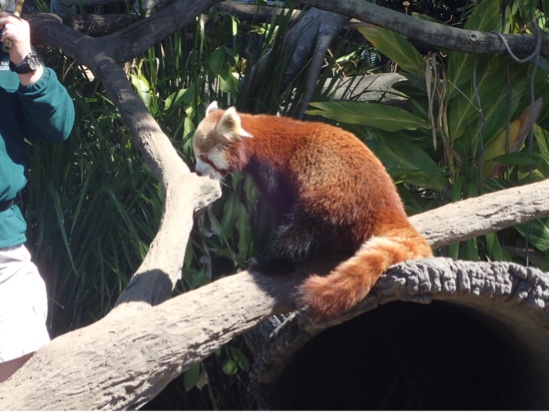
A large open kangaroo area led past a red panda to Bindi's Island, where there were hard-to-photograph lemurs.
Then we zipped back to the, ahem, Crocoseum for the midday show. This started with birds of prey and progressed to saltwater crocodiles. As our hosts explained the habits and hazards of the croc, a saltie was released into the water at their feet and lurked ominously nearby.
That was a scary creature to watch as it moved in its purposeful reptilian way. I wonder if there's a race memory stuck away at the back of our minds when it comes to these crocs, telling us to BEWARE?
In any case I shot a short video clip of the croc grabbing the meat it was offered by the handler, generously passing up him and the white bird which was hanging around suicidally nearby.
Here's the clip:
At the end of the day we took part in a special session where we met several animals up close, including a wombat, macaw, lizard, snake and koala. It made for good photos:
It was a great day out among the animals and the surrounding greenery. Australia Zoo was much bigger than I expected, and there's food available onsite, so if I returned on my own I'd make a full day of it.
In many, many ways, 2016 has been a horrendous year for the world. But you already know that. So let me change tack and talk about something positive: travel.
There's no guarantee that travel will make a narrow-minded person less narrow-minded. However, travel does give me hope.
When I travel, I learn a lot; not just about history and architecture, but about the different ways that humans have found to organise their societies. History casts a light on this in any case, but the lived experience of people in the here and now fascinates me too.
Hopefully many who travel come back with a new perspective on their own societies, and their own lives, and are the richer - and more accepting - for that. We can but hope.
Having said that, here are my personal travel highlights from the year just gone.
1. Taking the Spirit of the Outback train to Longreach, Queensland, and visiting the Qantas Founders Museum.
There's plenty do and see in Longreach and, farther out, Winton.
I was particularly interested in the Qantas Founders Museum, whose exhibits led to an interesting revelation (for me at least)...
Which is: the reason commercial air travel had such an early start in remote Queensland was because roads through the grasslands would often bog down impassably after heavy rainfalls. Aircraft allowed people to leapfrog that obstacle, and thus became instantly popular in the region, even in aviation's relatively dangerous early days.
I love the German tradition of all-nude mixed-gender bathhouses. There's something incredibly primal and freeing about them, stripping away (literally) all the pretence and titles of the outside world. They're also very relaxing.
On my last three trips to Germany I've visited a historic bathhouse at each of Cologne, Munich and Hamburg. Those visits culminated in this story for Fairfax Media. 3. Walking the alternative streets of Christiania, Denmark.
This was literally an insight into people experimenting in alternative ways to live. Christiania is a counter-culture enclave of Copenhagen, set up in the 1970s by squatters. In many ways it hasn't worked out the way they envisaged, but that itself is an interesting part of the story.
The quiet green reaches of eastern Poland are probably the last place you'd expect to find a Muslim community, but it's there. Before the 18th century Poland was the hub of a vast European state, the Polish-Lithuanian Commonwealth, whose borders stretched toward the Black Sea.
During this period, Muslims from the Commonwealth's periphery were granted land by Polish kings in Poland's east. Centuries later there's still a community worshipping at the beautiful mosques at Bohiniki and Krusziniany, a reminder of the country's past ethnic and religious diversity.
5. Sleeping over in Chernobyl, Ukraine.
My most extraordinary experience this year was a two-day tour of Chernobyl soon after the 30th anniversary of its infamous nuclear disaster.
It was the first time I'd delved deeply into the day-to-day details of the crisis, and I was overwhelmed by the bravery of those who fought the unfolding catastrophe in the crucial first few days, with many sacrificing their lives. Without their efforts, the outcome could have been vastly worse.
The monument to emergency workers you can see above stands on the outskirts of the city. I wrote about the tour for Lonely Planet here.
6. Attending Comic-Con in San Diego, USA.
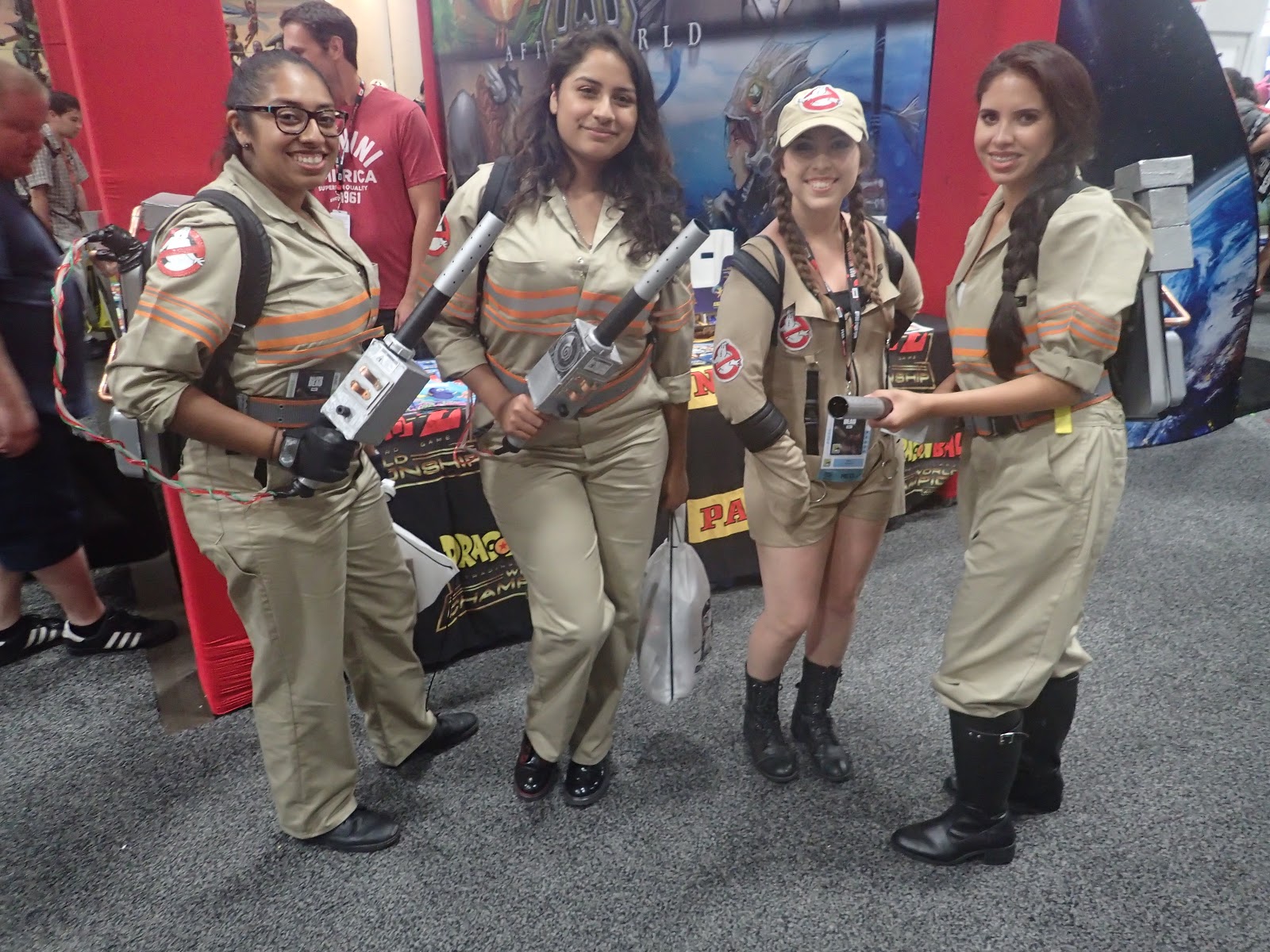
It was overwhelming, but I really enjoyed this huge pop culture event. Beyond the content of panels and workshops, the thing that really struck me was the diversity of the attendees.
There were people of every possible ethnic background dressing up as every fictional character under the sun - and dressing across gender as well. My favourite was the guy in the Wonder Woman outfit above, who became the star of my article for Fairfax Traveller.
It was inspirational to see such a diverse crowd surging around, enjoying their favourite fiction and sharing it with others. It was a great mood, and a partial antidote to the intolerance which seems to have edged back onto centre stage around the world this year. It gave me hope.
7. Dining in the Western Australian Outback via the Indian Pacific.
I caught the Indian Pacific train from Sydney to Perth in October, the first time I'd been aboard in five years. I was very impressed with the quality of the experience nowadays, especially the off-train excursions.
Simple as it was, my favourite activity was dinner on the third evening. We ate at tables set between the train and the derelict buildings of remote Rawlinna, Western Australia, as the sun set and an amazing star field emerged above. Magical.
So... how was your year in travel?
I was hosted on the trips mentioned above by the relevant tourism authorities and companies. This is my final post for 2016 (and the 450th overall on this blog!), so I'll wish you a Happy New Year now. See you in January 2017. Things can only get better... let's hope.
Over the past week I've been travelling through western Queensland, Australia, hosted by Outback Queensland and Queensland Rail Travel.
It's been a great experience, and one I'll be writing about soon for Fairfax's Traveller section. In the meantime, let me show you some memorable buildings and other structures I've seen on the way...
1. The Tree of Knowledge in Barcaldine; under its branches, the Australian Labor Party was born in the 1890s:
2. The Australian Stockman's Hall of Fame, Longreach; this light aircraft hanging from the ceiling is an impressive exhibit:
3. This tank and windmill blade at Camden Park cattle station near Longreach make a great photographic subject; there's a touch of Mad Max about them:
4. This is the retro-themed lobby of the North Gregory Hotel in Winton. Country cool:
5. This curious structure on Carisbrooke station, near Winton, was left behind by a TV crew who filmed the French version of Survivor here:
6. Finally, here's the man himself - poet Banjo Paterson. This statue of him stands on Winton's main street, with the words of his famous song Waltzing Matilda on a curved sheet of corrugated iron behind him:
For the record, the song was first performed in 1895 just across the road, at the North Gregory Hotel.

 There was an array of work on the walls, in both contemporary and traditional styles. One large portrait with a lot of black was painted by a woman who’d suffered from depression, said Shenane.

 In March 2018, I spent a few days in the remote Outback Queensland town of Normanton, awaiting the weekly run of the