Showing posts with label Jasper. Show all posts

Friday, 4 August 2017

A Day in Jasper, Canada

On this trip I was a guest of Destination Canada and Tourism Jasper.

During my recent trip to Canada I had a day free in Jasper, in the heart of the Rocky Mountains. This period was dictated by the timetables of two VIA Rail trains I was catching - The Canadian up from Vancouver, then the train northwest to Prince Rupert. So I hadn't thought much in advance about what I'd do in the town.

Turned out there were plenty of options. As Jasper is a popular holiday town in a beautiful location, there are lots of short tours and eating choices for visitors. Here's what I did with my day in the mountains.

1. Motorbike tour. In the middle of town is the base of Jasper Motorcycle Tours. It takes visitors on tours to nearby lakes and lookouts, perched on the back of, or in the sidecar of a Harley-Davidson.

There was a certain amount of theatrical dress-up involved, as the guest gets kitted out in leathers first:

img-alternative-text

Then it was off into the mountains outside town for a while, for a taste of the open road and some impressive scenery:

img-alternative-text

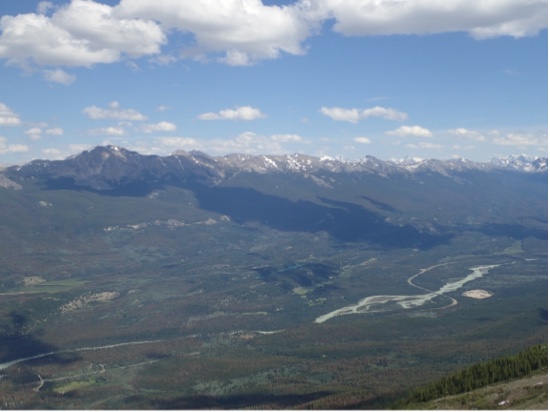
2. To the heights. After my motorcycle jaunt, I headed to the base station of the Jasper Skytram, a cable car that runs to the top of Whistlers Mountain (and whose staff seemed mostly Aussies!). From the top there are great views of the township and the surrounding mountains:

img-alternative-text

3. Dinner in the woods. To finish off the day, I had an excellent dinner in the atmospheric dining room of Tekarra Lodge, just outside town.

A set of cabins built in the 1940s, the Lodge has a certain retro charm. I was also told that its restaurant was haunted (but maybe just by the ghost of that deer on the wall...). There was certainly a Twin Peaks vibe to the decor.

img-alternative-text

I didn't meet any ghosts after dark, but the intersection of the Miette and Athabasca Rivers seemed a good place at which to finish my Jasper day. The next morning, I had a train to catch.

Friday, 28 July 2017

Train Stations of Canada's Jasper-Prince Rupert Line

On this trip I was hosted by the Canadian Tourism Commission, Destination British Columbia (HelloBC.com) and VIA Rail.

On my recent trip to Canada, I rode the railway from Jasper to Prince Rupert for the first time.

Though the route is lesser-known than that of The Canadian train which links Vancouver and Toronto, it's impressively scenic as it runs between several mountain ranges on its way to British Columbia's northern port.

I'll be writing about the journey in more depth for one of my outlets, so here I'm just going to focus on one element: the stations along the way.

We started at Jasper station around lunchtime on the first day. Being at the junction of two passenger routes, it's an impressive structure. It opened in 1926, replacing its predecessor which was lost in a fire the previous year.


Further along we paused at Dunster station, which opened in 1913. This is a "flag stop", which means trains don't stop here unless hailed by passengers.

It's a fine example of the standard station type which once existed along this line. Most have been demolished, but luckily locals bought this from the railway company and have restored it from a dilapidated state. So it stands as a great example of railway architecture from a century ago, and also fulfils a useful role as a general store.


Farther on, we stopped at McBride. This is another classic station, dating from 1919. As with Dunster station, it was adopted by locals and is now the home of the town's visitor information centre. I was able to hop out briefly to take a photo of this old CNR carriage standing nearby.


The major station on this line is at Prince George, the largest city in northern BC, where passengers spend a night before resuming the journey to Prince Rupert. No heritage building here - its relative significance means that it merits a modern concrete box:


The next day we were back on the rails, pausing briefly at the delightfully named Vanderhoof station, named after an early railway worker...


... before reaching Smithers station, opened 1918 and situated at the start of one of the most scenic stretches of the line. Babine Mountains Provincial Park is accessed from here, and the town is surrounded by four mountain ranges.


Running very late because of delays due to passing freight trains, we were able to alight for 15 minutes or so at Terrace station (while we waited for yet another freight train to go past).

An attractive timber building containing a visitor centre, this was once the family home of Terrace's founder, George Little. In 2003 it was relocated to this location and refurbished, to act as an anchor for the town's downtown heart. It was certainly the nicest station we encountered that day, especially as we had time to enter it and explore.


I'd show you the station we arrived at in Prince Rupert, which we reached over three hours late at 11.45pm, but there isn't one - instead the train drops passengers off at the BC Ferries terminal.

Near the site of the city's original station, nostalgics can visit the Kwinitsa Railway Museum. Originally a working station, it was floated down the Skeena River in 1985 to be installed here as a museum dedicated to the story of the Grand Trunk Pacific Railway. Which seems fitting, as it was that railway which gave birth to the city of Prince Rupert.


As for the original Prince Rupert station which stands nearby, it's sadly now closed and boarded up. I like to feel it'll be used again one day by passengers; if only for the reason that it's in a much more convenient central location. Here's hoping!

Wednesday, 4 September 2013

Jasper, Canada: Echoes of Edith Cavell

The more I travel, the more I stumble upon links between places scattered across the globe.

For example, in 2011 I visited Belfast, UK, to trace the origins of the SS Titanic, a year before the centenary of its sinking. A year later I was in Halifax, Canada, at the cemetery where the bodies of many of the victims of the tragedy were laid to rest.

As part of the same 2011 trip, I visited the tiny Irish village where Ned Kelly's dad stole the pigs which saw him transported to Australia as a convict. This neatly matched an earlier journey through the High Country of Victoria, Australia, writing about the newly established Ned Kelly Touring Route.

And then there was Edith Cavell.

I won't go deeply into her story here - you can find it comprehensively covered in the relevant Wikipedia entry.

In a nutshell, however, Cavell was a British nurse who stayed in place after the German occupation of Belgium in World War One. Ostensibly treating combatants on behalf of the Red Cross, she secretly assisted Allied soldiers to escape capture and leave the country.

As a result, the German authorities arrested her, tried her under military law and executed Cavell by firing squad in 1915.

This shocking act was, as you can imagine, a serious propaganda blunder on the part of the German occupiers. The execution of a nurse filled front pages everywhere, reinforcing the line the British Empire and its allies were pushing about Germans' inherent brutality.

A wave of sympathy followed, with the erection of monuments to Edith Cavell around the world.

With the passing of time and another brutal worldwide conflict having taken place between her time and ours, Cavell's story has been largely forgotten among the general public.

So I knew nothing about her when I happened across her statue in the Kings Domain gardens in my home city of Melbourne, researching items for my mobile app Melbourne Historical.

Here it is, the plinth beneath bearing her statement made the night before her death, "Patriotism is not enough, I must have no hatred or bitterness towards anyone":

As interesting as Cavell's story had been to discover, I wasn't expecting to encounter it again. But last year, visiting Norwich, UK, in the company of a Wodehouse Society tour, I happened upon this pub:

And across the street, near Norwich Cathedral, was this striking monument:

On investigation it turned out that Cavell was a daughter of Norfolk, having been born just outside Norwich in the village of Swardeston.

Finally, Cavell far from my mind, I arrived in Jasper, Canada, yesterday by train across the Rocky Mountains from Vancouver. On the drive from the railway station to our accommodation at Jasper Park Lodge, the driver pointed out a lofty peak in the distance and said "That's Edith Cavell."

You can see it below, in the centre of the picture beyond the attractive grounds of the Lodge:

Reaching an impressive 3300 metres, this snow-capped mountain was given Cavell's name in 1916.

Its earlier title, "La Montagne de la Grande Traverse" (Great Crossing Mountain), was granted by French-Canadian fur traders who used the nearby Athabasca Pass.

Renamed after the nurse whose execution shook the British Empire, Mount Edith Cavell is probably the most impressive and certainly the largest of her memorials. (At least on Earth - there's a 100km-wide Cavell Corona named after her on Venus. I suspect I'm unlikely to visit that one.)

Her story, though not so well remembered nowadays, is a tragic and fascinating one. And my unintended encounters with her memorials have reminded me how moving travel can be, when it allows you to join the dots of great historical events in person, rather than remotely via the experiences of others.

Disclosure time... On this trip I travelled courtesy of the Canadian Tourism Commission and VIA Rail.