Showing posts with label Goldfields. Show all posts

Friday, 10 March 2017

A White Night in Ballarat

Last weekend, Narrelle and I headed to Ballarat to experience its very first White Night.

I'd already written a preview of the all-night arts event for Fairfax Media's Traveller section, so I was curious to see how it would play out on the night.

White Night/Nuit Blanche has traditionally been an event staged by big cities - St Petersburg, Toronto, Paris, Melbourne - not a regional city of 100,000 people. Would it work?


It looked good from the start. When we stepped out of our Lydiard Street hotel at 10pm after a strategic nap, White Night had been underway for three hours and the city centre was packed with people.

As at White Night Melbourne, people were moving from artwork to artwork, with the largest pieces being huge illuminations mapped to Ballarat's plentiful historic facades.

In fact, the first thing we realised was that our own accommodation, Craig's Royal Hotel, was one of the buildings acting as a canvas:


There were smaller works to be discovered in the side streets running off Lydiard. One of these, Do Not Go Gentle, was a mesmerising video presentation in a vacant lot, examining ageing and the gaining of wisdom:


There were many of these interesting smaller pieces - including a mobile work, Crate Expectations, a strange object made of crates which trundled around producing curious effects and items as it occasionally popped open...


... and this, a row of "Here's Johnny!" heads smirking maniacally on screens in the window of the Regent Cinemas:


But the star attraction of White Night was undeniable the set of illuminations along Lydiard Street. It was here that White Night Ballarat had several advantages over its Melbourne equivalent.


Firstly, it was much easier to navigate Ballarat's White Night zone, which was basically two connected stretches of the city's broad goldrush-era streets, Lydiard and Sturt. It was crowded, but never did we feel that we couldn't progress.

Secondly, the relatively compact area enabled a visual unity that's impossible in Melbourne's sprawling White Night zone. One could stand at one end of Lydiard Street and see a stretch of illuminated facades along both sides, a kind of magical avatar of the daytime city:
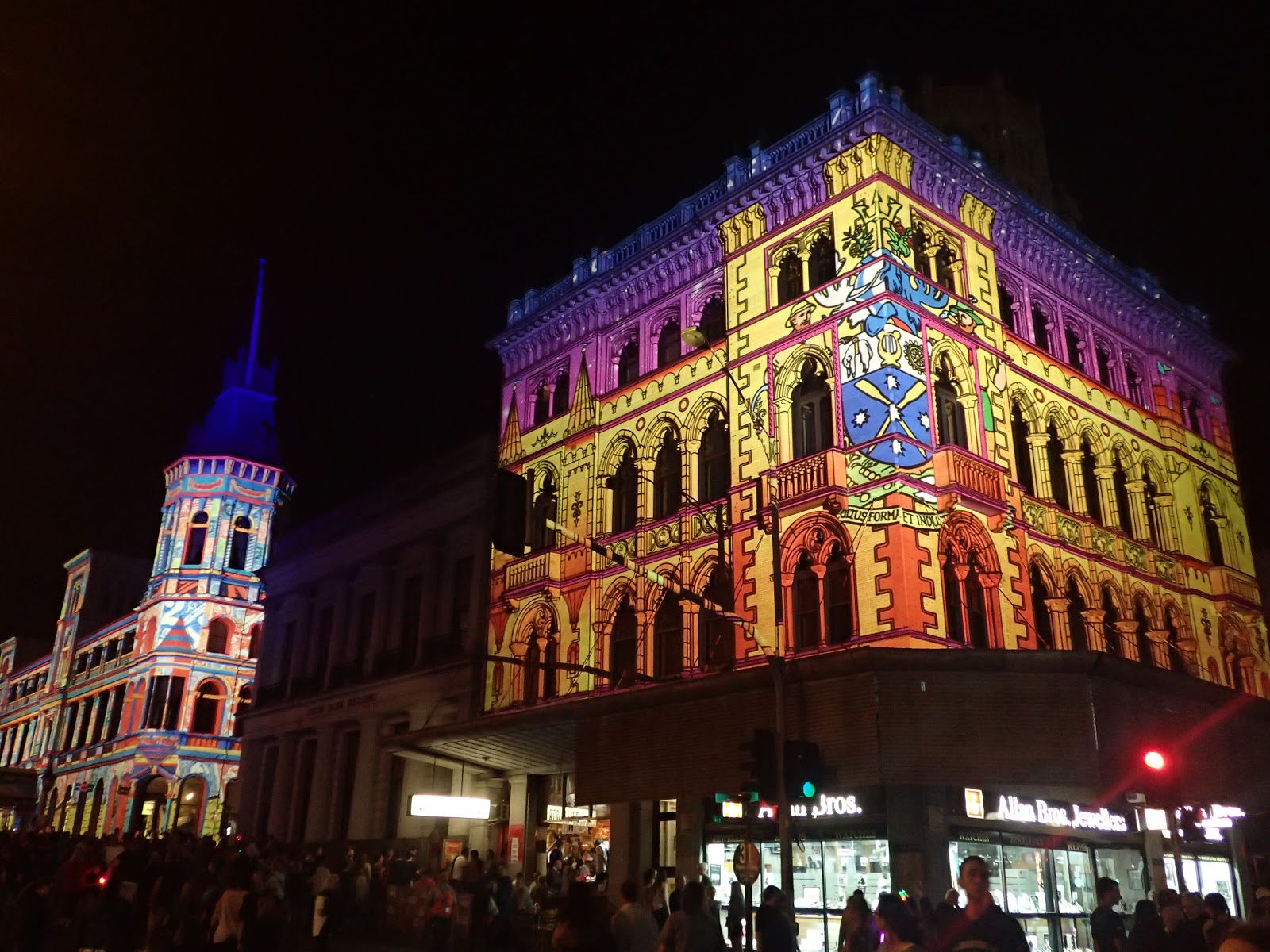


Another asset was Ballarat's tumultuous 19th century history, in which it rocketed into prominence as a rough-and-tumble gold mining community after the metal was discovered there in 1851. This lent a certain thematic unity to the illuminations, several of which drew on the city's past.

As an Australian history graduate I particularly liked this projection on the old post office building, which referred to the Eureka Stockade revolt of 1854:


On the other side of Lydiard was a work drawing on a much deeper past. More Than 1 Nation by local Aboriginal art group Pitcha Makin Fellas told the story of Australia's indigenous people, and wasn't shy about referencing the harsh realities of European settlement.

It was by far the best work of the night, an animated journey through centuries, and much admired by onlookers. It was good to see that such public art could still be frank and confronting.

Here are two clips I filmed on the night, the latter one dealing with more modern times:


The first White Night Ballarat was, to my eyes, a success both in crowd appeal and artistic merit.

The only flaw, it turned out, was the 12-hour timespan. While this made sense in Melbourne, where the huge crowds gave people good reason to enter the city in the wee small hours before dawn, in Ballarat it was easy to see everything during more reasonable hours.

As a result, when we walked back to our hotel at 3am, after drinks with friends at the buzzing Mitchell Harris wine bar, we found Lydiard Street almost deserted:


On reflection, it might have worked better to stage White Night Ballarat from, say, 7pm to 3am, rather than run all the way to the scheduled 7am.

Quiet finale aside, White Night Ballarat provided proof that successful big art events don't have to be the sole possession of big cities.

Whether there'll be a second such event in the goldfields city has yet to be decided, but I hope it happens. It was a great night out among the art, crowds, and colourful history.

Sunday, 6 May 2012

Clunes by the Book

One of the best things about living in Melbourne but not having grown up here, is that I have many undiscovered towns to visit outside the city in the state of Victoria.

One of these was Clunes, where I've spent the weekend. A small town of 1000 people north of Ballarat, it's famous for being a book town along the lines of Hay-on-Wye in Wales.

There are several bookshops operating here throughout the year, bolstered by the arrival of numerous additional booksellers for the annual Clunes Booktown Festival in May. At this event they're housed in all sorts of venues around the town, slipped into nooks and crannies within historic buildings and existing businesses.

As pleasant as the festival this weekend was, I particularly enjoyed spotting the historic relics of a town which housed 9000 inhabitants at its goldmining height in the 1880s. Here are a few highlights...

1. Outside the venue for the festival's opening dinner I spotted this sign attached to a shed. Jerilderie is a fair distance away across the border in New South Wales, so what was it doing here? Turns out it was a prop from the 2003 film Ned Kelly starring Heath Ledger, which had been partly filmed in Clunes:


2. And when you see the main street (Fraser Street) you can understand why this was the place to set a 19th century saga:


3. This is the old post office (now a bookshop). It's implausibly grand for a town of 1000 people, but at its gold rush height Clunes demanded nothing less than two storeys:


4. Surpassing it in grandeur is the former Town Hall:


5. On the topic of old-fashioned and possibly obsolete relics, I spotted this distinctive marker at the festival, used to indicate the location of temporary bookstalls. It's made mostly of outdated encyclopedias bolted together into a column. Sacrilege or the best use for them - what do you think?


6. Here's the accommodation we stayed in first, Keebles Country Guest House, which opened in 1863 as the Telegraph Hotel. It's quite plush now, but we were told the place had been everything from a bus station to a brothel in its time:


7. And finally, we hauled up the hill west of the shopping strip to check out the Clunes Bottle Museum inside an old school. Here's the attractive historic building:


8. And here's one of the most interesting exhibits in the museum. It's an unopened 1850s bottle of root beer which we were told has largely turned to sulphur dioxide over the years, due to the presence of SO2 in the original aerated drink. Not nice to sip - but a beautifully formed piece of history:


Disclosure time... On this trip I travelled courtesy of V/Line (as passenger rail services have just returned to Clunes, hooray!) and Tourism Victoria.

Tuesday, 10 April 2012

Geelong to Ballarat: All Aboard!

It's exactly 150 years today since the railway reached the Victorian gold mining town of Ballarat, on 10 April 1862.

Those were heady days for Ballarat: only 11 years since gold was discovered, creating a bustling settlement from nothing; and only eight years since the Eureka Stockade armed rebellion against the colonial authorities.

Nowadays there's a line directly linking Ballarat to Melbourne, but in 1862 the Ballarat route ran through Geelong, itself a busy port made busier by the gold rush.

It's many years since passenger services ran along the Geelong-Ballarat line, which still carries freight. But today, to mark the historic occasion, a special heritage train carried assorted local dignitaries, toffs and bigwigs (along with your humble correspondent) between the two regional cities to mark the occasion.

Here's a glimpse of what I saw on the way:

1. Here's our special train waiting at Geelong station, diesel-hauled but with early 20th century carriages:


2. Here's the interior of one of the second-class compartments. As attractive as it is, it struck me that there must have been a hell of a lot of maintenance required in those days for all the timber, both inside and outside the carriages:


3. There were a number of stations along the line in its passenger days, all solid constructions made of bluestone. Here's a glimpse of the station at Bannockburn, which I caught as the train sped past:


4. At a couple of stations along the way, the local government dignitaries disembarked in order to cut a ceremonial ribbon. Here they are using the Good Scissors at Lethbridge Station:


5. At our next stop, Lal Lal Station, I spotted this gent trying to influence the 19th century planning process. The inhabitants of Buninyong agitated for a station on the line, but to no avail:


6. Also at Lal Lal was this rather convincing 19th century couple. Station ghosts, perhaps?


7. Finally, about two hours after our departure from Geelong, we pulled into the impressive Ballarat Station. The grand tower dates from 1891:


8. Alighting, we were greeted by much pomp and ceremony, including catering, speeches, the unveiling of a commemorative plaque and the repertoire of this brass band. I caught a spot of Rule Britannia in there at one point...


If you're interested in taking this journey yourself, the Australian Railway Historical Society is operating a similar train from Melbourne via Geelong to Ballarat on Saturday 14 April 2012. More information is available at this link.

Disclosure time... On this trip I travelled courtesy of V/Line.

Friday, 18 February 2011

Pieces of Daylesford

Since the 19th century, the twin towns of Daylesford and Hepburn Springs, about 90km northwest of Melbourne, have attracted visitors wanting a brief escape from urban life.

The big drawcard, then and now, were the spa waters associated with the famous bathhouse in Hepburn Springs. The towns are also popular for their upmarket accommodation and dining.

For some reason, I hadn't been to Daylesford for six years before I dropped in last month for a few nights' stay. Partly I was there to write food and accommodation reviews for some of my regular outlets; and I was also fitting the last few pieces into my new iPhone/iPad app, Melbourne Getaways.

This travel guide for the smartphone lists over 200 sleeping, dining, shopping and sightseeing attractions outside Melbourne, and I had to include Daylesford's best places in the mix.

What did I find in Daylesford after such a long absence? Here's a small random sample...

1. The lemon verbena crème brûlée at the restaurant I reviewed for The Age, Perfect Drop. Just sensational.


2. This pig was decorating the pavement outside a garden nursery named Secret Garden.


3. Some of the handmade chocolates on sale at Chocorex, a new shopping centre inside the shell of the former Rex cinema.


4. I like a touch of communist retro design, but I didn't expect to find it in well-heeled Hepburn Springs. This is the exterior of the Red Star cafe.


5. Fancy spa! Set into a higher section of the split-level interior of my flash accommodation, Elira. The base is even ridged specifically so you can sit back comfortably and watch the TV in the next room.


6. Sometimes it's worth looking up. Here's the ornate ceiling of the Gourmet Larder cafe.


7. Finally, here's a close-up on the Alice in Wonderland chess pieces in my final accommodation, the fancy cottage called Hudson on Wombat.


(For more details of these and other Daylesford drawcards, download my Melbourne Getaways app)

Disclosure time... on this trip I was hosted by Tourism Victoria.

Sunday, 8 November 2009

Sovereign Hill: New Gold Mountain Remixed

Lola Montez and I have a history. In 1855 she scandalised Victoria’s polite society by performing her saucy spider dance across the colony.

Then in 2005, I wrote an article for The Age (which was dismissive of Montez the first time round) to commemorate the 150th anniversary of her all-conquering tour.

And finally, we met in passing today on the streets of Sovereign Hill, though the former mistress of the King of Bavaria was more concerned with trading blows with newspaper editor Henry Seekamp, who’d dared to imply that the dancer possessed uncertain morals.

It was, of course, a historical reenactment with a slight edit - Montez and Seekamp did test out horsewhips on each other in real life, but in the confines of the United States Hotel. I, coincidentally, am writing this at the long timber bar of the rebuilt United States Hotel, on the main street of this replica town, which recreates the lively and chaotic gold rush era of 1850s Ballarat.

Gold rush town

Got all that? Good. So while the folk band in the corner strikes up another tune and the barmaid pours another ale, let me give you my thoughts on the place.

The first time I came here, I’d expected a cheesy antipodean Disneyland, a kind of “Gold Rush World” complete with corporate branding and actors dressed in giant fibreglass heads resembling those of bearded, gap-toothed Victorian-era gold miners.

The reality was, to my surprise, quite different. There’s something about Sovereign Hill that’s both charming and very relaxing. It’s partly because it really does resemble a small country town - the inhabitants may be in fancy dress, but there are enough streets lined with dusty timber buildings and ragged miners’ tents that it has the right “feel”.

On top of that, it’s full of businesses selling items typical of the era - clothing, toiletries, candles, sweets - many of which are made here. As you wander away from the busy main street, there are more items of interest scattered through the side streets - market gardens, animals, a wheelwright’s factory - which you can often wander through on your lonesome.

Panning for gold


There are also activities to undertake, such as panning for gold at the diggings area below the main street. Here, crouching visitors agitate wide metal pans vigorously in the hope of retrieving a few flecks of gold. There is certainly gold present, by the way, as the management has thoughtfully salted the stream with a modest amount beforehand.

Watching the gold panners is theatre in itself; I sat and observed a tour group from China getting down and dirty at the stream, having a thoroughly good time sloshing the pans in the hope of scoring a speck of the fabled metal.

There were several Chinese tour groups here today, living proof of the reported big increase in Chinese arrivals at Melbourne Airport. And I noticed something I’d never seen before at Sovereign Hill - their Mandarin-speaking guides were themselves dressed in Chinese garb of the 19th century, featuring silk shirts and broad straw hats.

Chinese connection

And then the penny dropped - Sovereign Hill isn’t just another Australian peculiarity on the itineraries of Chinese tourists, like kangaroos and penguin watching. There’s a strong Chinese story here on the goldfields, via the thousands of Chinese miners who came to “New Gold Mountain”, as they named the Victorian goldfields, to try their luck on the diggings.

With that in mind, I had a look through Sovereign Hill's Chinese Camp, a recreation of the Chinese miners’ homes and lives in 1850s Victoria. To my surprise, the small temple contains an impressive audiovisual presentation, via suspended widescreen TVs placed strategically within (haven’t flatscreen TVs been a godsend to museum curators everywhere?).

The story of the Chinese miners is an intriguing element of the multi-ethnic Victoria of those days. It’s not a story, frankly, that reflects well on the European population, who did much to make the Chinese feel unwelcome; but seeing the crowds of newly prosperous Chinese tourists now visiting Sovereign Hill and panning for gold, there’s a sense that amends have been made.

Disclosure time... on this trip I travelled courtesy of V/Line's daily Goldrush Special train and Sovereign Hill. But I paid for all the sippin’ whisky myself (and soon hope to have my sight back). For accommodation, see my 2007 review of Sovereign Hill Lodge.

Also check out the Sovereign Hill post and Eureka Centre post of my friend and blogger Walter Lim, who accompanied us on this trip.

Monday, 2 November 2009

Barbecue at Hanging Rock

Partaking in a barbecue at Hanging Rock, was I in any danger of vanishing into the ether like those poor schoolgirls in Peter Weir's classic film? Or would I be safe as long as I avoided pan pipe music, and didn't wear Victorian petticoats?

With all the exotic overseas travel I do, it's easy to overlook the attractions of domestic travel.

Even easier, perhaps, to overlook what I think of as ultra-domestic travel, ie a short trip only an hour or two away from one's home. The weekend break in a cottage somewhere near wineries is glamorous enough, but in a low-key, relaxed sort of way.

Narrelle and I have needed a holiday for a while - she's been flitting between contract jobs that don't allow for leave days, and I've been busy taking notes, photos and interviews while on the road.

The answer last weekend was to rent a place called Bella Loft in Woodend, an hour or so's train ride northwest of Melbourne. Comfortably lodged in this lace-free, non-cottagey apartment just behind the High Street shops, we set about the weekend.

Did I explore magnificent art galleries, pore over museum collections, wield exotic languages or hike to mountaintops? No. But here's what I modestly achieved:

Read a book. Though not all of it (yet). I've just switched to an iPhone but there's an e-book I paid for on the old Palm which can't be switched to the new device. So I slaved away dutifully on Revelation Space by British science fiction author Alastair Reynolds, and found it was rather good. Hard to describe; absorbing to read.

Read some comic books. The monthly DC title Justice Society of America, about a team which comprises both the surviving 1940s superheroes and present-day heroes inspired by their legends, is the one I always read first after collecting a pile of comics from Minotaur in Melbourne. Devoured issues 29-31 in which Obsidian is transformed, Mr Terrific is stabbed, and we're introduced to a new Doctor Fate. All good stuff.

Ate a sticky date pudding. I had thought this dessert to be lost back in the 1990s, but here it was on the menu of Zarby's, where we had dinner on Saturday night. Narrelle had a crème brûlée, another retro touch. Both were excellent. Zarby's had that distinctive vibe of country restaurants in popular treechange commuter towns - a broad enough menu for family groups and locals, and classy decor and high-end choices for foodie city types. Oh, and early arrivals and departures: the place was near-full when we arrived at 7.30pm, and almost empty by 9pm.

Drank a boutique beer. Specifically The Hopinator, a product of the Holgate Brewhouse in the old Keatings Hotel in the middle of town. As the name suggests, it's insanely full of hops and very bitter - I suggested Narrelle take a sip just so I could see the look on her face (she's not a "bitter" sort of person). She had a Temptress, a porter beer brewed with a dash of cocoa.

Saw a kangaroo. We were sitting at a barbecue table beneath Hanging Rock, sampling various meat products we'd just charred, when I looked up to see a kangaroo casually hopping past toward the lawn below the cafe. I suspect it's a tame roo that hangs around cadging scraps from visitors, but it seemed a positive omen - there would be no malign mystic powers wreaking havoc here today (though admittedly I couldn't get any reception on my mobile phone).

Drank bubbly. On a hilltop just south of Woodend, along a gravel road on the slopes of Mount Macedon, is the the Mt Macedon Winery. The cellar door's verandah is a very ambient place to sit on a warm Sunday afternoon, looking out over the spreading view of the Black Forest below, and sipping a little of the winery's Brut Cuvée. And so we did.

I can't say our achievements over the weekend set new benchmarks for daredevil travellers everywhere; but it was just the break we needed. Sometimes there's no place like somewhere other than home.

Disclosure time... on this trip I received complimentary accommodation at Bella Loft, Woodend.

Sunday, 26 April 2009

Castlemaine by Pod

The problem with imagining the gold rush era in regional Victoria is one of the imagination: how do you revive the exciting chaos of those days within the peaceful, settled scenery of today?

It's also a challenge for those aiming to popularise history. Static displays of old household objects or photographs just don't cut it anymore (if they ever did). There's nothing more exciting than feeling a real emotional connection to days past, a visceral understanding of what it was like to be there, then. And this is, apparently, where 21st century technology steps in.

I'm in Castlemaine, in central Victoria, Australia, researching a mini guide for The Age. The town was founded in 1851 as a direct result of the gold boom. The gold eventually ran out but it left the place with a fine collection of Victorian-era buildings which mysteriously survived the godawful architectural trends of the post-WWII era.

But what of its evocative rough-and-tumble early history? That's where the tech comes in. The local tourism authorities have commissioned a series of podcast audio tours of the town and its surrounds, which can be downloaded from the Web or listened to via an MP3 player borrowed from the visitor information centre.

On Thursday I was driven to three of the sites on the Gold Rush to Mount Alexander tour. This is what I experienced:
  • Pennyweight Flat Cemetery: Not far out of town, this small fenced-off area feels rather forlorn, surrounded by dry grass and dotted with gum trees. Throughout the cemetery in a seemingly random pattern are tiny circles of stones with faded headstones. They're small because this was a children's cemetery that was only in use for a few years at the height of the rush. Interestingly, there are Chinese markings on some of the headstones, a contradiction of the usually strict racial separation of those days. The commentary, by local resident Jan Wositzky, leads to a folk song commissioned especially for the tour. It's wistful, emotional, and beautifully pitched to summon an impression of the sorrow of those who lost a child here. (Listen to the pod tour segment)
  • Garfield Water Wheel: Further out from town, up a hill in the middle of native bushland, is a bizarre remnant of the gold rush years. It's a pair of towering brick walls in a trapezoid shape, looking like some strange ruin of the Roman Empire. What's even more surprising is to discover they once supported a gigantic wooden wheel more than twice their height, bearing hundreds of buckets that scooped water from the trench below. The pod tour, after explaining the wheel's role in the gold mining process, gives way to an old woman telling a true story of a young girl who once had her head caught in the wheel and survived, but was marked for life. It's an intriguing story, all the more powerful for being heard on the spot, the listener peering up at the stone walls and trying to imagine the scene. (Listen to the pod tour segment)
  • Monster Meeting: I've always liked the term the Eureka Stockade era protesters had for their mass demonstrations against the iniquitous mining licences of the 1850s. 'Monster meeting' summons up images of thousands of humans forming a single angry organism ready to devour the corrupt state. It turns out these meetings weren't confined to Ballarat - the monster meeting held on a slope above a creek outside Castlemaine attracted some 15,000 people, and is apparently still the largest gathering ever held here. The pod tour really gets into its stride here, with a stirring hell-raising speech against the government, complete with shouts from an angry crowd. Then the podcast takes the liberty of bringing Governor La Trobe, who it admits was never there, into the rally to fruitlessly address the miners. Without this fantastically effective element of the audio tour, I'd merely be looking at a dry, bare hillside with a monument. (Listen to the pod tour segment)
All history is, of course, composed of stories about people; it's tours like this which help you reach them through the barrier of time.

Tim Richards travelled courtesy of Tourism Victoria.